Showing posts with label poor due diligence. Show all posts

Tuesday, June 3, 2008

Environmentalist Ideology Behind Congressional Climate Change Chicanery


To solve the oil crisis, we need to use resources, not gimmicks


By Kathryn Lopez (National Review Online)


Austin-American Statesman


June 1, 2008


COMMENTARY


The temperature's getting hot, and so is the energy-policy debate. Gas prices are reaching new heights as anyone with a car knows. What are we going to do about it? Apparently, nothing serious.


Republican presidential candidate John McCain has taken out ads pushing his silly gas-tax holiday. A gas-tax holiday may be a fun, cheap marketing gimmick, but it's not a solution. In fact, McCain, like the Democrat he will run against, opposes a real solution: Drilling here. Drilling alone won't do it, but it's a practical start.


Thus far, the debate about accessing those resources closest to home has focused on Alaska's Arctic National Wildlife Reserve (ANWR). Congress ridiculously refuses to green-light the project. I say "ridiculous" because concerns about preserving the vast swaths of nature and the caribou there are not serious: Congress would be giving a go-ahead to oil exploration on 2,000 — or 0.01 percent — of ANWR's 19 million acres, which can supply 5 percent of America's oil per year for 12 years, according to the U.S. Energy Department.

"Drill here" is a mantra on conservative talk radio. As former House Speaker Newt Gingrich puts it: "Drill Here. Drill Now. Pay Less." He is collecting signatures on a petition that reads, "We, therefore, the undersigned citizens of the United States, petition the U.S. Congress to act immediately to lower gasoline prices by authorizing the exploration of proven energy reserves to reduce our dependence on foreign energy sources from unstable countries."

Meanwhile, we keep hearing sad high-gas-price stories such as that of Nevada's Clark County School District: With a 62 percent budget expenditure increase due largely to the price of gas, the district has cut its bus route and stops to reduce costs. According to the Department of Transportation, Americans are (predictably) driving less.

It's no wonder that Gallup reports that a majority of Americans support "drilling in U.S. coastal and wilderness areas now off limits." Unlike Congress, Americans don't blame oil companies for the high prices. According to Gallup, "The number of Americans who blame oil companies for the high price of gasoline has decreased from 34 percent to 20 percent."


But don't expect Congress to pull out its power tools any time soon. Right now, the momentum is with America's Climate Security Act of 2007, a bill sponsored by Sens. Joe Lieberman, I-Conn., and John Warner, R-Va. According to the Heritage Foundation, the bill "would likely be — by far — the most expensive environmental undertaking in history." As Heritage describes it, the Warner-Lieberman Bill "extracts trillions of dollars from the millions of American energy consumers and delivers this wealth to permanently identified classes of recipients, such as tribal groups and preferred technology sectors, while largely circumventing the normal congressional appropriations process."
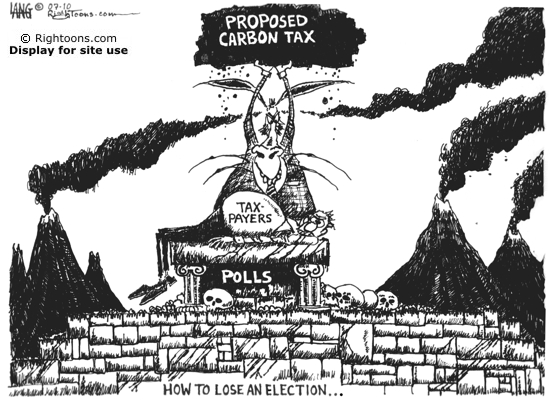
The legislation is a perilous road with high costs — costs Americans tell pollsters they don't want to pay. But Congress is poised to go its own way, skipping over simpler, more promising steps that cost less, such as unleashing America's reserves.


Instead, we go on with the absurd scene of the president of the United States going to Saudi Arabia with his hands out. America is an entrepreneurial nation with resources. We should not be acting like helpless victims. We should not be punishing energy users and embracing regulation over ingenuity and incentives.


Everyone should take a deep breath and listen to Bjorn Lomborg, author of "Cool It: The Skeptical Environmentalist's Guide to Global Warming," who says the legislation before Congress "looks set to be a massive subsidy-fest that would achieve very little for the environment, at great cost." He warns: "Wishful thinking is not sound public policy."


Lomborg says that instead of frenzied regulations and expenditures, "We need the technological solutions that will allow our societies to transition cost-effectively to low-carbon energy by mid-century. McCain could recognize that this is a century-long problem which needs century-long, smart solutions."


In other words — cool it. Drop the gimmicks. Stop getting freaked out by Al Gore. Let's be smart and think creatively rather than as a conventional pack of frenzied followers.

klopez@nationalreview.com

Tuesday, May 6, 2008

US & EU Ethanol Ecstasy Accentuates Weaknesses in Food & Energy Policy Planning

http://ap.google.com/article/ALeqM5g5BBXipUNID1wgmdeVD7nyK5AKYQD90FJVOO0


US, EU asked to reconsider biofuel goals as food prices rise


By AOIFE WHITE – 19 hours ago


BRUSSELS, Belgium (AP) — The U.S. and European Union should reconsider a shift to biofuels that has helped increase food prices worldwide by turning agricultural land over to energy crops, American economist Jeffrey Sachs said Monday.


Targets to produce more fuels that release less carbon dioxide when burned "do not make sense now in a global food scarcity condition," Sachs, a special adviser to the United Nations, told reporters before he spoke to EU lawmakers at the European Parliament.


[POLICYMAKERS SHOULD HAVE SEEN THIS EVENTUALITY BEFORE AGREEING TO PROMOTE 'BIO'-ETHANOL IN A 'VACUUM'. GOVERNMENTS ARE INCAPABLE OF 'PICKING WINNERS' IN 'HORSE RACES' SUCH AS THESE. THE MOST PRUDENT OPTION WOULD HAVE BEEN, AND CONTINUES TO BE: PROMOTE, THROUGH INCENTIVES, THE RESEARCH, DEVELOPMENT & COMMERCIALIZATION OF VARIOUS ENERGY RESOURCES UNTIL A 'COMPLETE ENERGY SHIFT' CAN BE ACCOMPLISHED. THIS MEANS, ALL ENERGY SOURCES REMAIN ON THE TABLE, INCLUDING OIL & CLEAN COAL, UNTIL CLEANER, ALTERNATIVE RENEWABLE ENERGY SOURCES ARE 'READY TO ROLL'.]


"In the United States, as much as one-third of the maize crop this year will go to the gas tank and this is a huge blow to the world food supply, so these programs should be cut back significantly," he said.


Top international food scientists recommended last month that the use of food-based biofuels, such as ethanol, be halted, saying that would cut corn prices by 20 percent during a world food crisis.


So far, the U.S. biofuel program has had more impact on food shortages, but Europe's plans to rapidly boost biofuel output in coming years would also start to bite, Sachs said.


"Neither of them makes much sense actually in terms of the environmental effect, the energy balance, or the food impact, so I would advocate a reconsideration of both under the new market conditions," he said.


European Commission spokesman Michael Mann insisted that biofuels were not a significant factor in pushing up food prices. More important are recent poor global harvests, growing food demand in Asia and export restrictions in Ukraine and Russia, he said.


[IN OTHER WORDS, THERE ARE UNCONTROLLABLE /VARIABLE EXTERNAL, BUT PREDICTABLE FACTORS THAT, WHEN ADDED TO READILY KNOWN FACTORS, CREATED THE PRESENT DYNAMIC OF FOOD SHORTAGES (DECREASED SUPPLY) AMID INCREASING DEMAND, THUS SPARKING HIGHER FOOD PRICES.]


"In Europe, we use less than 2 percent of our cereals production for biofuels, so their contribution to higher food prices is marginal, if not nonexistent," Mann said.


to affMann said the EU did not expect replacing 10 percent of all transport fuel with biofuels by 2010 ect future food prices because Europe planned to increase the amount of land under cultivation and use crop waste, such as straw, to make some biofuel to meet the target.


But Sachs insisted that biofuels in Europe were hitting the food supply to a "modest extent" because some wheat is turned into ethanol and "land is diverted from grains to rapeseed and other inputs for biodiesel."


The U.S. ethanol industry also rejects claims that biofuels are responsible for food price increases, saying ethanol — made from wheat and sugar cane — and other biofuels account for just 4 percent of the price surge.


The U.S. Department of Agriculture puts the figure closer to 20 percent.


Sachs, the director of the Earth Institute at Columbia University, said it was unfair to blame financial speculators for soaring prices for basic foods such as wheat and rice.


[PROFESSOR SACHS IS OFF-BASED HERE. BIO-CRAZY VENTURE CAPITALISTS HAVE BEEN PARTIALLY RESPONSIBLE FOR PUSHING NEW LAWS IN THE U.S. CONGRESS TO PROMOTE BIO-ETHANOL RESEARCH, DEVELOPMENT & PRODUCTION. AND, FINANCIAL SPECULATORS IN CHICAGO, NEW YORK, LONDON, ETC. HAVE CERTAINLY BEEN PARTIALLY RESPONSIBLE FOR BIDDING THE PRICE OF FOODSTUFFS UP INTO THE STRATOSPHERE.]


"The fact inventories are very low, that food supply is more stagnant compared to food demand, gives a reason for speculators to try and buy and hold grains," he said.


Underlying problems — "a tight food supply and vulnerability to climate shocks" — need long-term solutions such as boosting aid to poorer nations to help them increase food production, he said.

Sunday, March 2, 2008

Mindless Green UK Mandates Make Migraines A Medical Concern

Energy-Saving Light Bulbs Blamed for Migraines


http://www.telegraph.co.uk/earth/main.jhtml?xml=/earth/2008/01/03/eabulb103.xml


Telegraph.co.uk


By Laura Clout


Last Updated: 12:01am GMT 03/01/2008


The energy-saving light bulbs that will be made compulsory in homes in a few years can trigger migraines, campaigners have claimed. The Migraine Action Association (MAA) said some of its members alleged the fluorescent bulbs had led to attacks of the powerful headaches. Some energy-saving bulbs may trigger headaches.


By 2011, Britain will be the first European country to phase out traditional bulbs as part of a strategy to reduce carbon dioxide emissions. The MAA is calling on the Government to avoid a complete ban on old-style bulbs, by providing an opt-out for people with health problems. Last year it was claimed that the "green" bulbs can cause people with epilepsy to experience symptoms similar to the early stages of a fit.


There have also been complaints from people with lupus, a chronic immune disease that causes pain and extreme tiredness. Low energy light bulbs use only a quarter of the energy consumed by traditional versions and are estimated to save 2,000 times their weight in greenhouse gases. They are often five times more expensive but the greater efficiency means they can pay for themselves within months. Several versions use a technology similar to fluorescent strip lights and some migraine sufferers say they produce a flickering effect that triggers their condition.


Karen Manning, from the MAA, said: "When the Government announced that traditional light bulbs would be phased out, we were inundated with over 200 calls and emails from members who said the flickering had caused migraines."This is a debilitating condition which can often leave people bed-ridden for days."The bulbs do not necessarily affect every sufferer, but we are talking about up to six million people in the UK who suffer migraines - so this is a serious concern.


"We would ask the Government to avoid banning them completely and leave some opportunity for conventional bulbs to be purchased."The Lighting Association, which represents manufacturers, denied that modern designs produced a flicker.A spokesman said: "A small number of cases have been reported by people who suffer from reactions to certain types of linear fluorescent lamps. These were almost certainly triggered by old technology."