http://onenewsnow.com/Politics/Default.aspx?id=165930
Domestic drilling split along party lines
By Jim Brown
OneNewsNow
7/8/2008
A veteran U.S. senator from Iowa laments that members of Congress beholden to the environmentalist lobby are still blocking domestic oil drilling opportunities as gas prices continue to skyrocket.
Last week in response to a question regarding soaring oil prices, President Bush called on American consumers to write their members of Congress and urge them to open up the Arctic National Wildlife Refuge (ANWR) and the Outer Continental Shelf for oil drilling and to increase oil shale exploration.
Senator Chuck Grassley (R-Iowa) says there is not much division among the two parties on the need for more renewable energy sources and conservation -- but the Senate, he says, is deadlocked on oil drilling.
"I'd say 45 out of 49 [Republicans] want to drill almost every place where you can drill in the United States; and Democrats, except for one or two, are taking the view that we should not be drilling," says Grassley.
"That's the environmentalist point of view, and they respond to that environmentalist point of view to a great extent." [THIS SOUNDS EXACTLY LIKE WHAT THE EUROPEAN COMMISSION & EU PARLIAMENT DO - EMBRACE THE ENVIRONMENTALIST POSITION, NO MATTER THE COST TO CONSUMERS].
The Iowa Republican says he is constantly being asked why Congress will not approve oil drilling in the ANWR to combat record high fuel prices.
Two months ago, he says, constituents were not asking him that question. "Boy, I'm telling you, it's coming up at my town meetings in the last month. It's coming up in polls," he remarks. "And we're hoping that there's going to be a shift of opinion among Democrats to support more drilling.
But right now it's deadlocked with the end result that some people are willing to import more oil and send $140 [per barrel] overseas instead of keeping it in the United States."
Grassley says drilling in Alaska will yield 13 billion barrels of oil, but there is even more than that in the Gulf of Mexico Outer Continental Shelf.
------------------------------------------------------------------------------------------------
http://thehill.com/leading-the-news/energy-bill-out-of-gas-2008-07-07.html
Energy bill out of gas
By Jared Allen and Mike Soraghan
07/07/08
House Democrats are in a bind on the focal point of their energy plan.
Worried that a floor vote on any energy-related measure would trigger a Republican-forced vote on domestic drilling, the leadership has scrubbed the floor schedule of the energy legislation that it vowed to tackle after the Fourth of July recess.
Just before leaving for their districts, a number of House Democrats called a press conference to declare victory on a number of energy bills — including overwhelming passage of a bill to rein in excessive oil market speculation.
Democrats declared victory on a bill they failed to pass on the suspension calendar — their “use it or lose it bill” to force energy companies to either start drilling on their federally leased land or give it back — saying they had put 176 Republicans on record as siding with the oil companies over consumers.
And they vowed that the bill, the centerpiece of their energy message, would be back.
“We’ve taken some bold steps this week, and we’re going to build on that [after recess] with the bills we take up,” Democratic Caucus Vice Chairman John Larson (Conn.) said at the press conference.
But, as of Monday afternoon, neither “use it or lose it” nor any other energy measure had been scheduled for floor action this week.
Democrats said they were simply taking a different approach to passing their top energy-related priorities.
Nadeam Elshami, spokesman for House Speaker Nancy Pelosi (D-Calif.), said energy activity this week is taking place at the committee level, noting that there are four hearings planned on the issue of speculation in oil trading.
“Different members have different ideas,” Elshami said. “We’ll bring forward the best piece of legislation based on the recommendations and hearings we are having this week.”
Republicans pounced, saying Democrats were backtracking after realizing they would be unable to defeat a Republican vote on increased domestic oil drilling in new areas.
“It’s panic time for Democrats,” said a senior Republican aide. “They are on the wrong side of three-quarters of the American people who support increased production of American-made energy.”
While Democrats were in their districts advocating their plans to end gas price-gouging, rein in speculation, pass “use it or lose it” and even call for President Bush to release millions of barrels of crude oil from the Strategic Petroleum Reserve (SPR), Republicans were touting polls showing that a healthy majority of Americans now support increased domestic energy production.
That is proving to be a particular concern for Democrats in that any non-suspension-calendar energy vote would be subject to a Republican alternative, almost certainly calling for offshore and Arctic drilling, that would very likely pass.
“If we could send deepwater drilling over, it would pass the Senate,” said a Republican leadership aide, highlighting just how much an energy vote could backfire on Democrats.
A senior Democratic leadership aide acknowledged this week that there are plenty of members of the majority caucus “who want to drill and want to drill where Republicans want to drill.”
Even if Democratic leaders could beat back a GOP motion on drilling, the vote could be used as political ammunition against their vulnerable members this fall.
The Democratic setbacks come after they scored a political victory this spring when they overwhelmingly passed an SPR bill over initial White House objections. But Republicans now claim they have the upper hand, noting that Sen. John McCain (R-Ariz.) is citing drilling repeatedly on the campaign trail.
Further complicating matters for Democrats is the growing number of pro-drilling Democrats who are becoming increasingly worried that voters might throw them in with their anti-drilling leadership.
One pro-drilling Democrat predicted that the backlash against Congress for gas prices could rival the outrage voters felt about the Jack Abramoff lobbying scandal.
Another, Rep. Charlie Melancon (D-La.), is frustrated at not being listened to.
“My concern with my leadership is that they’re not letting all the people in the room to present the facts,” said Melancon, a proponent of more offshore drilling. “Where are all the pro-oil legislators? I’m not in the room. I don’t know who is. My feeling is we are not being all-inclusive to pass legislation that can get through the Senate and avoid a veto.”
For now, though, there will be no legislation to pass, as the only energy-related action this week will occur at the committee level.
Republicans may try to continue a strategy they demonstrated before recess by forcing drilling votes as energy amendments to bills being considered at the committee level, including appropriations bills.
And Republicans may go one step further by trying to get amendments added to the energy and water appropriations bill, a likely contender to see the floor this week.
“We’re going to demand a pro-production energy vote before Congress goes home for the month of August,” said House Republican Conference Chairman Adam Putnam (Fla.). “We’ve tried to highlight efforts to solve America’s energy problem a thousand ways to Sunday, and [Democrats] keep pulling them from committee, pulling them from the floor and kicking the can down the road.”
Exactly when Democrats will change their present course and bring an energy bill to the floor remains uncertain.
“Right now, our strategy on gas prices is ‘Drive small cars and wait for the wind,’ ” said a Democratic aide.
Showing posts with label flawed US and EU energy policy. Show all posts
Showing posts with label flawed US and EU energy policy. Show all posts
Tuesday, July 8, 2008


Tuesday, July 1, 2008
The US Congress Should Learn from Brussels' Biofuels Bumbling
http://www.reuters.com/article/environmentNews/idUSL3027453120080630?sp=true
France says EU may need to reconsider biofuel goal
Mon Jun 30, 2008
Reporting by Paul Taylor, writing by Pete Harrison
PARIS (Reuters) - The European Union may have to reconsider its target of getting 10 percent of transport fuel from renewable sources such as biofuels by 2020, or extend the deadline, incoming EU president France said on Monday.
Biofuel use is soaring as developed countries try to curb dependence on imported oil and cut emissions of carbon dioxide, but critics say the industry has encouraged deforestation and pushed up food prices by competing for grain.
The EU's target, which is intended to spur investment, has been a particular focus of criticism.
"On biofuels, we do not rule out in the long-run reconsidering the target, but that's not the issue now," French secretary of state for ecology Nathalie Kosciusko-Morizet told visiting EU reporters.
She said the EU approach of setting a quota target was "probably a mistake", and it would be better to set strict environmental and social criteria for biofuels and then see what level of use was viable.
Those criteria would have to include measures to ensure biofuels do not displace food-producing crops, she said.
"Probably we will be obliged to call into question or postpone the 10 percent objective," said Kosciusko-Morizet.
Earlier this month, Italy became the first EU member to publicly call for a review of the target.
Britain has also raised concerns, and this week its government will receive a long-awaited report on the impact of its targets for biofuels.
Environment Commissioner Stavros Dimas has said the EU target must be conditional on rigorously applied sustainability criteria.
[THE EU SHOULD BE FOCUSING ON ECONOMIC COST-BENEFIT, not SUSTAINABILITY].
Efforts towards a sustainable market for biofuels are being closely watched by producers such as Brazil, which hope the EU's huge market will create the critical mass to bring biofuels into the global mainstream.
-----------------------------------------------------------------------------------------------
http://euobserver.com/9/26419
EU biofuels target 'probably a mistake,' France says
By LEIGH PHILLIPS
EU Observer
June 30, 2008
The noose is steadily tightening around the neck of EU biofuels targets, with France on Monday (30 June) saying that the EU's 10 percent biofuels target may have to be reconsidered, in the latest attack on the renewable energy drive.
"Probably we will be obliged to call into question or postpone the 10 percent objective," said French ecology minister Nathalie Kosciusko-Morizet speaking to reporters in Paris, according to the Reuters news agency.
The renewable energy source has come under attack from all quarters.
She added that developing a target for the controversial fuel source was "probably a mistake" and that the EU had proposed things the wrong way round: setting environmental and social criteria for the production of biofuels should have been developed first and then any target should have been drafted to match that. [???]
[PERHAPS, NO TARGET SHOULD HAVE BEEN SET AT ALL UNTIL STUDIES & SIMULATIONS WERE PERFORMED EVALUATED THE PROBABLE SOCIO-ECONOMIC-ENVIRONMENTAL OUTCOMES OF VARIOUS TARGET SCENARIOS]
The EU in 2007 agreed that 10 percent of all transport fuel should come form renewable sources such as biofuels by 2020 as part of a wider overhaul of its energy sector. "On biofuels, we do not rule out in the long-run reconsidering the target," Ms Kosciusko-Morizet said.
With France taking over the six-month rotating presidency of the EU on Tuesday (1 July), the statement carries added weight, and follows on from a call from Italy earlier in the month for the bloc to review the target.
"We took with too much haste the decision on an objective that is not reachable," said Italian economic development minister Claudio Scajola in early June.
The UK as well is expected to shortly adapt its position on biofuels with the expected release this week of the Gallagher Report, a review of Britain's biofuels policies.
Meanwhile, Reuters reports that the working group set up by the European Commission and EU member states to consider how to develop environmental and social criteria on biofuel production and imports is close to agreement on a set of standards.
Quoting the Slovenian diplomat appointed to chair the group's discussions, Miran Kresal, the news agency says the group is likely to include language preventing the use of biofuels grown in habitats of endangered species, or biodiverse savannahs and grasslands, as well as land whose use has resulted in significant net emissions of carbon dioxide.
Legally binding labour standards were ruled out by the group due to concerns that such a move would not pass muster with the World Trade Organisation. Instead, the group will be looking to task the European Commission with the job of strict monitoring of social standards.
[THIS IS ANOTHER WAY IN WHICH THE EU COMMISSION MAY PARTAKE IN 'SOCIAL BLACKLISTING' OF THOSE COMPANIES THAT DO NOT COMPLY WITH EU CORPORATE SOCIAL RESPONSIBILITY MANDATES IMPOSED, VERIFIED AND AUDITED BY EU-FUNDED NONGOVERNMENTAL ORGANIZATIONS.]
The key concern of environmentalists - the amount of CO2 emitted – who in the last year have moved from being supporters of biofuels to campaigning against their use, remains a source of contention within the working group, however.
Biofuels and food prices
The group has not developed any criteria relating to the possible effect of biofuels on food prices.
While the European Commission has repeatedly argued biofuels policies have had a negligible impact on food costs, the UN Food and Agriculture organisation says that biofuels explain 10 percent of recent price rises.
The International Monetary Fund puts this figure at 30, a figure backed by the International Food Policy Research Institute. The World Bank, however, says that biofuels have contributed to 65 percent of the price rises.
Dragan Barbutovski, a spokesperson for the Slovenian presidency of the EU, told EUobserver "The working group was set up long before the food crisis was high on the EU's agenda."
"As such it only ever had a mandate to assess potential sustainability criteria for the fuel quality directive and the renewable energy directive," he added.
France says EU may need to reconsider biofuel goal
Mon Jun 30, 2008
Reporting by Paul Taylor, writing by Pete Harrison
PARIS (Reuters) - The European Union may have to reconsider its target of getting 10 percent of transport fuel from renewable sources such as biofuels by 2020, or extend the deadline, incoming EU president France said on Monday.
Biofuel use is soaring as developed countries try to curb dependence on imported oil and cut emissions of carbon dioxide, but critics say the industry has encouraged deforestation and pushed up food prices by competing for grain.
The EU's target, which is intended to spur investment, has been a particular focus of criticism.
"On biofuels, we do not rule out in the long-run reconsidering the target, but that's not the issue now," French secretary of state for ecology Nathalie Kosciusko-Morizet told visiting EU reporters.
She said the EU approach of setting a quota target was "probably a mistake", and it would be better to set strict environmental and social criteria for biofuels and then see what level of use was viable.
Those criteria would have to include measures to ensure biofuels do not displace food-producing crops, she said.
"Probably we will be obliged to call into question or postpone the 10 percent objective," said Kosciusko-Morizet.
Earlier this month, Italy became the first EU member to publicly call for a review of the target.
Britain has also raised concerns, and this week its government will receive a long-awaited report on the impact of its targets for biofuels.
Environment Commissioner Stavros Dimas has said the EU target must be conditional on rigorously applied sustainability criteria.
[THE EU SHOULD BE FOCUSING ON ECONOMIC COST-BENEFIT, not SUSTAINABILITY].
Efforts towards a sustainable market for biofuels are being closely watched by producers such as Brazil, which hope the EU's huge market will create the critical mass to bring biofuels into the global mainstream.
-----------------------------------------------------------------------------------------------
http://euobserver.com/9/26419
EU biofuels target 'probably a mistake,' France says
By LEIGH PHILLIPS
EU Observer
June 30, 2008
The noose is steadily tightening around the neck of EU biofuels targets, with France on Monday (30 June) saying that the EU's 10 percent biofuels target may have to be reconsidered, in the latest attack on the renewable energy drive.
"Probably we will be obliged to call into question or postpone the 10 percent objective," said French ecology minister Nathalie Kosciusko-Morizet speaking to reporters in Paris, according to the Reuters news agency.
The renewable energy source has come under attack from all quarters.
She added that developing a target for the controversial fuel source was "probably a mistake" and that the EU had proposed things the wrong way round: setting environmental and social criteria for the production of biofuels should have been developed first and then any target should have been drafted to match that. [???]
[PERHAPS, NO TARGET SHOULD HAVE BEEN SET AT ALL UNTIL STUDIES & SIMULATIONS WERE PERFORMED EVALUATED THE PROBABLE SOCIO-ECONOMIC-ENVIRONMENTAL OUTCOMES OF VARIOUS TARGET SCENARIOS]
The EU in 2007 agreed that 10 percent of all transport fuel should come form renewable sources such as biofuels by 2020 as part of a wider overhaul of its energy sector. "On biofuels, we do not rule out in the long-run reconsidering the target," Ms Kosciusko-Morizet said.
With France taking over the six-month rotating presidency of the EU on Tuesday (1 July), the statement carries added weight, and follows on from a call from Italy earlier in the month for the bloc to review the target.
"We took with too much haste the decision on an objective that is not reachable," said Italian economic development minister Claudio Scajola in early June.
The UK as well is expected to shortly adapt its position on biofuels with the expected release this week of the Gallagher Report, a review of Britain's biofuels policies.
Meanwhile, Reuters reports that the working group set up by the European Commission and EU member states to consider how to develop environmental and social criteria on biofuel production and imports is close to agreement on a set of standards.
Quoting the Slovenian diplomat appointed to chair the group's discussions, Miran Kresal, the news agency says the group is likely to include language preventing the use of biofuels grown in habitats of endangered species, or biodiverse savannahs and grasslands, as well as land whose use has resulted in significant net emissions of carbon dioxide.
Legally binding labour standards were ruled out by the group due to concerns that such a move would not pass muster with the World Trade Organisation. Instead, the group will be looking to task the European Commission with the job of strict monitoring of social standards.
[THIS IS ANOTHER WAY IN WHICH THE EU COMMISSION MAY PARTAKE IN 'SOCIAL BLACKLISTING' OF THOSE COMPANIES THAT DO NOT COMPLY WITH EU CORPORATE SOCIAL RESPONSIBILITY MANDATES IMPOSED, VERIFIED AND AUDITED BY EU-FUNDED NONGOVERNMENTAL ORGANIZATIONS.]
The key concern of environmentalists - the amount of CO2 emitted – who in the last year have moved from being supporters of biofuels to campaigning against their use, remains a source of contention within the working group, however.
Biofuels and food prices
The group has not developed any criteria relating to the possible effect of biofuels on food prices.
While the European Commission has repeatedly argued biofuels policies have had a negligible impact on food costs, the UN Food and Agriculture organisation says that biofuels explain 10 percent of recent price rises.
The International Monetary Fund puts this figure at 30, a figure backed by the International Food Policy Research Institute. The World Bank, however, says that biofuels have contributed to 65 percent of the price rises.
Dragan Barbutovski, a spokesperson for the Slovenian presidency of the EU, told EUobserver "The working group was set up long before the food crisis was high on the EU's agenda."
"As such it only ever had a mandate to assess potential sustainability criteria for the fuel quality directive and the renewable energy directive," he added.
Wednesday, June 18, 2008
EU Influences, Congressional Climate Change Chicanery and Environmental Extremists Continue to Hold U.S. Energy Security Hostage
http://news.aol.com/story/_a/bush-renews-call-for-offshore-oil/20080618093109990001
Bush Renews Call for Offshore Oil Drilling
By H. JOSEF HEBERT,
AP
June 18, 2008
WASHINGTON (June 18) -- With gasoline topping $4 a gallon, President Bush urged Congress on Wednesday to lift its long-standing ban on offshore oil and gas drilling, saying the United States needs to increase its energy production. Democrats quickly rejected the idea."There is no excuse for delay," the president said in a statement in the Rose Garden. With the presidential election just months away, Bush made a pointed attack on Democrats, accusing them of obstructing his energy proposals and blaming them for high gasoline costs. His proposal echoed a call by Republican presidential candidate John McCain to open the Continental Shelf for exploration.
"Families across the country are looking to Washington for a response," Bush said.
Congressional Democrats were quick to reject the push for lifting the drilling moratorium, saying oil companies already have 68 million acres offshore waters under lease that are not being developed. [???]
House Speaker Nancy Pelosi called Bush's proposals "another page from (an)... energy policy that was literally written by the oil industry — give away more public resources."
[MS. PELOSI PREFERS AN ENERGY POLICY WRITTEN BY THE EUROPEANS AND THE ENVIRONMENTAL EXTREMISTS]
 Sen. Barack Obama, the Democrats' presumptive presidential nominee, rejected lifting the drilling moratorium that has been supported by a succession of presidents for nearly two decades.
[MR. OBAMA WOULD PREFER HIGHER GAS, OIL PRICES, AS THE EUROPEANS AND THE ENVIRONMENTAL EXTREMISTS WANT, SO THAT WE COULD JOIN WITH THEM IN CLIMATE CHANGE KUMBAYA!!]
"This is not something that's going to give consumers short-term relief and it is not a long-term solution to our problems with fossil fuels generally and oil in particular," said Obama. Senate Majority Leader Harry Reid, lumping Bush with McCain, accused them of staging a "cynical campaign ploy" that won't help lower energy prices.
"Despite what President Bush, John McCain and their friends in the oil industry claim, we cannot drill our way out of this problem," Reid said. "The math is simple: America has just three percent of the world's oil reserves, but Americans use a quarter of its oil."
[MESSRS. OBAMA AND REID: THE MATH IS SIMPLE - WINDMILLS, SOLAR PANELS AND ETHANOL ARE NOT GOING TO MEET CURRENT OR FUTURE U.S. ENERGY NEEDS ALONE. THE U.S. NEEDS TO EXPLOIT ALL ENERGY SOURCES AND TO DEPLOY CLEANER TECHNOLOGIES ALONG THE WAY TO ADDRESS OUR IMMEDIATE ENERGY CRISIS.]
Bush said offshore drilling could yield up to 18 billion barrels of oil over time, although it would take years for production to start. Bush also said offshore drilling would take pressure off prices over time.
[THIS IS TRUE, GIVEN THE PSYCHOLOGY OF THE MARKETS WHICH LOOK FOR POLICY DIRECTION AND POCKET BOOK RELIEF.]
There are two prohibitions on offshore drilling, one imposed by Congress and another by executive order signed by Bush's father in 1990. Bush's brother, Jeb, fiercely opposed offshore drilling when he was governor of Florida. What the president now proposes would rescind his father's decision — but the president took the position that Congress has to act first and then he would follow behind.
Asked why Bush doesn't act first and lift the ban, Keith Hennessey, the director of the president's economic council, said: "He thinks that probably the most productive way to work with this Congress is to try to do it in tandem."
Before Bush spoke, the House Appropriations Committee postponed a vote it had scheduled for Wednesday on legislation doing the opposite of what the president asked — extending Congress' ban on offshore drilling. Lawmakers said they wanted to focus on a disaster relief bill for the battered Midwest.
Bush also proposed opening the Arctic National Wildlife Refuge for drilling, lifting restrictions on oil shale leasing in the Green River Basin of Colorado, Utah and Wyoming and easing the regulatory process to expand oil refining capacity.
[WHILE ANWR IS NOT NECESSARY, THERE IS NO LOGICAL REASON WHY OIL SHALE LEASING IN THE GREEN RIVER BASIN OF COLORADO, UTAH AND WYOMING, AND EVEN COAL MINING IN MONTANA SHOULD NOT PROCEED IMMEDIATELY. THE ONLY REASON WHY THEY HAVE NOT PROCEEDED, IS BECAUSE OF ENVIRONMENTAL EXTREMIST OPPOSITION AND CONGRESSIONAL MAJORITY SUPPORT.]
[See: Why Do Environmentalists Continue to Block Montana's Exploitation of Vast Inexpensive Coal Reserves That Could Be Made Greener With New Technologies? , ITSSD Journal on Energy Security, at: http://itssdenergysecurity.blogspot.com/2008/06/why-do-environmentalists-continue-to.html ; Are Wall Street Carbon Credit Traders So 'Invested' That They Are Blocking Exploitation of Known U.S. Oil Reserves in Montana??, ITSSD Journal on Energy Security, at: http://itssdenergysecurity.blogspot.com/2008/06/are-wall-street-carbon-credit-traders.html ; Former Greenpeace Co-Founder Exposes 'Pop-Environmentalism' as the Root of Climate Change Hysteria, While Calmly Discussing Virtues of Nuclear Energy, ITSSD Journal on Energy Security, at: http://itssdenergysecurity.blogspot.com/2008/04/former-greenpeace-co-founder-exposes.html .]
With Americans deeply pessimistic about the economy, Bush tried to put on the onus on Congress. He acknowledged that his new proposals would take years to have a full effect, hardly the type of news that will help drivers at the gas stations now. The White House says no quick fix exists.Still, Bush said Congress was obstructing progress — and directly contributing to consumers' pain at the pump.
"I know the Democratic leaders have opposed some of these policies in the past," Bush said. "Now that their opposition has helped drive gas prices to record levels, I ask them to reconsider their positions.
"Bush said that if congressional leaders head home for their July 4 recess without taking action, they will need to explain why "$4 a gallon gasoline is not enough incentive for them to act. And Americans will rightly ask how high gas prices have to rise before the Democratic-controlled Congress will do something about it."
Bush said restrictions on offshore drilling have become "outdated and counterproductive.
"In a nod to the environmental arguments against drilling, Bush said technology has come a long way. These days, he said, oil exploration off the coastline can be done in a way that "is out of sight, protects coral reefs and habitats, and protects against oil spills."
Congressional Democrats, joined by some GOP lawmakers from coastal states, have opposed lifting the prohibition that has barred energy companies from waters along both the East and West coasts and in the eastern Gulf of Mexico for 27 years.
On Monday, McCain made lifting the federal ban on offshore oil and gas development a key part of his energy plan. McCain said states should be allowed to pursue energy exploration in waters near their coasts and get some of the royalty revenue.Obama retorted that the Arizona senator had flip-flopped on that issue.
Copyright 2008 The Associated Press.
------------------------------------------------------------------------------------------------
The following excerpts are taken from: Lawrence A. Kogan, ARCTIC ESCAPADES - Can The Precautionary Principle Be Invoked via UNCLOS to Undermine U.S. Polar Interests?, Prepared for the National Defense University Symposium "Unfrozen Treasures- National Security, Climate Change and the Arctic Frontier", (May 14, 2008, at pp. 47-48, at: http://www.itssd.org/Programs/KOGANIII.ppt .
►The U.S. oil & gas industries support US ratification of the UNCLOS & its application in the Arctic because U.S. environmental activists have thus far left the OCS in [the northern shores of] Alaska as the only place within the U.S. to undertake new drilling. Wouldn’t it be rational for the USG to reopen OCS drilling along the eastern & western U.S. coastlines, and to enable U.S. coastal states to share in the revenues, to ensure US energy security in the short-medium term while newer cleaner technologies are being developed???
§“Oil and gas leasing has been prohibited on most of the outer continental shelf (OCS) since the 1980s. Congress has enacted OCS leasing moratoria for each of fiscal years 1982-2006 in the annual Interior Appropriations bill, allowing leasing only in the Gulf of Mexico (except near Florida) and parts of Alaska. President George H.W. Bush in 1990 issued a Presidential Directive ordering the Department of the Interior not to conduct offshore leasing or preleasing activity in areas covered by the annual legislative moratoria until 2000. In 1998 President Clinton extended the offshore leasing prohibition until 2012. Proponents of the moratoria contend that offshore drilling would pose unacceptable environmental risks and threaten coastal tourism industries, while supporters of expanded offshore leasing counter that more domestic oil and gas production is vital for the nation’s energy security.” (See: Marc Humphries, Outer Continental Shelf: Debate Over Oil & Gas Leasing and Revenue Sharing, CRS Issue Brief for Congress (April 7, 2006) at p. CRS-1).
►U.S. environmental activists effectively invoke the Precautionary Principle – they recently sued to block ALL OCS oil & drilling around Alaska, alleging that “the Minerals Management Service did not fairly evaluate the potential effects if offshore petroleum fields were developed in the lease area...
§“Earthjustice attorney Eric Jorgensen said the lawsuit does not seek an injunction to block the sale, but asks the court to declare leases invalid if they are sold improperly. He said the groups hope federal authorities will cancel the sale based on the lawsuit and pending legislation. On Tuesday, U.S. Sen. John Kerry, D-Mass., introduced legislation to prohibit oil and gas exploration in the Beaufort and Chukchi seas until the full effect on polar bear populations was understood. Jorgensen said the lawsuit seeks a more thorough environmental review.” (See: Environmentalists, Natives Sue Feds to Halt Petroleum Lease Sale in Alaska, Associated Press (Feb. 1, 2008)).
§“Environmental groups and Alaska Natives who harvest whales, seals, walrus and salmon said not one acre should have been opened for drilling until oil companies prove they can overcome a basic environmental hurdle: cleaning up a major spill in sea water that's partially covered by broken ice. No oil spill responders have demonstrated that they can clean up oil in broken ice that ranges from slush to cakes, said Margaret Williams of the World Wildlife Fund in Alaska...The same conditions that contribute to oil spill risk — darkness during the long Alaska winter, extreme cold, moving ice, high wind and low visibility — would make spill response difficult or ineffective, according to the WWF...The stakes are enormous as federal policy makers look to find new sources of domestic oil and conservation groups turn to lawsuits to protect northern marine mammals and birds already facing habitat loss from the effects of global warming on sea ice... Williams said the MMS pushed ahead with the Chukchi sale despite information gaps, including an agreement for spill cleanup with Russia. The burden to prove risk continues to fall on conservation groups, she said. The Arctic and vulnerable wildlife already are undergoing stresses with global warming and don't need more from seismic activity, marine traffic and the potential for petroleum spills, she said. (See: Icy Area Opens to Drills, But What About Spills, Associated Press (April 13, 2008)).
... ►Apparently, Ted Stevens, the U.S. Senator from Alaska, sought administration support for OCS drilling to bring jobs & economic growth to the State of Alaska, and suggested that Alaska be cited as an example of how USG OCS licensing could be structured elsewhere in the U.S. (See: Senator Stevens Asks for Bush Administration Support for OCS Revenue Sharing for Alaska, Opening ANWR, Press Release, Office of United States Senator Ted Stevens for Alaska (April 15, 2008)).
------------------------------------------------------------------------------------------------
U.S. environmental extremist groups have been notorious over the years for blocking the exploration and drilling for oil and natural gas along U.S. coastlines and up to 200 miles therefrom. However, many Americans have only begun to realize how U.S. environmental extremist groups, now backed by the 110th Congressional Majority, have long blocked the construction of use of nuclear power, clean coal technology using plants, hydroelectric power stations and of liquified natural gas terminals (even if the gas is not drilled in the US). Without any exploration and drilling over the past several decades, this type of policymaking has left the United States in an extreme energy security quandary.
The political debate seems now to be focused only on what the environmentalists will let the country do or not do. This sounds pretty similar to what occurs in the European Union, and has practically left the EU with high fuel and home heating & airconditioning costs and dependent on natural gas imports from volatile, unfriendly and/or unreliable regimes.
Is this what we want for the U.S.? Who will step into the current political leadership vacuum??
How much do Americans have to suffer before something is done??
How can the president and the congress permit the environmental extremists to kidnap and hold hostage to their demands our country's energy security and the well being of the U.S. economy???
Don't our leaders understand that the market prices of oil, gas and other energy sources is largely psychological, and that their policies and prescriptions must prudently address that psychology?
Why hasn't the president tapped the U.S. Strategic Petroleum Reserve to relieve the pressure on oil prices??
Is it prohibited from doing so by the International Energy Agency??
"According to the United States Energy Information Administration, approximately 4.1 billion barrels (650,000,000 m³) of oil are held in strategic reserves, of which 1.4 billion is government-controlled. The remainder is held by private industry. At the moment the US Strategic Petroleum Reserve is one of the largest strategic reserves, with much of the remainder held by the other 26 members of the International Energy Agency.[1] Recently, other non-IEA countries have begun creating their own strategic petroleum reserves, with China being the largest of these new reserves. According to a March 2001 agreement, all 26 members of the International Energy Agency must have a strategic petroleum reserve equal to 90 days of oil imports for their respective country...In addition to maintaining a domestic stockpile of petroleum, several countries also have agreements to share their stockpiles in the event of an emergency...The United States has the largest reported Strategic Petroleum Reserve with a total capacity of 727 million barrels. If completely filled, the US SPR could theoretically replace about 60 days of oil imports." See Global Strategic Petroleum Reserves, Wikipedia at: http://en.wikipedia.org/wiki/Global_strategic_petroleum_reserves .
Apparently, the U.S. cannot touch its Strategic Petroleum Reserves because of the European Union dominated and climate change-focused Organization for Economic Cooperation and Development (OECD) International Energy Agency Treaty by which it is bound:
"The International Energy Agency (IEA, or AIE in Romance languages) is a Paris-based intergovernmental organization founded by the Organisation for Economic Co-operation and Development (OECD) in 1974 in the wake of the oil crisis. The IEA was initially dedicated to preventing disruptions in the supply of oil, as well as acting as an information source on statistics about the international oil market and other energy sectors. Recently, they have expanded their mandate to include energy security, economic development, and environmental protection. The latter has focused on mitigating climate change.[1] [Environment (HTML). OECD/IEA. Retrieved on 2007-12-23. ] They have a role in promoting and developing alternate energy sources, rational energy policies, and multinational energy technology co-operation. Until recently, it did not study nuclear power in detail, except as a contribution to the overall energy balance and economy. Nuclear power is also covered by the Nuclear Energy Agency of the OECD and the International Atomic Energy Agency of the United Nations.
IEA member countries are required to maintain total oil stock levels equivalent to at least 90 days of net imports. At the end of June 2007, IEA member countries held a combined stockpile of almost 4.1 billion barrels of oil, 1.5 billion of which governments control for emergency use." See International Energy Agency, Wikipedia at: http://en.wikipedia.org/wiki/International_Energy_Agency .
One last question for our leaders: How much longer will you permit the EU-dominated and climate change focused IEA determine U.S. emergency needs???
Bush Renews Call for Offshore Oil Drilling
By H. JOSEF HEBERT,
AP
June 18, 2008
WASHINGTON (June 18) -- With gasoline topping $4 a gallon, President Bush urged Congress on Wednesday to lift its long-standing ban on offshore oil and gas drilling, saying the United States needs to increase its energy production. Democrats quickly rejected the idea."There is no excuse for delay," the president said in a statement in the Rose Garden. With the presidential election just months away, Bush made a pointed attack on Democrats, accusing them of obstructing his energy proposals and blaming them for high gasoline costs. His proposal echoed a call by Republican presidential candidate John McCain to open the Continental Shelf for exploration.
"Families across the country are looking to Washington for a response," Bush said.
Congressional Democrats were quick to reject the push for lifting the drilling moratorium, saying oil companies already have 68 million acres offshore waters under lease that are not being developed. [???]
House Speaker Nancy Pelosi called Bush's proposals "another page from (an)... energy policy that was literally written by the oil industry — give away more public resources."
[MS. PELOSI PREFERS AN ENERGY POLICY WRITTEN BY THE EUROPEANS AND THE ENVIRONMENTAL EXTREMISTS]
 Sen. Barack Obama, the Democrats' presumptive presidential nominee, rejected lifting the drilling moratorium that has been supported by a succession of presidents for nearly two decades.
[MR. OBAMA WOULD PREFER HIGHER GAS, OIL PRICES, AS THE EUROPEANS AND THE ENVIRONMENTAL EXTREMISTS WANT, SO THAT WE COULD JOIN WITH THEM IN CLIMATE CHANGE KUMBAYA!!]
"This is not something that's going to give consumers short-term relief and it is not a long-term solution to our problems with fossil fuels generally and oil in particular," said Obama. Senate Majority Leader Harry Reid, lumping Bush with McCain, accused them of staging a "cynical campaign ploy" that won't help lower energy prices.
"Despite what President Bush, John McCain and their friends in the oil industry claim, we cannot drill our way out of this problem," Reid said. "The math is simple: America has just three percent of the world's oil reserves, but Americans use a quarter of its oil."
[MESSRS. OBAMA AND REID: THE MATH IS SIMPLE - WINDMILLS, SOLAR PANELS AND ETHANOL ARE NOT GOING TO MEET CURRENT OR FUTURE U.S. ENERGY NEEDS ALONE. THE U.S. NEEDS TO EXPLOIT ALL ENERGY SOURCES AND TO DEPLOY CLEANER TECHNOLOGIES ALONG THE WAY TO ADDRESS OUR IMMEDIATE ENERGY CRISIS.]
Bush said offshore drilling could yield up to 18 billion barrels of oil over time, although it would take years for production to start. Bush also said offshore drilling would take pressure off prices over time.
[THIS IS TRUE, GIVEN THE PSYCHOLOGY OF THE MARKETS WHICH LOOK FOR POLICY DIRECTION AND POCKET BOOK RELIEF.]
There are two prohibitions on offshore drilling, one imposed by Congress and another by executive order signed by Bush's father in 1990. Bush's brother, Jeb, fiercely opposed offshore drilling when he was governor of Florida. What the president now proposes would rescind his father's decision — but the president took the position that Congress has to act first and then he would follow behind.
Asked why Bush doesn't act first and lift the ban, Keith Hennessey, the director of the president's economic council, said: "He thinks that probably the most productive way to work with this Congress is to try to do it in tandem."
Before Bush spoke, the House Appropriations Committee postponed a vote it had scheduled for Wednesday on legislation doing the opposite of what the president asked — extending Congress' ban on offshore drilling. Lawmakers said they wanted to focus on a disaster relief bill for the battered Midwest.
Bush also proposed opening the Arctic National Wildlife Refuge for drilling, lifting restrictions on oil shale leasing in the Green River Basin of Colorado, Utah and Wyoming and easing the regulatory process to expand oil refining capacity.
[WHILE ANWR IS NOT NECESSARY, THERE IS NO LOGICAL REASON WHY OIL SHALE LEASING IN THE GREEN RIVER BASIN OF COLORADO, UTAH AND WYOMING, AND EVEN COAL MINING IN MONTANA SHOULD NOT PROCEED IMMEDIATELY. THE ONLY REASON WHY THEY HAVE NOT PROCEEDED, IS BECAUSE OF ENVIRONMENTAL EXTREMIST OPPOSITION AND CONGRESSIONAL MAJORITY SUPPORT.]
[See: Why Do Environmentalists Continue to Block Montana's Exploitation of Vast Inexpensive Coal Reserves That Could Be Made Greener With New Technologies? , ITSSD Journal on Energy Security, at: http://itssdenergysecurity.blogspot.com/2008/06/why-do-environmentalists-continue-to.html ; Are Wall Street Carbon Credit Traders So 'Invested' That They Are Blocking Exploitation of Known U.S. Oil Reserves in Montana??, ITSSD Journal on Energy Security, at: http://itssdenergysecurity.blogspot.com/2008/06/are-wall-street-carbon-credit-traders.html ; Former Greenpeace Co-Founder Exposes 'Pop-Environmentalism' as the Root of Climate Change Hysteria, While Calmly Discussing Virtues of Nuclear Energy, ITSSD Journal on Energy Security, at: http://itssdenergysecurity.blogspot.com/2008/04/former-greenpeace-co-founder-exposes.html .]
With Americans deeply pessimistic about the economy, Bush tried to put on the onus on Congress. He acknowledged that his new proposals would take years to have a full effect, hardly the type of news that will help drivers at the gas stations now. The White House says no quick fix exists.Still, Bush said Congress was obstructing progress — and directly contributing to consumers' pain at the pump.
"I know the Democratic leaders have opposed some of these policies in the past," Bush said. "Now that their opposition has helped drive gas prices to record levels, I ask them to reconsider their positions.
"Bush said that if congressional leaders head home for their July 4 recess without taking action, they will need to explain why "$4 a gallon gasoline is not enough incentive for them to act. And Americans will rightly ask how high gas prices have to rise before the Democratic-controlled Congress will do something about it."
Bush said restrictions on offshore drilling have become "outdated and counterproductive.
"In a nod to the environmental arguments against drilling, Bush said technology has come a long way. These days, he said, oil exploration off the coastline can be done in a way that "is out of sight, protects coral reefs and habitats, and protects against oil spills."
Congressional Democrats, joined by some GOP lawmakers from coastal states, have opposed lifting the prohibition that has barred energy companies from waters along both the East and West coasts and in the eastern Gulf of Mexico for 27 years.
On Monday, McCain made lifting the federal ban on offshore oil and gas development a key part of his energy plan. McCain said states should be allowed to pursue energy exploration in waters near their coasts and get some of the royalty revenue.Obama retorted that the Arizona senator had flip-flopped on that issue.
Copyright 2008 The Associated Press.
------------------------------------------------------------------------------------------------
The following excerpts are taken from: Lawrence A. Kogan, ARCTIC ESCAPADES - Can The Precautionary Principle Be Invoked via UNCLOS to Undermine U.S. Polar Interests?, Prepared for the National Defense University Symposium "Unfrozen Treasures- National Security, Climate Change and the Arctic Frontier", (May 14, 2008, at pp. 47-48, at: http://www.itssd.org/Programs/KOGANIII.ppt .
►The U.S. oil & gas industries support US ratification of the UNCLOS & its application in the Arctic because U.S. environmental activists have thus far left the OCS in [the northern shores of] Alaska as the only place within the U.S. to undertake new drilling. Wouldn’t it be rational for the USG to reopen OCS drilling along the eastern & western U.S. coastlines, and to enable U.S. coastal states to share in the revenues, to ensure US energy security in the short-medium term while newer cleaner technologies are being developed???
§“Oil and gas leasing has been prohibited on most of the outer continental shelf (OCS) since the 1980s. Congress has enacted OCS leasing moratoria for each of fiscal years 1982-2006 in the annual Interior Appropriations bill, allowing leasing only in the Gulf of Mexico (except near Florida) and parts of Alaska. President George H.W. Bush in 1990 issued a Presidential Directive ordering the Department of the Interior not to conduct offshore leasing or preleasing activity in areas covered by the annual legislative moratoria until 2000. In 1998 President Clinton extended the offshore leasing prohibition until 2012. Proponents of the moratoria contend that offshore drilling would pose unacceptable environmental risks and threaten coastal tourism industries, while supporters of expanded offshore leasing counter that more domestic oil and gas production is vital for the nation’s energy security.” (See: Marc Humphries, Outer Continental Shelf: Debate Over Oil & Gas Leasing and Revenue Sharing, CRS Issue Brief for Congress (April 7, 2006) at p. CRS-1).
►U.S. environmental activists effectively invoke the Precautionary Principle – they recently sued to block ALL OCS oil & drilling around Alaska, alleging that “the Minerals Management Service did not fairly evaluate the potential effects if offshore petroleum fields were developed in the lease area...
§“Earthjustice attorney Eric Jorgensen said the lawsuit does not seek an injunction to block the sale, but asks the court to declare leases invalid if they are sold improperly. He said the groups hope federal authorities will cancel the sale based on the lawsuit and pending legislation. On Tuesday, U.S. Sen. John Kerry, D-Mass., introduced legislation to prohibit oil and gas exploration in the Beaufort and Chukchi seas until the full effect on polar bear populations was understood. Jorgensen said the lawsuit seeks a more thorough environmental review.” (See: Environmentalists, Natives Sue Feds to Halt Petroleum Lease Sale in Alaska, Associated Press (Feb. 1, 2008)).
§“Environmental groups and Alaska Natives who harvest whales, seals, walrus and salmon said not one acre should have been opened for drilling until oil companies prove they can overcome a basic environmental hurdle: cleaning up a major spill in sea water that's partially covered by broken ice. No oil spill responders have demonstrated that they can clean up oil in broken ice that ranges from slush to cakes, said Margaret Williams of the World Wildlife Fund in Alaska...The same conditions that contribute to oil spill risk — darkness during the long Alaska winter, extreme cold, moving ice, high wind and low visibility — would make spill response difficult or ineffective, according to the WWF...The stakes are enormous as federal policy makers look to find new sources of domestic oil and conservation groups turn to lawsuits to protect northern marine mammals and birds already facing habitat loss from the effects of global warming on sea ice... Williams said the MMS pushed ahead with the Chukchi sale despite information gaps, including an agreement for spill cleanup with Russia. The burden to prove risk continues to fall on conservation groups, she said. The Arctic and vulnerable wildlife already are undergoing stresses with global warming and don't need more from seismic activity, marine traffic and the potential for petroleum spills, she said. (See: Icy Area Opens to Drills, But What About Spills, Associated Press (April 13, 2008)).
... ►Apparently, Ted Stevens, the U.S. Senator from Alaska, sought administration support for OCS drilling to bring jobs & economic growth to the State of Alaska, and suggested that Alaska be cited as an example of how USG OCS licensing could be structured elsewhere in the U.S. (See: Senator Stevens Asks for Bush Administration Support for OCS Revenue Sharing for Alaska, Opening ANWR, Press Release, Office of United States Senator Ted Stevens for Alaska (April 15, 2008)).
------------------------------------------------------------------------------------------------
U.S. environmental extremist groups have been notorious over the years for blocking the exploration and drilling for oil and natural gas along U.S. coastlines and up to 200 miles therefrom. However, many Americans have only begun to realize how U.S. environmental extremist groups, now backed by the 110th Congressional Majority, have long blocked the construction of use of nuclear power, clean coal technology using plants, hydroelectric power stations and of liquified natural gas terminals (even if the gas is not drilled in the US). Without any exploration and drilling over the past several decades, this type of policymaking has left the United States in an extreme energy security quandary.
The political debate seems now to be focused only on what the environmentalists will let the country do or not do. This sounds pretty similar to what occurs in the European Union, and has practically left the EU with high fuel and home heating & airconditioning costs and dependent on natural gas imports from volatile, unfriendly and/or unreliable regimes.
Is this what we want for the U.S.? Who will step into the current political leadership vacuum??
How much do Americans have to suffer before something is done??
How can the president and the congress permit the environmental extremists to kidnap and hold hostage to their demands our country's energy security and the well being of the U.S. economy???
Don't our leaders understand that the market prices of oil, gas and other energy sources is largely psychological, and that their policies and prescriptions must prudently address that psychology?
Why hasn't the president tapped the U.S. Strategic Petroleum Reserve to relieve the pressure on oil prices??
Is it prohibited from doing so by the International Energy Agency??
"According to the United States Energy Information Administration, approximately 4.1 billion barrels (650,000,000 m³) of oil are held in strategic reserves, of which 1.4 billion is government-controlled. The remainder is held by private industry. At the moment the US Strategic Petroleum Reserve is one of the largest strategic reserves, with much of the remainder held by the other 26 members of the International Energy Agency.[1] Recently, other non-IEA countries have begun creating their own strategic petroleum reserves, with China being the largest of these new reserves. According to a March 2001 agreement, all 26 members of the International Energy Agency must have a strategic petroleum reserve equal to 90 days of oil imports for their respective country...In addition to maintaining a domestic stockpile of petroleum, several countries also have agreements to share their stockpiles in the event of an emergency...The United States has the largest reported Strategic Petroleum Reserve with a total capacity of 727 million barrels. If completely filled, the US SPR could theoretically replace about 60 days of oil imports." See Global Strategic Petroleum Reserves, Wikipedia at: http://en.wikipedia.org/wiki/Global_strategic_petroleum_reserves .
Apparently, the U.S. cannot touch its Strategic Petroleum Reserves because of the European Union dominated and climate change-focused Organization for Economic Cooperation and Development (OECD) International Energy Agency Treaty by which it is bound:
"The International Energy Agency (IEA, or AIE in Romance languages) is a Paris-based intergovernmental organization founded by the Organisation for Economic Co-operation and Development (OECD) in 1974 in the wake of the oil crisis. The IEA was initially dedicated to preventing disruptions in the supply of oil, as well as acting as an information source on statistics about the international oil market and other energy sectors. Recently, they have expanded their mandate to include energy security, economic development, and environmental protection. The latter has focused on mitigating climate change.[1] [Environment (HTML). OECD/IEA. Retrieved on 2007-12-23. ] They have a role in promoting and developing alternate energy sources, rational energy policies, and multinational energy technology co-operation. Until recently, it did not study nuclear power in detail, except as a contribution to the overall energy balance and economy. Nuclear power is also covered by the Nuclear Energy Agency of the OECD and the International Atomic Energy Agency of the United Nations.
IEA member countries are required to maintain total oil stock levels equivalent to at least 90 days of net imports. At the end of June 2007, IEA member countries held a combined stockpile of almost 4.1 billion barrels of oil, 1.5 billion of which governments control for emergency use." See International Energy Agency, Wikipedia at: http://en.wikipedia.org/wiki/International_Energy_Agency .
One last question for our leaders: How much longer will you permit the EU-dominated and climate change focused IEA determine U.S. emergency needs???
Sunday, June 8, 2008
Expensive Precautionary Principle-Based Global Warming Fears Block Deployment of Promising New Technologies Needed to Achieve Energy Security
http://www.nytimes.com/2008/06/08/weekinreview/08wald.html
Running in Circles Over Carbon
By MATTHEW L. WALD
New York Times
June 8, 2008
WASHINGTON— Cutting carbon dioxide emissions is a fine idea, and a lot of companies would be proud to do it. But they would prefer to be second, if not third or fourth.
This is not a good way to get started in fighting global warming.
As efforts to pass a global warming bill collapsed in the Senate last week, companies that burn coal to make electricity were looking for a way to build a plant that would capture its emissions. There is a will and a way — several ways, in fact — to do just that.
Capturing carbon from these plants may become a lot more important soon. Emissions from coal-fired power plants already account for about 27 percent of American greenhouse emissions, but as prices for other fuels rise, along with power demand, utilities will burn more coal. And if cars someday run on batteries, a trend that $4-a-gallon gasoline will accelerate, then the utilities will burn even more fuel to generate the electricity to recharge those batteries.
This could be good news, because controlling emissions from a few hundred power plants is easier than controlling them from tens of millions of house chimneys, or hundreds of millions of tailpipes. And in the laboratory, at least, there are three very promising systems for capturing carbon dioxide before pumping it underground.
But supplying electricity is not like most other businesses. Unlike the companies that make microchips, clothing for teenagers or snack foods, the companies that make electricity can see no advantage in going first. This is true for the traditionally regulated utilities that can charge everything to a captive class of customers (if regulators approve), and it is also true for the “merchant generators,” who build power plants and sell their output on the open market.
“No one wants to go into the new world,” said Armond Cohen, executive director of the Clean Air Task Force, a nonprofit group that favors stringent controls on power plant emissions. “We have very few takers because of the price premium.”
By price premium, Mr. Cohen meant not only the costs of going first, with the high probability of mistakes that others can learn from, but the costs of the new technology itself. The problem is, the premium is of unknown size, which makes everyone in the industry especially wary.
[IF THIS IS THE CASE, HOW CAN U.S. SENATOR BARBARA BOXER HONESTLY SAY THAT THE 'CAP & TRADE' CLIMATE CHANGE BILL SHE SUPPORTS WILL NOT RAISE ENERGY, GOODS & SERVICES PRICES???].
The point was illustrated by a recent decision by the Virginia State Corporation Commission, which regulates utilities, to turn down an application by the Appalachian Power Company to build a plant that would have captured 90 percent of its carbon and deposited it nearly two miles underground, at a well that it dug in 2003. The applicant’s parent was American Electric Power, one of the nation’s largest coal users, and perhaps the most technically able. But the company is a regulated utility and spends money only when it can be reimbursed.
The Virginia commission said that it was “neither reasonable nor prudent” for the company to build the plant, and the risks for ratepayers were too great, because costs were uncertain, perhaps double that of a standard coal plant. And in a Catch-22 that plagues the whole effort, the commission said A.E.P. should not build a commercial-scale plant because no one had demonstrated the technology on a commercial scale.
Thus an approach that makes collective sense — trying out technologies that could be helpful over the long term — is unattractive to individual participants.
That is not the only where-to-get-started problem. Another is that building a plant might make sense to a utility regulator, or to a company that builds power plants on speculation, if it generated pollution credits that the company could then sell to other polluters, for instance, or could help the plant meet emissions quotas. But there are, as yet, no credits to buy or sell and no quota to meet.
When Congress debates the idea, one of the drawbacks is that no one is sure where to set the caps on emissions, because no one is sure what the carbon regulation would cost. So there is no regulation, no plant built to meet the regulation, and thus no plant for lawmakers to look at to determine how strict a regulation to pass.
Carbon capture is not the only field in which nobody wants to go first; another is nuclear power. Builders in that industry also recognize that the first to build a next-generation reactor (the last one ordered that was actually built was in 1973) will pay a lot more than the builders who follow. But Congress has tried, at least, to solve that problem by offering generous loan guarantees and risk insurance for the first few reactors. There was a plan to heavily subsidize a single capture-and-storage coal plant, but when the estimated construction price nearly doubled, to $1.8 billion, the Energy Department dropped the plan.
And without full-scale tests, nobody knows what all this would cost.
“The estimates are accurate to within plus 20 percent to plus 100 percent,” said John Rowe, the chief executive of Exelon, which burns coal and also operates nuclear reactors, and leans toward the latter for new projects. “These are very complicated projects, with a great deal of both science and engineering and of public acceptability tests that have simply not happened yet,” he said. In contrast, he argued, nuclear is easier.
While others differ, or argue that solar or wind would be a better bet, the failure to get started does have a certain circularity to it. Companies will not run to build plants that sequester their carbon because Congress has not set a price for emitting the pollutant. Without the early plants, Congress has little clue how many tons the economy can afford to capture and sequester.
[CONGRESS NEEDS TO INCENTIVIZE THE TECHNOLOGY & INNOVATION CYCLE, NOT PENALIZE IT.]
Running in Circles Over Carbon
By MATTHEW L. WALD
New York Times
June 8, 2008
WASHINGTON— Cutting carbon dioxide emissions is a fine idea, and a lot of companies would be proud to do it. But they would prefer to be second, if not third or fourth.
This is not a good way to get started in fighting global warming.
As efforts to pass a global warming bill collapsed in the Senate last week, companies that burn coal to make electricity were looking for a way to build a plant that would capture its emissions. There is a will and a way — several ways, in fact — to do just that.
Capturing carbon from these plants may become a lot more important soon. Emissions from coal-fired power plants already account for about 27 percent of American greenhouse emissions, but as prices for other fuels rise, along with power demand, utilities will burn more coal. And if cars someday run on batteries, a trend that $4-a-gallon gasoline will accelerate, then the utilities will burn even more fuel to generate the electricity to recharge those batteries.
This could be good news, because controlling emissions from a few hundred power plants is easier than controlling them from tens of millions of house chimneys, or hundreds of millions of tailpipes. And in the laboratory, at least, there are three very promising systems for capturing carbon dioxide before pumping it underground.
But supplying electricity is not like most other businesses. Unlike the companies that make microchips, clothing for teenagers or snack foods, the companies that make electricity can see no advantage in going first. This is true for the traditionally regulated utilities that can charge everything to a captive class of customers (if regulators approve), and it is also true for the “merchant generators,” who build power plants and sell their output on the open market.
“No one wants to go into the new world,” said Armond Cohen, executive director of the Clean Air Task Force, a nonprofit group that favors stringent controls on power plant emissions. “We have very few takers because of the price premium.”
By price premium, Mr. Cohen meant not only the costs of going first, with the high probability of mistakes that others can learn from, but the costs of the new technology itself. The problem is, the premium is of unknown size, which makes everyone in the industry especially wary.
[IF THIS IS THE CASE, HOW CAN U.S. SENATOR BARBARA BOXER HONESTLY SAY THAT THE 'CAP & TRADE' CLIMATE CHANGE BILL SHE SUPPORTS WILL NOT RAISE ENERGY, GOODS & SERVICES PRICES???].
The point was illustrated by a recent decision by the Virginia State Corporation Commission, which regulates utilities, to turn down an application by the Appalachian Power Company to build a plant that would have captured 90 percent of its carbon and deposited it nearly two miles underground, at a well that it dug in 2003. The applicant’s parent was American Electric Power, one of the nation’s largest coal users, and perhaps the most technically able. But the company is a regulated utility and spends money only when it can be reimbursed.
The Virginia commission said that it was “neither reasonable nor prudent” for the company to build the plant, and the risks for ratepayers were too great, because costs were uncertain, perhaps double that of a standard coal plant. And in a Catch-22 that plagues the whole effort, the commission said A.E.P. should not build a commercial-scale plant because no one had demonstrated the technology on a commercial scale.
Thus an approach that makes collective sense — trying out technologies that could be helpful over the long term — is unattractive to individual participants.
That is not the only where-to-get-started problem. Another is that building a plant might make sense to a utility regulator, or to a company that builds power plants on speculation, if it generated pollution credits that the company could then sell to other polluters, for instance, or could help the plant meet emissions quotas. But there are, as yet, no credits to buy or sell and no quota to meet.
When Congress debates the idea, one of the drawbacks is that no one is sure where to set the caps on emissions, because no one is sure what the carbon regulation would cost. So there is no regulation, no plant built to meet the regulation, and thus no plant for lawmakers to look at to determine how strict a regulation to pass.
Carbon capture is not the only field in which nobody wants to go first; another is nuclear power. Builders in that industry also recognize that the first to build a next-generation reactor (the last one ordered that was actually built was in 1973) will pay a lot more than the builders who follow. But Congress has tried, at least, to solve that problem by offering generous loan guarantees and risk insurance for the first few reactors. There was a plan to heavily subsidize a single capture-and-storage coal plant, but when the estimated construction price nearly doubled, to $1.8 billion, the Energy Department dropped the plan.
And without full-scale tests, nobody knows what all this would cost.
“The estimates are accurate to within plus 20 percent to plus 100 percent,” said John Rowe, the chief executive of Exelon, which burns coal and also operates nuclear reactors, and leans toward the latter for new projects. “These are very complicated projects, with a great deal of both science and engineering and of public acceptability tests that have simply not happened yet,” he said. In contrast, he argued, nuclear is easier.
While others differ, or argue that solar or wind would be a better bet, the failure to get started does have a certain circularity to it. Companies will not run to build plants that sequester their carbon because Congress has not set a price for emitting the pollutant. Without the early plants, Congress has little clue how many tons the economy can afford to capture and sequester.
[CONGRESS NEEDS TO INCENTIVIZE THE TECHNOLOGY & INNOVATION CYCLE, NOT PENALIZE IT.]
A Reverse Senate 'Boxer Rebellion' Previously Sought to Enhance Foreign (European) Regulatory Influence in U.S.
http://epw.senate.gov/public/index.cfm?FuseAction=Majority.PressReleases&ContentRecord_id=ae230690-802a-23ad-4b41-cfdc0d90bac6&Region_id=&Issue_id=
Boxer Introduces Bill to Reverse EPA Global Warming Waiver Decision
U.S. Senate Committee on Environment and Public Works
January 24, 2008
[THE REFERENCE ABOVE TO A REVERSE 'BOXER REBELLION' IS INTENTIONAL, AS IT IMPLIES HOW SENATOR BARBARA BOXER IS ENDEAVORING TO IMPORT EUROPEAN NON-SCIENCE & NON-ECONOMICS-BASED PRECAUTIONARY PRINCIPLE CLIMATE CHANGE REGULATIONS INTO THE UNITED STATES AS U.S. LAW. THE 'BOXER REBELLION' IS ACTUALLY AN HISTORICAL EVENT THAT TOOK PLACE AT THE BEGINNING OF THE 20TH CENTURY IN CHINA. UNLIKE SENATOR
BOXER'S INVITING FOREIGN INFLUENCES INTO THE U.S., THE CHINESE BOXER REBELLION REFLECTED CHINESE PEASANT'S REPULSION OF FOREIGN INFLUENCES. "The Boxer Rebellion, or Boxer Movement, was an uprising by members of the Chinese Society of Right and Harmonious Fists against foreign influence in areas such as trade, politics, religion and technology. It took place in China from November 1899 to 7 September 1901, during the final years of the Manchu rule (Qing Dynasty). The members of the Society of Right and Harmonious Fists were simply called 'Boxers' by the Westerners due to the martial arts and calisthenics they practiced. The uprising began as an anti-foreign, anti-imperialist peasant-based movement in northern China. They attacked foreigners who were building railroads and violating Feng shui, as well as Christians, who were held responsible for the foreign domination of China." See Wikipedia at: http://en.wikipedia.org/wiki/Boxer_Rebellion ].
UPDATED: This release has been revised to include quotes from Senators Olympia Snowe (R-ME) and Robert Menendez (D-NJ) as original cosponsors.
Washington, DC - U.S. Senator Barbara Boxer (D-CA), Chairman of the Senate Committee on Environment and Public Works, introduced legislation today that would direct the U.S. Environmental Protection Agency (EPA) to grant California a waiver under the Clean Air Act to cut global warming pollution from motor vehicles.
Cosponsors of the bill include Senators Dianne Feinstein (D-CA), Joseph Lieberman (ID, CT), Hillary Clinton (D-NY), Frank Lautenberg (D-NJ), Benjamin Cardin (D-MD), Bernie Sanders (I-VT), Sheldon Whitehouse (D-RI), Edward Kennedy (D-MA), Patrick Leahy (D-VT), Christopher Dodd (D-CT), John Kerry (D-MA), Barbara A. Mikulski (D-MD), Olympia Snowe (R-ME), Susan Collins (R-ME), Bill Nelson (D-FL.) Barack Obama (D, IL), and Roberts Menendez (D-NJ).
Senator Boxer said, "Administrator Johnson's decision to deny the waiver was not supported by the facts, by the law, by the science, or by precedent. I will use every available tool to ensure that California and the nation are able to reduce the pollution that causes global warming. One of those tools is legislation that essentially overturns Mr. Johnson's actions."
Senator Feinstein said, "It's become clear that Administrator Johnson's denial of California's waiver was based on politics, not science. Even the EPA's own experts have said that there was a compelling need for action. So, today, Senator Boxer and I have introduced legislation to take this decision out of the hands of the EPA - and allow California to move ahead with curbing tailpipe emissions. Bottom line: I'm committed to protecting California's landmark global warming efforts - and will do everything in my power to ensure that this Administration doesn't stand in the way."
Senator Lieberman said, "The vision and leadership of California, Connecticut, and the other states that have moved to curb global warming pollution from cars should be rewarded by the grant of authority to implement the states' programs. In the wake of the Bush administration's failure to follow federal law and deliver the needed authority, we in Congress must step in with legislation that gives the states the go-ahead to fight climate change."
Senator Clinton said, "It is outrageous that the Bush Administration chose to block the efforts of New York, California and many other states that want to reduce greenhouse gas emissions from vehicles. Chairman Boxer's continued oversight on this issue is critically important, and I am proud to join with her in introducing legislation to overturn EPA's wrongheaded decision and allow states to move forward on global warming."
Senator Lautenberg said: "It's bad enough the Bush Administration has been sitting on its hands and done virtually nothing to fight global warming, but now it's trying to block states from taking strong action on their own. Our legislation would work to overturn this misguided decision and allow states like New Jersey and California to continue their efforts to reduce greenhouse gases and combat global warming."
Senator Cardin said, "The EPA has clearly chosen to ignore the issue of global warming. It's time that States are allowed to take meaningful action to protect the health of their citizens by reducing greenhouse gas emissions."
Senator Sanders told the EPA administrator, "If you can't do the right thing, at least get out of the way of California, Vermont and other states. If we do not move aggressively, this planet is in danger."
Senator Whitehouse said, "Allowing Rhode Island and all these states to set tough vehicle emissions standards is one of the strongest and most common-sense steps we can take to begin to tackle the enormous challenge of global warming. But once again, this administration has put blind ideology before science; once again, this administration has let politics govern policy; and once again, this administration has taken an action that will directly undermine our efforts to protect our environment and safeguard public health. I applaud Chairman Boxer's commitment to addressing this issue and am proud to cosponsor this important bill."
Senator Kennedy said, "It's extremely unfortunate that the Administration has stood in the way of states' efforts to reduce greenhouse gas emissions from vehicles. I commend Senator Boxer for her leadership in filing this bill, which is so vital to states like Massachusetts and California which are ready to do the things necessary to curb global warming in spite of the obstacles EPA has set."
Senator Leahy said, "The Bush Administration has been AWOL or worse on air quality issues, and now they even want to undermine states like California and Vermont that are trying to pick up the slack. They won't lead and they won't follow, so the Boxer bill would force them at least to get out of the way and stop obstructing states like ours that are trying to lead on clean air policy."
Senator Dodd said, "The EPA's decision in December to deny the request by California, Connecticut, and 15 other states for the authority to regulate greenhouse gas emissions from motor vehicles was a politically-motivated roadblock erected to stop responsible solutions to the growing problem of global warming. Indeed, evidence suggests that EPA Administrator Stephen Johnson ignored the advice of his own climate experts, who recommended that this request be approved. This bill restores those efforts to address one of the most pressing issues of our day. I thank Senator Boxer for her leadership on this issue and am committed to seeing this important piece of legislation passed."
Senator Kerry said, "If the Bush Administration refuses to combat climate change, they at least need to get out of the way when the states do. California needs this waiver, and deserves a lot of credit for meeting an environmental challenge with the reform it demands."
Senator Mikulski said, "The world is facing a climate crisis and we must act now. Maryland and a number of other states have already joined California in setting a higher bar to reduce greenhouse gas emissions from vehicles than the federal government has. The country is looking to us for leadership. As we continue to assist our manufacturing industries in making this transition, we need to set the standard so states can do the right thing."
Senator Snowe said, "I am deeply disappointed that the Administration failed to follow the statute outlined in the Clean Air Act that allows California to adopt distinct environmental laws. This is a setback for Maine and as well as our national environmental stewardship. Although I am confident that the court system will ultimately overturn this decision, I am troubled that this Administration has unnecessarily delayed enactment of a strong curtailment of greenhouse gas emissions. This legislation will allow the states to move forward with enacting strong reductions in green house gas emissions filling the void of federal action."
Senator Collins said, "Climate change is one of the most daunting challenges we face and we must develop reasonable solutions to reduce our greenhouse gas emissions. If states, like my home state of Maine, establish reasonable standards to help address this serious problem, the federal government should not stand in the way."
Senator Nelson said, "The failure of the Bush administration to allow states to clean up auto emissions means that Congress is going to have to step in and pass this legislation."
Senator Obama said, "Effectively tackling global warming demands bold and innovative solutions, and given the failure of this Administration to act, California should be allowed to pioneer. I commend Chairman Boxer for her leadership on this bill and on working to eliminate the damaging consequences of climate change around the world."
Sen. Menendez said: "Our planet is in peril and this administration simply refuses to let anyone do very much about it. Under this administration, the EPA is acting like the ‘Environmental Pollution Agency'. Since they won't act, states that want to undertake serious efforts to clean our air should not have their hands tied. New Jersey is one of those states, and I will stand up for our right to help save our planet. I applaud Chairwoman Boxer for her leadership on this issue."
The bill introduced today directs the Administrator of the Environmental Protection Agency to grant California's request for the waiver, which will allow California to implement its greenhouse gas emissions standards for motor vehicles. The waiver will also permit other states to adopt California's emissions standards.
Fourteen other states have adopted California's standards, or are in the process of adopting them. Another four are moving toward adopting the California standards. All together, those 19 states represent more than 152,000,000 Americans - a majority of the U.S. population.
[THE EPA ADMINISTRATOR WAS DOING WHAT WAS CALLED FOR. THE EPA CANNOT GRANT A WAIVER FROM A FEDERAL STANDARD THAT DOES NOT YET EXIST. THAT IS PRECISELY WHAT THE EPA WAS TRYING TO DEVELOP - A FEDERAL STANDARD. THE PROBLEM HERE, IS THUS, THAT THE PROPONENTS OF THE BILL DO NOT WISH TO GRANT THE EPA THE OPPORTUNITY TO DEVELOP A FEDERAL STANDARD THAT CAN WITHSTAND LEGAL CHALLENGE FROM WHICH IT COULD THEN GRANT A WAIVER.]
-------------------------------------------------------------------------------------------------
http://www.greencarcongress.com/2007/12/epa-denies-cali.html
EPA Denies California Vehicle GHG Waiver; State Will Sue to Overturn Decision
Green Car Congress
December 19, 2007
The US Environmental Agency (EPA) today denied the state of California the waiver required to enable the state to regulate tailpipe greenhouse gas emissions from passenger cars and light trucks. Sixteen other states—Arizona, Colorado, Connecticut, Florida, Maine, Maryland, Massachusetts, New Jersey, New Mexico, New York, Oregon, Pennsylvania, Rhode Island, Utah, Vermont and Washington—have adopted or are in the process of adopting the California regulations.
In announcing the rejection of the waiver, EPA Administrator Stephen Johnson said, “The Bush Administration is moving forward with a clear national solution—not a confusing patchwork of state rules—to reduce America’s climate footprint from vehicles. President Bush and Congress have set the bar high, and, when fully implemented, our federal fuel economy standard will achieve significant benefits by applying to all 50 states.”
The EPA is relying upon the new CAFE standard of an average 35 mpg by 2020 to deliver reductions in greenhouse gas emissions from cars and trucks. President Bush signed the CAFE legislation—contained with the larger energy bill—into law today. The California standards call for 205 g CO2/mile for passenger cars (about 43 mpg for a gasoline vehicle) and 332 g/mile for light trucks (about 27 mpg for a gasoline vehicle) by 2016.
The EPA said that California’s current waiver request is distinct from all prior requests, which covered pollutants that predominantly impacted local and regional air quality. The agency asserted that greenhouse gases are fundamentally global in nature, unlike the other air pollutants covered by prior California waiver requests. Since these gases contribute to the challenge of global climate change affecting every state in the union, the EPA argued, according to the criteria in section 209 of the Clean Air Act, it did not find that separate California standards are needed to “meet compelling and extraordinary conditions.”
In reaction, California Governor Arnold Schwarzenegger vowed to appeal the decision and pursue every legal opportunity to obtain the waiver.
While the federal energy bill is a good step toward reducing dependence on foreign oil, the President's approval of it does not constitute grounds for denying our waiver. The energy bill does not reflect a vision, beyond 2020, to address climate change, while California's vehicle greenhouse gas standards are part of a carefully designed, comprehensive program to fight climate change through 2050.
It has been nearly two years since we requested the waiver and, now, sixteen other states are following our lead to reduce our dependence on foreign oil, increase fuel efficiency and help reduce harmful greenhouse gases. A ruling from the US Supreme Court earlier this year made it clear that the US EPA has the authority to limit greenhouse gas emissions from motor vehicles.
It is disappointing that the federal government is standing in our way and ignoring the will of tens of millions of people across the nation. We will continue to fight this battle. California sued to compel the agency to act on our waiver, and now we will sue to overturn today’s decision and allow Californians to protect our environment.
—Gov. Schwarzenegger
[GOVERNOR SCHWARZENEGGER HAS FAILED TO CONSIDER THE VIEWS OF TENS OF MILLIONS OF PEOPLE ACROSS THE NATION THAT DO NOT BELIEVE IN THE GLOBAL WARMING CRISES, LET ALONE, THE RECOMMENDED EUROPEAN REGULATORY CAP & TRADE LEGISLATION SITTING IN CONGRESS OR IN CALIFORNIA. THE CALIFORNIA CAFE STANDARD IS BUT THE TIP OF THE REGULATORY ICEBERG. WHILE HIGHER MPG REQUIREMENTS ARE NECESSARY TO HELP SECURE U.S. ENERGY INDEPENDENCE BASED ON REDUCED ENERGY USE /EFFICIENCY, IT DOES LITTLE TO ADDRESS CO2 EMISSIONS. EUROPEAN-STYLE CLIMATE CHANGE CAP & TRADE REGULATIONS ARE REALLY WHAT THESE DEMOGAGUES ARE AFTER, SINCE THEY WOULD COVER ALL U.S. ECONOMIC SECTORS...]
Under the Federal Clean Air Act, California has the right to set its own tougher-than-federal vehicle emission standards, as long as it obtains a waiver from US EPA. Over the past 30 years the US EPA has granted California more than 40 such waivers, denying none.
The original request for a waiver of federal preemption of California's Motor Vehicle Greenhouse Gas Emissions Standards was made by the California Air Resources Board (ARB) on December 21, 2005. The waiver, allowing California to enact and enforce emissions standards to reduce greenhouse gas emissions from automobiles, was requested after the Air Resources Board developed regulations based on a 2002 California law, AB 1493 by Assemblymember Fran Pavley.
That law required California to establish new standards for motor vehicle greenhouse gas emissions beginning in model year 2009. The ARB-adopted regulations will phase in and ramp up over eight years to cut global warming emissions from new vehicles by nearly 30% by model year 2016.
In letters sent on April 10, 2006 and October 24, 2006 to President Bush, the Governor reiterated the urgency of approving California's request to address global warming. On April 25, 2007, 16 months after the original waiver request, Governor Schwarzenegger sent a letter to Administrator Johnson informing him of California’s intent to sue after 180 days under the Clean Air Act and Administrative Procedure Act, which provides mechanisms for compelling delayed agency action.
California’s request has been supported by recent judicial decisions.
Boxer Introduces Bill to Reverse EPA Global Warming Waiver Decision
U.S. Senate Committee on Environment and Public Works
January 24, 2008
[THE REFERENCE ABOVE TO A REVERSE 'BOXER REBELLION' IS INTENTIONAL, AS IT IMPLIES HOW SENATOR BARBARA BOXER IS ENDEAVORING TO IMPORT EUROPEAN NON-SCIENCE & NON-ECONOMICS-BASED PRECAUTIONARY PRINCIPLE CLIMATE CHANGE REGULATIONS INTO THE UNITED STATES AS U.S. LAW. THE 'BOXER REBELLION' IS ACTUALLY AN HISTORICAL EVENT THAT TOOK PLACE AT THE BEGINNING OF THE 20TH CENTURY IN CHINA. UNLIKE SENATOR
BOXER'S INVITING FOREIGN INFLUENCES INTO THE U.S., THE CHINESE BOXER REBELLION REFLECTED CHINESE PEASANT'S REPULSION OF FOREIGN INFLUENCES. "The Boxer Rebellion, or Boxer Movement, was an uprising by members of the Chinese Society of Right and Harmonious Fists against foreign influence in areas such as trade, politics, religion and technology. It took place in China from November 1899 to 7 September 1901, during the final years of the Manchu rule (Qing Dynasty). The members of the Society of Right and Harmonious Fists were simply called 'Boxers' by the Westerners due to the martial arts and calisthenics they practiced. The uprising began as an anti-foreign, anti-imperialist peasant-based movement in northern China. They attacked foreigners who were building railroads and violating Feng shui, as well as Christians, who were held responsible for the foreign domination of China." See Wikipedia at: http://en.wikipedia.org/wiki/Boxer_Rebellion ].
UPDATED: This release has been revised to include quotes from Senators Olympia Snowe (R-ME) and Robert Menendez (D-NJ) as original cosponsors.
Washington, DC - U.S. Senator Barbara Boxer (D-CA), Chairman of the Senate Committee on Environment and Public Works, introduced legislation today that would direct the U.S. Environmental Protection Agency (EPA) to grant California a waiver under the Clean Air Act to cut global warming pollution from motor vehicles.
Cosponsors of the bill include Senators Dianne Feinstein (D-CA), Joseph Lieberman (ID, CT), Hillary Clinton (D-NY), Frank Lautenberg (D-NJ), Benjamin Cardin (D-MD), Bernie Sanders (I-VT), Sheldon Whitehouse (D-RI), Edward Kennedy (D-MA), Patrick Leahy (D-VT), Christopher Dodd (D-CT), John Kerry (D-MA), Barbara A. Mikulski (D-MD), Olympia Snowe (R-ME), Susan Collins (R-ME), Bill Nelson (D-FL.) Barack Obama (D, IL), and Roberts Menendez (D-NJ).
Senator Boxer said, "Administrator Johnson's decision to deny the waiver was not supported by the facts, by the law, by the science, or by precedent. I will use every available tool to ensure that California and the nation are able to reduce the pollution that causes global warming. One of those tools is legislation that essentially overturns Mr. Johnson's actions."
Senator Feinstein said, "It's become clear that Administrator Johnson's denial of California's waiver was based on politics, not science. Even the EPA's own experts have said that there was a compelling need for action. So, today, Senator Boxer and I have introduced legislation to take this decision out of the hands of the EPA - and allow California to move ahead with curbing tailpipe emissions. Bottom line: I'm committed to protecting California's landmark global warming efforts - and will do everything in my power to ensure that this Administration doesn't stand in the way."
Senator Lieberman said, "The vision and leadership of California, Connecticut, and the other states that have moved to curb global warming pollution from cars should be rewarded by the grant of authority to implement the states' programs. In the wake of the Bush administration's failure to follow federal law and deliver the needed authority, we in Congress must step in with legislation that gives the states the go-ahead to fight climate change."
Senator Clinton said, "It is outrageous that the Bush Administration chose to block the efforts of New York, California and many other states that want to reduce greenhouse gas emissions from vehicles. Chairman Boxer's continued oversight on this issue is critically important, and I am proud to join with her in introducing legislation to overturn EPA's wrongheaded decision and allow states to move forward on global warming."
Senator Lautenberg said: "It's bad enough the Bush Administration has been sitting on its hands and done virtually nothing to fight global warming, but now it's trying to block states from taking strong action on their own. Our legislation would work to overturn this misguided decision and allow states like New Jersey and California to continue their efforts to reduce greenhouse gases and combat global warming."
Senator Cardin said, "The EPA has clearly chosen to ignore the issue of global warming. It's time that States are allowed to take meaningful action to protect the health of their citizens by reducing greenhouse gas emissions."
Senator Sanders told the EPA administrator, "If you can't do the right thing, at least get out of the way of California, Vermont and other states. If we do not move aggressively, this planet is in danger."
Senator Whitehouse said, "Allowing Rhode Island and all these states to set tough vehicle emissions standards is one of the strongest and most common-sense steps we can take to begin to tackle the enormous challenge of global warming. But once again, this administration has put blind ideology before science; once again, this administration has let politics govern policy; and once again, this administration has taken an action that will directly undermine our efforts to protect our environment and safeguard public health. I applaud Chairman Boxer's commitment to addressing this issue and am proud to cosponsor this important bill."
Senator Kennedy said, "It's extremely unfortunate that the Administration has stood in the way of states' efforts to reduce greenhouse gas emissions from vehicles. I commend Senator Boxer for her leadership in filing this bill, which is so vital to states like Massachusetts and California which are ready to do the things necessary to curb global warming in spite of the obstacles EPA has set."
Senator Leahy said, "The Bush Administration has been AWOL or worse on air quality issues, and now they even want to undermine states like California and Vermont that are trying to pick up the slack. They won't lead and they won't follow, so the Boxer bill would force them at least to get out of the way and stop obstructing states like ours that are trying to lead on clean air policy."
Senator Dodd said, "The EPA's decision in December to deny the request by California, Connecticut, and 15 other states for the authority to regulate greenhouse gas emissions from motor vehicles was a politically-motivated roadblock erected to stop responsible solutions to the growing problem of global warming. Indeed, evidence suggests that EPA Administrator Stephen Johnson ignored the advice of his own climate experts, who recommended that this request be approved. This bill restores those efforts to address one of the most pressing issues of our day. I thank Senator Boxer for her leadership on this issue and am committed to seeing this important piece of legislation passed."
Senator Kerry said, "If the Bush Administration refuses to combat climate change, they at least need to get out of the way when the states do. California needs this waiver, and deserves a lot of credit for meeting an environmental challenge with the reform it demands."
Senator Mikulski said, "The world is facing a climate crisis and we must act now. Maryland and a number of other states have already joined California in setting a higher bar to reduce greenhouse gas emissions from vehicles than the federal government has. The country is looking to us for leadership. As we continue to assist our manufacturing industries in making this transition, we need to set the standard so states can do the right thing."
Senator Snowe said, "I am deeply disappointed that the Administration failed to follow the statute outlined in the Clean Air Act that allows California to adopt distinct environmental laws. This is a setback for Maine and as well as our national environmental stewardship. Although I am confident that the court system will ultimately overturn this decision, I am troubled that this Administration has unnecessarily delayed enactment of a strong curtailment of greenhouse gas emissions. This legislation will allow the states to move forward with enacting strong reductions in green house gas emissions filling the void of federal action."
Senator Collins said, "Climate change is one of the most daunting challenges we face and we must develop reasonable solutions to reduce our greenhouse gas emissions. If states, like my home state of Maine, establish reasonable standards to help address this serious problem, the federal government should not stand in the way."
Senator Nelson said, "The failure of the Bush administration to allow states to clean up auto emissions means that Congress is going to have to step in and pass this legislation."
Senator Obama said, "Effectively tackling global warming demands bold and innovative solutions, and given the failure of this Administration to act, California should be allowed to pioneer. I commend Chairman Boxer for her leadership on this bill and on working to eliminate the damaging consequences of climate change around the world."
Sen. Menendez said: "Our planet is in peril and this administration simply refuses to let anyone do very much about it. Under this administration, the EPA is acting like the ‘Environmental Pollution Agency'. Since they won't act, states that want to undertake serious efforts to clean our air should not have their hands tied. New Jersey is one of those states, and I will stand up for our right to help save our planet. I applaud Chairwoman Boxer for her leadership on this issue."
The bill introduced today directs the Administrator of the Environmental Protection Agency to grant California's request for the waiver, which will allow California to implement its greenhouse gas emissions standards for motor vehicles. The waiver will also permit other states to adopt California's emissions standards.
Fourteen other states have adopted California's standards, or are in the process of adopting them. Another four are moving toward adopting the California standards. All together, those 19 states represent more than 152,000,000 Americans - a majority of the U.S. population.
[THE EPA ADMINISTRATOR WAS DOING WHAT WAS CALLED FOR. THE EPA CANNOT GRANT A WAIVER FROM A FEDERAL STANDARD THAT DOES NOT YET EXIST. THAT IS PRECISELY WHAT THE EPA WAS TRYING TO DEVELOP - A FEDERAL STANDARD. THE PROBLEM HERE, IS THUS, THAT THE PROPONENTS OF THE BILL DO NOT WISH TO GRANT THE EPA THE OPPORTUNITY TO DEVELOP A FEDERAL STANDARD THAT CAN WITHSTAND LEGAL CHALLENGE FROM WHICH IT COULD THEN GRANT A WAIVER.]
-------------------------------------------------------------------------------------------------
http://www.greencarcongress.com/2007/12/epa-denies-cali.html
EPA Denies California Vehicle GHG Waiver; State Will Sue to Overturn Decision
Green Car Congress
December 19, 2007
The US Environmental Agency (EPA) today denied the state of California the waiver required to enable the state to regulate tailpipe greenhouse gas emissions from passenger cars and light trucks. Sixteen other states—Arizona, Colorado, Connecticut, Florida, Maine, Maryland, Massachusetts, New Jersey, New Mexico, New York, Oregon, Pennsylvania, Rhode Island, Utah, Vermont and Washington—have adopted or are in the process of adopting the California regulations.
In announcing the rejection of the waiver, EPA Administrator Stephen Johnson said, “The Bush Administration is moving forward with a clear national solution—not a confusing patchwork of state rules—to reduce America’s climate footprint from vehicles. President Bush and Congress have set the bar high, and, when fully implemented, our federal fuel economy standard will achieve significant benefits by applying to all 50 states.”
The EPA is relying upon the new CAFE standard of an average 35 mpg by 2020 to deliver reductions in greenhouse gas emissions from cars and trucks. President Bush signed the CAFE legislation—contained with the larger energy bill—into law today. The California standards call for 205 g CO2/mile for passenger cars (about 43 mpg for a gasoline vehicle) and 332 g/mile for light trucks (about 27 mpg for a gasoline vehicle) by 2016.
The EPA said that California’s current waiver request is distinct from all prior requests, which covered pollutants that predominantly impacted local and regional air quality. The agency asserted that greenhouse gases are fundamentally global in nature, unlike the other air pollutants covered by prior California waiver requests. Since these gases contribute to the challenge of global climate change affecting every state in the union, the EPA argued, according to the criteria in section 209 of the Clean Air Act, it did not find that separate California standards are needed to “meet compelling and extraordinary conditions.”
In reaction, California Governor Arnold Schwarzenegger vowed to appeal the decision and pursue every legal opportunity to obtain the waiver.
While the federal energy bill is a good step toward reducing dependence on foreign oil, the President's approval of it does not constitute grounds for denying our waiver. The energy bill does not reflect a vision, beyond 2020, to address climate change, while California's vehicle greenhouse gas standards are part of a carefully designed, comprehensive program to fight climate change through 2050.
It has been nearly two years since we requested the waiver and, now, sixteen other states are following our lead to reduce our dependence on foreign oil, increase fuel efficiency and help reduce harmful greenhouse gases. A ruling from the US Supreme Court earlier this year made it clear that the US EPA has the authority to limit greenhouse gas emissions from motor vehicles.
It is disappointing that the federal government is standing in our way and ignoring the will of tens of millions of people across the nation. We will continue to fight this battle. California sued to compel the agency to act on our waiver, and now we will sue to overturn today’s decision and allow Californians to protect our environment.
—Gov. Schwarzenegger
[GOVERNOR SCHWARZENEGGER HAS FAILED TO CONSIDER THE VIEWS OF TENS OF MILLIONS OF PEOPLE ACROSS THE NATION THAT DO NOT BELIEVE IN THE GLOBAL WARMING CRISES, LET ALONE, THE RECOMMENDED EUROPEAN REGULATORY CAP & TRADE LEGISLATION SITTING IN CONGRESS OR IN CALIFORNIA. THE CALIFORNIA CAFE STANDARD IS BUT THE TIP OF THE REGULATORY ICEBERG. WHILE HIGHER MPG REQUIREMENTS ARE NECESSARY TO HELP SECURE U.S. ENERGY INDEPENDENCE BASED ON REDUCED ENERGY USE /EFFICIENCY, IT DOES LITTLE TO ADDRESS CO2 EMISSIONS. EUROPEAN-STYLE CLIMATE CHANGE CAP & TRADE REGULATIONS ARE REALLY WHAT THESE DEMOGAGUES ARE AFTER, SINCE THEY WOULD COVER ALL U.S. ECONOMIC SECTORS...]
Under the Federal Clean Air Act, California has the right to set its own tougher-than-federal vehicle emission standards, as long as it obtains a waiver from US EPA. Over the past 30 years the US EPA has granted California more than 40 such waivers, denying none.
The original request for a waiver of federal preemption of California's Motor Vehicle Greenhouse Gas Emissions Standards was made by the California Air Resources Board (ARB) on December 21, 2005. The waiver, allowing California to enact and enforce emissions standards to reduce greenhouse gas emissions from automobiles, was requested after the Air Resources Board developed regulations based on a 2002 California law, AB 1493 by Assemblymember Fran Pavley.
That law required California to establish new standards for motor vehicle greenhouse gas emissions beginning in model year 2009. The ARB-adopted regulations will phase in and ramp up over eight years to cut global warming emissions from new vehicles by nearly 30% by model year 2016.
In letters sent on April 10, 2006 and October 24, 2006 to President Bush, the Governor reiterated the urgency of approving California's request to address global warming. On April 25, 2007, 16 months after the original waiver request, Governor Schwarzenegger sent a letter to Administrator Johnson informing him of California’s intent to sue after 180 days under the Clean Air Act and Administrative Procedure Act, which provides mechanisms for compelling delayed agency action.
California’s request has been supported by recent judicial decisions.
EIA & EPA Both Find S.2191 Climate Change Bill Would Cost $Trillions in Added Expense: How Could US Senators Conscientiously Do This to Americans?
The U.S. Energy Information Administration & the U.S. Environmental Protection Agency Both Find S.2191 Climate Change Bill Would Impose $Trillions in Added Cost of Living Expenses. How Could U.S. Senators Conscientiously Do This to Americans?

http://www.eia.doe.gov/oiaf/servicerpt/s2191/execsummary.html
Energy Market and Economic Impacts of S. 2191, the Lieberman-Warner Climate Security Act of 2007 (Exec. Summ.)
Energy Information Administration
April 29, 2008
[The Energy Information Administration (EIA), created by Congress in 1977, is a statistical agency of the U.S. Department of Energy.]
This report responds to a request from Senators Lieberman and Warner for an analysis of S. 2191, the Lieberman-Warner Climate Security Act of 2007 and a subsequent analysis request from Senators Barasso, Inhofe, and Voinovich. S. 2191 is a complex bill regulating emissions of greenhouse gases (GHG) through market-based mechanisms, energy efficiency programs, and economic incentives.
...Key Findings
...S. 2191 increases energy prices and energy bills for consumers. Relative to the Reference Case, the price of using coal for power generation, including the cost of holding allowances, is between 161 percent and 413 percent higher in 2020 and between 305 percent and 804 percent higher in 2030 in the S. 2191 cases. The price of electricity is between 5 percent and 27 percent higher in 2020 and between 11 percent and 64 percent higher in 2030 in the S. 2191 cases. Under S. 2191, average annual household energy bills, excluding transportation costs, are between $30 and $325 higher in 2020 and $76 to $723 higher in 2030.
...S. 2191 increases the cost of using energy, which reduces real economic output, reduces purchasing power, and lowers aggregate demand for goods and services. The result is that projected real gross domestic product (GDP) generally falls relative to the Reference Case. Adverse economic impacts generally increase over time as higher cost emissions abatement options are required as emissions caps become more stringent while population and economic activity levels continue to grow. Total discounted GDP losses over the 2009 to 2030 time period range from $444 billion (-0.2 percent) to $1,308 billion (-0.6 percent) across the S. 2191 cases (Table ES3). Similarly, the cumulative discounted losses for personal consumption range from $546 billion (-0.2 percent) to $1,425 billion (-0.6 percent). GDP losses in 2030, the last year explicitly modeled in this analysis, range from $27 billion to $163 billion (-0.1 to -0.8 percent) while consumption losses in that year range from $58 billion to $149 billion (-0.4 to -1.1 percent). Economic impacts are largest when it is assumed that key low-emissions technologies including nuclear, fossil with CCS, and various renewables are not developed and deployed in a timeframe consistent with the emissions reduction requirements and international offsets are not available.
...S. 2191 impacts industrial activity, including manufacturing, to greater extent than it affects the overall economy. Industrial shipments in 2030, excluding services, are reduced by $233 billion to $589 billion (-2.9 to -7.4 percent), with the largest impacts occurring in the Limited Alternatives/No International Case.
-------------------------------------------------------------------------------------------------
http://www.eia.doe.gov/oiaf/servicerpt/s2191/economic.html
Energy Market and Economic Impacts of S. 2191, the Lieberman-Warner Climate Security Act of 2007 (EIA)
Economic Impacts
Implementing the S. 2191 GHG allowance program will affect the economy through two key mechanisms. First, the cost of using energy, particularly fossil fuels and electricity, will be increased by the requirement to lower total emissions and submit allowances for any ongoing emissions. Second, the auctioning of allowances together with the free distribution of allowances to non-emitting sources will generate revenue that will be spent on programs designed to help businesses and consumers reduce their emissions or ameliorate the impacts associated with higher energy prices.5 However, as the share of allowances auctioned and the price of allowances grow over time in the S. 2191 cases, the revenue to the government that could be redistributed also grows, while the economy slows.
...Real GDP and Consumption Impacts
The higher delivered energy prices lower real output for the economy. They reduce energy consumption, but also indirectly reduce real consumer spending for other goods and services due to lower purchasing power. The lower aggregate demand for goods and services results in lower real GDP relative to the Reference Case (Figure 26 and Table 4). Relative to the Reference Case, real GDP in 2030 is $163 (0.8 percent) lower in the Limited Alternatives/No International Case and $27 billion (0.1 percent) lower in the No International Offsets Case. In the S. 2191 Core Case, real GDP is 59 billion (0.3 percent) lower in 2030. Over the entire forecast period, the cumulative present value GDP loss reaches $444 billion in 2000 dollars (0.2 percent) in the S. 2191 Core Case. The Limited Alternatives/No International Case shows the largest real discounted GDP loss between 2009 and 2030, reaching $1.3 trillion (0.6 percent).
While real GDP is a measure of what the economy produces, the composition of GDP may change considerably between the major components: consumption, investment, government, and net exports. Consumer expenditures, one indicator of consumers’ welfare, show larger relative losses compared to GDP. Figure 27 depicts consumption impacts over time and the cumulative discounted percent change in consumption over the 2009 to 2030 period compared to the Reference Case. The cumulative losses of real consumption are between $558 billion (0.4 percent) in the S. 2191 Core Case and $1.4 trillion (0.6 percent) in the Limited Alternatives/No International Case. By 2030, real consumption losses reach $68 billion (0.5 percent) in the S. 2191 Core Case. The Limited Alternatives/No International Case shows the highest consumption loss, reaching $149 billion (1.1 percent) in 2030.
Industrial Impacts
Industrial energy prices increase more than consumer energy prices since 11 percent of the allowance revenue received by industry is aimed at ameliorating energy price impacts for consumers, 9 percent to electricity load-serving entities and 2 percent to natural gas distributors. As a result, industrial impacts show substantial losses. As energy prices increase, the energy-intensive sectors, including food, paper, bulk chemicals, petroleum refining, glass, cement, steel and aluminum, show greater losses compared to the rest of the industrial sectors, reaching 3.6 percent below the Reference Case by 2030 in the S. 2191 Core Case, and 5.0, 5.3, 6.4 and 10.2 percent in the No International Offsets, High Cost, Limited Alternatives, and Limited Alternatives/No International Cases, respectively. Figure 28 highlights manufacturing industries’ impacts across the S. 2191 cases, separately showing the energy-intensive and non-energy-intensive manufacturing industrial sectors.
Figure 29 shows industrial sector (all non-service industries) and employment impacts for the S. 2191 Core, Limited Alternatives, No International Offsets, High Cost, and Limited Alternatives/No International Cases. In the S. 2191 Core Case, industrial output is down by 2.9 percent compared to the Reference Case in 2030 as higher prices and lower demand leads industrial output to fall. Manufacturing employment changes mirror industrial impacts.
Uncertainty
All long-term projections engender considerable uncertainty. It is particularly difficult to foresee how existing technologies might evolve or what new technologies might emerge as market conditions change, particularly when those changes are fairly dramatic. Under S. 2191, this analysis finds energy providers, particularly electricity producers, will increasingly rely on technologies that currently play a relatively small role or have not been built in the United States in many years. Sensitivity analyses suggest that the economic impacts can change significantly under alternative assumptions regarding the cost and availability of new technologies and the availability of offsets.
-------------------------------------------------------------------------------------------------
http://epa.gov/climatechange/downloads/s2191_EPA_Analysis.pdf
EPA Analysis of the Lieberman-Warner Climate Security Act of 2008 S. 2191 in 110th Congress
March 14, 2008
On November 9, 2007 Senators Lieberman (Ind) and Warner (Rep) requested that EPA estimate the economic impacts of the S. 2191, the “Climate Security Act of 2007” (the “Lieberman-Warner Climate Security Act of 2008”). S. 2191 places declining greenhouse gas (GHG) emission caps upstream on petroleum, natural gas, as well as manufacturers of fluorinated gases (F-gases) and N2O and downstream on coal facilities...The analysis was conducted by EPA’s Office of Atmospheric Programs.
The main conclusions are as follows:
The US economy is robust enough to withstand the high oil prices, the credit crises and other similar hurdles. By 2030, GDP and consumption are projected to increase 97% from 2007 levels in the Reference Scenario. By 2050, the projected increase in GDP and consumption from 2007 levels is 215% (see page 3).
However, the US economy cannot elude the adverse impacts of S. 2191. Under S.2191, GDP is modeled to be between 0.9% ($238 billion) and 3.8% ($983 billion) lower in 2030 and between 2.4% ($1,012 billion) and 6.9% ($2,856 billion) lower in 2050 than in the Reference Scenario. Consumption is modeled to be between 0.9% ($180 billion) and 1.4% ($233 billion) lower in 2030 and between 2.1% ($670 billion) and 3.3% ($843 billion) lower in 2050 than in the Reference Scenario. The average annual growth rate of consumption is ~0.08 percentage points lower than the reference case. In 2030 per household average annual consumption is ~$1,375 lower and gasoline prices increase ~$0 .53 per gallon. In 2050 per household average annual consumption is ~$4,377 lower and gasoline prices increase ~$1.40 per gallon. Electricity prices are projected to increase 44% in 2030 and 26% in 2050 (see page 3).
...Key Results & Insights
...Under S.2191, GDP is modeled to be between 0.9% ($238 billion) and 3.8% ($983 billion) lower in 2030 and between 2.4% ($1,012 billion) and 6.9% ($2,856 billion) lower in 2050 than in the Reference Scenario. Consumption is modeled to be between 0.9% ($180 billion) and 1.4% ($233 billion) lower in 2030 and between 2.1% ($670 billion) and 3.3% ($843 billion) lower in 2050 than in the Reference Scenario.
The average annual growth rate of consumption is ~0.08 percentage points lower than the reference case. In 2030 per household average annual consumption is ~$1 ,375 lower and gasoline prices increase ~$0 .53 per gallon . In 2050 per household average annual consumption is ~$4,377 lower and gasoline prices increase ~$1.40 per gallon.
Electricity prices are projected to increase 44% in 2030 and 26% in 2050, assuming the cost of allowances can partially be passed on to consumers (as is the case in a full auction). If allowances are given directly to power companies, the cost of those allowances would not be passed on to consumers in regulated electricity markets, so electricity price increases would be smaller in much of the country. (p. 3).
...If international credits are not allowed (or are more expensive than U.S. GHG allowances), and domestic offsets are still limited to 15%, then allowance prices increase by 34% compared to the bill as written.
If domestic offsets and international credits are not allowed, and the caps must be met solely through emissions reductions in covered sectors, then allowance price increases by 93% compared to the bill as written.
(p.6).
...Fuel Prices (ADAGE)
...S. 2191 electricity prices are 44% higher than in the Reference Scenario in 2030 and 26% higher in 2050, reflecting a shift in fuel mix from coal to gas in the earlier years, the adoption of carbon capture and storage technology in la ter years, and the in creased prices the consumers of coal and gas face due to th e price of allowances.
...Electricity prices in the S. 2191 case under alternative reference assumptions are 35% higher in 2030 and 28% higher in 2050 than the Alternative Reference Scenario prices.
• With assumptions that limit the growth of nuclear, biomass, or carbon capture and storage technologies, meeting the cap becomes more expensive, resulting in larger reductions in demand and increases in the costs of traditional fossil fuels as generators must purchase additional allowances. If all three technologies are constrained, electricity prices in 2030 are 79% higher and 2050 prices are 98% higher than the reference scenario prices.
(p. 57).

http://www.eia.doe.gov/oiaf/servicerpt/s2191/execsummary.html
Energy Market and Economic Impacts of S. 2191, the Lieberman-Warner Climate Security Act of 2007 (Exec. Summ.)
Energy Information Administration
April 29, 2008
[The Energy Information Administration (EIA), created by Congress in 1977, is a statistical agency of the U.S. Department of Energy.]
This report responds to a request from Senators Lieberman and Warner for an analysis of S. 2191, the Lieberman-Warner Climate Security Act of 2007 and a subsequent analysis request from Senators Barasso, Inhofe, and Voinovich. S. 2191 is a complex bill regulating emissions of greenhouse gases (GHG) through market-based mechanisms, energy efficiency programs, and economic incentives.
...Key Findings
...S. 2191 increases energy prices and energy bills for consumers. Relative to the Reference Case, the price of using coal for power generation, including the cost of holding allowances, is between 161 percent and 413 percent higher in 2020 and between 305 percent and 804 percent higher in 2030 in the S. 2191 cases. The price of electricity is between 5 percent and 27 percent higher in 2020 and between 11 percent and 64 percent higher in 2030 in the S. 2191 cases. Under S. 2191, average annual household energy bills, excluding transportation costs, are between $30 and $325 higher in 2020 and $76 to $723 higher in 2030.
...S. 2191 increases the cost of using energy, which reduces real economic output, reduces purchasing power, and lowers aggregate demand for goods and services. The result is that projected real gross domestic product (GDP) generally falls relative to the Reference Case. Adverse economic impacts generally increase over time as higher cost emissions abatement options are required as emissions caps become more stringent while population and economic activity levels continue to grow. Total discounted GDP losses over the 2009 to 2030 time period range from $444 billion (-0.2 percent) to $1,308 billion (-0.6 percent) across the S. 2191 cases (Table ES3). Similarly, the cumulative discounted losses for personal consumption range from $546 billion (-0.2 percent) to $1,425 billion (-0.6 percent). GDP losses in 2030, the last year explicitly modeled in this analysis, range from $27 billion to $163 billion (-0.1 to -0.8 percent) while consumption losses in that year range from $58 billion to $149 billion (-0.4 to -1.1 percent). Economic impacts are largest when it is assumed that key low-emissions technologies including nuclear, fossil with CCS, and various renewables are not developed and deployed in a timeframe consistent with the emissions reduction requirements and international offsets are not available.
...S. 2191 impacts industrial activity, including manufacturing, to greater extent than it affects the overall economy. Industrial shipments in 2030, excluding services, are reduced by $233 billion to $589 billion (-2.9 to -7.4 percent), with the largest impacts occurring in the Limited Alternatives/No International Case.
-------------------------------------------------------------------------------------------------
http://www.eia.doe.gov/oiaf/servicerpt/s2191/economic.html
Energy Market and Economic Impacts of S. 2191, the Lieberman-Warner Climate Security Act of 2007 (EIA)
Economic Impacts
Implementing the S. 2191 GHG allowance program will affect the economy through two key mechanisms. First, the cost of using energy, particularly fossil fuels and electricity, will be increased by the requirement to lower total emissions and submit allowances for any ongoing emissions. Second, the auctioning of allowances together with the free distribution of allowances to non-emitting sources will generate revenue that will be spent on programs designed to help businesses and consumers reduce their emissions or ameliorate the impacts associated with higher energy prices.5 However, as the share of allowances auctioned and the price of allowances grow over time in the S. 2191 cases, the revenue to the government that could be redistributed also grows, while the economy slows.
...Real GDP and Consumption Impacts
The higher delivered energy prices lower real output for the economy. They reduce energy consumption, but also indirectly reduce real consumer spending for other goods and services due to lower purchasing power. The lower aggregate demand for goods and services results in lower real GDP relative to the Reference Case (Figure 26 and Table 4). Relative to the Reference Case, real GDP in 2030 is $163 (0.8 percent) lower in the Limited Alternatives/No International Case and $27 billion (0.1 percent) lower in the No International Offsets Case. In the S. 2191 Core Case, real GDP is 59 billion (0.3 percent) lower in 2030. Over the entire forecast period, the cumulative present value GDP loss reaches $444 billion in 2000 dollars (0.2 percent) in the S. 2191 Core Case. The Limited Alternatives/No International Case shows the largest real discounted GDP loss between 2009 and 2030, reaching $1.3 trillion (0.6 percent).
While real GDP is a measure of what the economy produces, the composition of GDP may change considerably between the major components: consumption, investment, government, and net exports. Consumer expenditures, one indicator of consumers’ welfare, show larger relative losses compared to GDP. Figure 27 depicts consumption impacts over time and the cumulative discounted percent change in consumption over the 2009 to 2030 period compared to the Reference Case. The cumulative losses of real consumption are between $558 billion (0.4 percent) in the S. 2191 Core Case and $1.4 trillion (0.6 percent) in the Limited Alternatives/No International Case. By 2030, real consumption losses reach $68 billion (0.5 percent) in the S. 2191 Core Case. The Limited Alternatives/No International Case shows the highest consumption loss, reaching $149 billion (1.1 percent) in 2030.
Industrial Impacts
Industrial energy prices increase more than consumer energy prices since 11 percent of the allowance revenue received by industry is aimed at ameliorating energy price impacts for consumers, 9 percent to electricity load-serving entities and 2 percent to natural gas distributors. As a result, industrial impacts show substantial losses. As energy prices increase, the energy-intensive sectors, including food, paper, bulk chemicals, petroleum refining, glass, cement, steel and aluminum, show greater losses compared to the rest of the industrial sectors, reaching 3.6 percent below the Reference Case by 2030 in the S. 2191 Core Case, and 5.0, 5.3, 6.4 and 10.2 percent in the No International Offsets, High Cost, Limited Alternatives, and Limited Alternatives/No International Cases, respectively. Figure 28 highlights manufacturing industries’ impacts across the S. 2191 cases, separately showing the energy-intensive and non-energy-intensive manufacturing industrial sectors.
Figure 29 shows industrial sector (all non-service industries) and employment impacts for the S. 2191 Core, Limited Alternatives, No International Offsets, High Cost, and Limited Alternatives/No International Cases. In the S. 2191 Core Case, industrial output is down by 2.9 percent compared to the Reference Case in 2030 as higher prices and lower demand leads industrial output to fall. Manufacturing employment changes mirror industrial impacts.
Uncertainty
All long-term projections engender considerable uncertainty. It is particularly difficult to foresee how existing technologies might evolve or what new technologies might emerge as market conditions change, particularly when those changes are fairly dramatic. Under S. 2191, this analysis finds energy providers, particularly electricity producers, will increasingly rely on technologies that currently play a relatively small role or have not been built in the United States in many years. Sensitivity analyses suggest that the economic impacts can change significantly under alternative assumptions regarding the cost and availability of new technologies and the availability of offsets.
-------------------------------------------------------------------------------------------------
http://epa.gov/climatechange/downloads/s2191_EPA_Analysis.pdf
EPA Analysis of the Lieberman-Warner Climate Security Act of 2008 S. 2191 in 110th Congress
March 14, 2008
On November 9, 2007 Senators Lieberman (Ind) and Warner (Rep) requested that EPA estimate the economic impacts of the S. 2191, the “Climate Security Act of 2007” (the “Lieberman-Warner Climate Security Act of 2008”). S. 2191 places declining greenhouse gas (GHG) emission caps upstream on petroleum, natural gas, as well as manufacturers of fluorinated gases (F-gases) and N2O and downstream on coal facilities...The analysis was conducted by EPA’s Office of Atmospheric Programs.
The main conclusions are as follows:
The US economy is robust enough to withstand the high oil prices, the credit crises and other similar hurdles. By 2030, GDP and consumption are projected to increase 97% from 2007 levels in the Reference Scenario. By 2050, the projected increase in GDP and consumption from 2007 levels is 215% (see page 3).
However, the US economy cannot elude the adverse impacts of S. 2191. Under S.2191, GDP is modeled to be between 0.9% ($238 billion) and 3.8% ($983 billion) lower in 2030 and between 2.4% ($1,012 billion) and 6.9% ($2,856 billion) lower in 2050 than in the Reference Scenario. Consumption is modeled to be between 0.9% ($180 billion) and 1.4% ($233 billion) lower in 2030 and between 2.1% ($670 billion) and 3.3% ($843 billion) lower in 2050 than in the Reference Scenario. The average annual growth rate of consumption is ~0.08 percentage points lower than the reference case. In 2030 per household average annual consumption is ~$1,375 lower and gasoline prices increase ~$0 .53 per gallon. In 2050 per household average annual consumption is ~$4,377 lower and gasoline prices increase ~$1.40 per gallon. Electricity prices are projected to increase 44% in 2030 and 26% in 2050 (see page 3).
...Key Results & Insights
...Under S.2191, GDP is modeled to be between 0.9% ($238 billion) and 3.8% ($983 billion) lower in 2030 and between 2.4% ($1,012 billion) and 6.9% ($2,856 billion) lower in 2050 than in the Reference Scenario. Consumption is modeled to be between 0.9% ($180 billion) and 1.4% ($233 billion) lower in 2030 and between 2.1% ($670 billion) and 3.3% ($843 billion) lower in 2050 than in the Reference Scenario.
The average annual growth rate of consumption is ~0.08 percentage points lower than the reference case. In 2030 per household average annual consumption is ~$1 ,375 lower and gasoline prices increase ~$0 .53 per gallon . In 2050 per household average annual consumption is ~$4,377 lower and gasoline prices increase ~$1.40 per gallon.
Electricity prices are projected to increase 44% in 2030 and 26% in 2050, assuming the cost of allowances can partially be passed on to consumers (as is the case in a full auction). If allowances are given directly to power companies, the cost of those allowances would not be passed on to consumers in regulated electricity markets, so electricity price increases would be smaller in much of the country. (p. 3).
...If international credits are not allowed (or are more expensive than U.S. GHG allowances), and domestic offsets are still limited to 15%, then allowance prices increase by 34% compared to the bill as written.
If domestic offsets and international credits are not allowed, and the caps must be met solely through emissions reductions in covered sectors, then allowance price increases by 93% compared to the bill as written.
(p.6).
...Fuel Prices (ADAGE)
...S. 2191 electricity prices are 44% higher than in the Reference Scenario in 2030 and 26% higher in 2050, reflecting a shift in fuel mix from coal to gas in the earlier years, the adoption of carbon capture and storage technology in la ter years, and the in creased prices the consumers of coal and gas face due to th e price of allowances.
...Electricity prices in the S. 2191 case under alternative reference assumptions are 35% higher in 2030 and 28% higher in 2050 than the Alternative Reference Scenario prices.
• With assumptions that limit the growth of nuclear, biomass, or carbon capture and storage technologies, meeting the cap becomes more expensive, resulting in larger reductions in demand and increases in the costs of traditional fossil fuels as generators must purchase additional allowances. If all three technologies are constrained, electricity prices in 2030 are 79% higher and 2050 prices are 98% higher than the reference scenario prices.
(p. 57).
...The cost of the carbon content increases the price of gasoline by 21%, increases the price of oil by 47%, increases the price of natural gas by 57%, increases the price of coal by 360%, and increases the price of coal used with CCS by 36%.
(p. 58 - "Results: Scenario 2 - S. 2191 Fuel Price Adders for 2030 ( ADAGE)").
...[SEE ALSO:] Appendix 4: Additional Information
(pp. 153-164).
Tuesday, June 3, 2008
Environmentalist Ideology Behind Congressional Climate Change Chicanery
 To solve the oil crisis, we need to use resources, not gimmicks
By Kathryn Lopez (National Review Online)
Austin-American Statesman
June 1, 2008
COMMENTARY
The temperature's getting hot, and so is the energy-policy debate. Gas prices are reaching new heights as anyone with a car knows. What are we going to do about it? Apparently, nothing serious.
Republican presidential candidate John McCain has taken out ads pushing his silly gas-tax holiday. A gas-tax holiday may be a fun, cheap marketing gimmick, but it's not a solution. In fact, McCain, like the Democrat he will run against, opposes a real solution: Drilling here. Drilling alone won't do it, but it's a practical start.
Thus far, the debate about accessing those resources closest to home has focused on Alaska's Arctic National Wildlife Reserve (ANWR). Congress ridiculously refuses to green-light the project. I say "ridiculous" because concerns about preserving the vast swaths of nature and the caribou there are not serious: Congress would be giving a go-ahead to oil exploration on 2,000 — or 0.01 percent — of ANWR's 19 million acres, which can supply 5 percent of America's oil per year for 12 years, according to the U.S. Energy Department.
"Drill here" is a mantra on conservative talk radio. As former House Speaker Newt Gingrich puts it: "Drill Here. Drill Now. Pay Less." He is collecting signatures on a petition that reads, "We, therefore, the undersigned citizens of the United States, petition the U.S. Congress to act immediately to lower gasoline prices by authorizing the exploration of proven energy reserves to reduce our dependence on foreign energy sources from unstable countries."
Meanwhile, we keep hearing sad high-gas-price stories such as that of Nevada's Clark County School District: With a 62 percent budget expenditure increase due largely to the price of gas, the district has cut its bus route and stops to reduce costs. According to the Department of Transportation, Americans are (predictably) driving less.
It's no wonder that Gallup reports that a majority of Americans support "drilling in U.S. coastal and wilderness areas now off limits." Unlike Congress, Americans don't blame oil companies for the high prices. According to Gallup, "The number of Americans who blame oil companies for the high price of gasoline has decreased from 34 percent to 20 percent."
But don't expect Congress to pull out its power tools any time soon. Right now, the momentum is with America's Climate Security Act of 2007, a bill sponsored by Sens. Joe Lieberman, I-Conn., and John Warner, R-Va. According to the Heritage Foundation, the bill "would likely be — by far — the most expensive environmental undertaking in history." As Heritage describes it, the Warner-Lieberman Bill "extracts trillions of dollars from the millions of American energy consumers and delivers this wealth to permanently identified classes of recipients, such as tribal groups and preferred technology sectors, while largely circumventing the normal congressional appropriations process."
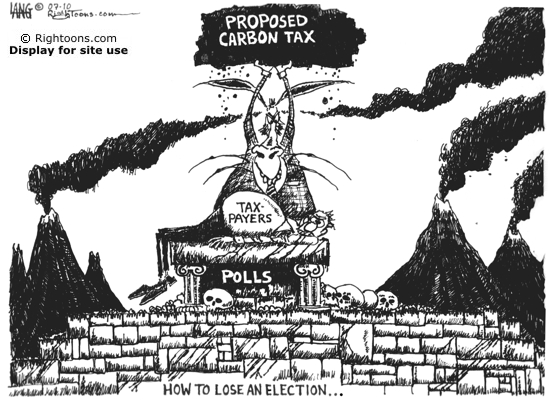
The legislation is a perilous road with high costs — costs Americans tell pollsters they don't want to pay. But Congress is poised to go its own way, skipping over simpler, more promising steps that cost less, such as unleashing America's reserves.
Instead, we go on with the absurd scene of the president of the United States going to Saudi Arabia with his hands out. America is an entrepreneurial nation with resources. We should not be acting like helpless victims. We should not be punishing energy users and embracing regulation over ingenuity and incentives.
Everyone should take a deep breath and listen to Bjorn Lomborg, author of "Cool It: The Skeptical Environmentalist's Guide to Global Warming," who says the legislation before Congress "looks set to be a massive subsidy-fest that would achieve very little for the environment, at great cost." He warns: "Wishful thinking is not sound public policy."
Lomborg says that instead of frenzied regulations and expenditures, "We need the technological solutions that will allow our societies to transition cost-effectively to low-carbon energy by mid-century. McCain could recognize that this is a century-long problem which needs century-long, smart solutions."
In other words — cool it. Drop the gimmicks. Stop getting freaked out by Al Gore. Let's be smart and think creatively rather than as a conventional pack of frenzied followers.
klopez@nationalreview.com
Sunday, June 1, 2008
Lieberman-Warner Global Warming Bill Adopts Very Costly, Unproven European Socialist Regulatory Model at Expense of U.S. Consumers, New Report Finds
http://www.heritage.org/Research/EnergyandEnvironment/wm1940.cfm 
Five Myths About the Lieberman-Warner Global Warming Legislation (S. 2191)
by Ben Lieberman
Heritage Foundation WebMemo #1940 (May 30, 2008)
Myth #1: LW would not be expensive.
"
 ...By restricting carbon dioxide emissions from coal, oil, and natural gas--with a freeze at 2005 levels beginning in 2012, to a 70 percent reduction in 2050--the bill forces down supply and thus boosts the price of energy...Cumulative gross domestic product (GDP) losses could reach $4.8 trillion by 2030...
Myth #2: The costs fall on industry, not consumers.
...Particularly hard hit is the manufacturing sector where over one million jobs will be lost by 2022 and two million by 2027. The losses in household incomes could reach $1,026 per year by 2015. Annual household energy-price increases could hit $1,000 by 2030, including a 29 percent increase in the price of gasoline from 2008 levels.
Myth #3: Global warming is a crisis that must be addressed at all costs.

 Global warming is a concern, not a crisis. Both the seriousness and the imminence of the threat are overstated... Overall, current and expected future temperatures are far from unprecedented, and are highly unlikely to lead to catastrophes.
Myth #4: LW effectively addresses the threat of climate change.
 China has overtaken America as the world's largest emitter, and its emissions growth is several times greater than that of the U.S. India and other fast-developing nations are on a similar trajectory. Thus, the unilateral impact of the bill on global emissions would be inconsequential.
Myth #5: LW's cap-and-trade approach is a proven success.


Most E.U. nations are not on track to meet their targets, and many are seeing their emissions rise faster than those in the U.S. The program is furthermore plagued by accusations of fraud and unfairness. LW essentially adopts the European approach wholesale."
-------------------------------------------------------------------------------------------------
http://www.europa-eu-un.org/documents/en/070531_eu_action_against_climate_change.pdf
EU action against climate change: Leading global action to 2020 and beyond
© European Communities, 2007
"The February 2007 science report from the Intergovernmental Panel on Climate Change (IPCC)1 shows that the world has warmed by an average of 0.76º Celsius since pre-industrial times and the temperature rise is accelerating. Sea levels rose almost twice as fast between 1993 and 2003 as during the previous three decades. Man-made emissions of greenhouse gases are causing these changes.
 The IPPC projects that, without action to limit emissions, the global average temperature is likely to increase further by 1.8º to 4ºC this century. We cannot allow this to happen. The European Union considers it vital to prevent global warming of more than 2ºC above the pre-industrial level.
There is considerable scientific evidence that, beyond this threshold, irreversible and potentially catastrophic changes could occur. In March 2007 EU Heads of State and Government endorsed an integrated climate change and energy strategy put forward by the European Commission which outlines the EU’s proposals for a global and comprehensive agreement to combat climate change after 2012, when the Kyoto Protocol targets will expire.
[READERS SHOULD NOTE THAT IT DOESN'T SAY 'CONCLUSIVE SCIENTIFIC EVIDENCE!].
The Commission’s analysis shows that for the world to have a fair chance of keeping the average temperature rise to no more than 2ºC, global emissions of greenhouse gases will have to be stabilised by around 2020 and then reduced by up to 50% of 1990 levels by 2050.
...The European Commission’s analysis shows that the investment needed to achieve a low-carbon economy would cost only around 0.5% of world GDP between 2013 and 2030. According to its projections, taking action against climate change would reduce global GDP growth by just 0.14% per year up to 2020. Global GDP growth over the period 2005-2020 would be 53%, barely lower than the 55% growth projected if no action were undertaken. And this figure does not take account of the benefits of cutting emissions, such as reduced damage from avoided climate change, greater energy security, and healthcare savings from less air pollution.
-------------------------------------------------------------------------------------------------
http://www.heritage.org/Research/EnergyandEnvironment/cda08-02.cfm
The Economic Costs of the Lieberman-Warner Climate Change Legislation
by William W. Beach, David Kreutzer, Ph.D., Ben Lieberman and Nick Loris
"...S. 2191 imposes strict upper limits on the emission of six greenhouse gases (GHGs) with the primary emphasis on carbon dioxide (CO2). The mechanism for capping these emissions requires emitters to acquire federally created permits (allowances) for each ton emitted. The cost of the allowances will be significant and will lead to large increases in the cost of energy. Because the allowances have an economic effect much like the effect of an energy tax, the increase in energy costs creates correspondingly large transfers of income from private energy consumers to special interests.

...We use these two cases to bracket our cost projections of S. 2191:
- Cumulative gross domestic product (GDP) losses are at least $1.7 trillion and could reach $4.8 trillion by 2030 (in inflation-adjusted 2006 dollars).
- Single-year GDP losses hit at least $155 billion and realistically could exceed $500 billion (in inflation-adjusted 2006 dollars).
- Annual job losses exceed 500,000 before 2030 and could approach 1,000,000.
- The annual cost of emission permits to energy users will be at least $100 billion by 2020 and could exceed $300 billion by 2030 (in inflation-adjusted 2006 dollars).
- The average household will pay $467 more each year for its natural gas and electricity (in inflation-adjusted 2006 dollars). That means that the average household will spend an additional $8,870 to purchase household energy over the period 2012 through 2030.
Our analysis does not extend beyond 2030, at which point S. 2191 mandates GHG reductions to 33 percent below the 2005 level. However, it should be noted that the mandated GHG reductions continue to become more severe and must be 70 percent below the 2005 level by 2050.

...Since income (as measured by GDP) drops as a result of S. 2191, it is clear that more capital is destroyed than is created. The cumulative GDP losses for the period 2010 to 2030 fall between $1.7 trillion and $4.8 trillion, with single-year losses reaching into the hundreds of billions.
...With S. 2191, there is an initial small employment increase as firms build and purchase the newer more CO2-friendly plants and equipment. However, any "green-collar" jobs created are more than offset by other job losses. The initial uptick is small compared to the hundreds of thousands of lost jobs in later years. Table 1 shows the high and low projections of the employment and income effects of S. 2191.

...Distribution of Auction Proceeds
S. 2191 specifies how the distribution of the auction proceeds will be spent, with constant percentages from 2012 to 2036. The auction process depends on the creation of a new nonprofit corporation called the Climate Change Credit Corporation to initiate and complete the auctioning of allowances.
Eleven percent will be allocated to an advanced-technology vehicles-manufacturing incentive. While 44 percent is to be spent on low-carbon energy technology, advanced coal and sequestration programs, and cellulosic biomass ethanol technology programs, 45 percent is to be spent on assisting individuals, families, firms, and organizations in the transition to a low-carbon regime. This includes 20 percent allocated to an Energy Assistance Fund, 20 percent allocated to an Adaptation Fund, and 5 percent allocated to a Climate Change Worker Training Fund.
...Proponents of cap and trade describe it as a flexible and market-based approach that allows the private sector to find the most cost-effective means of reducing greenhouse gas emissions. They expect the program to motivate fossil energy producers and users to reduce their carbon dioxide emissions through improvements in energy efficiency, expanded use of energy sources with fewer or no carbon emissions, or new carbon capture and sequestration (CCS) technologies that allow such emissions to be stored underground rather than released into the atmosphere.
...In contrast, critics fear that many of the necessary advances are decades away from being technologically and economically viable and that, in the interim, the caps in S. 2191 can be met only with severe reductions in energy use, which would drive up energy costs significantly--and would be, in effect, a massive energy tax.
...Critics also point to the substantial difficulties that the European Union has faced since implementing its greenhouse gas cap-and-trade program in 2005 in order to comply with the Kyoto Protocol, the multilateral treaty on emissions that the United States declined to ratify.
...In addition to the provisions of the bill, the many baseline assumptions about the future also affect the projected costs of S. 2191. They include assumptions about the pace of technological advances, especially those regarding the CCS breakthroughs that will be necessary for the continued use of coal, the energy source with the highest CO2 emissions per unit of energy. Continued use of coal is critical because it provides half of the nation's electricity. Assumptions about America's economic growth and concomitant energy needs are also of great importance, as are assumptions about the effect of previously enacted energy legislation, particularly the Energy Independence and Security Act of 2007.
...The Simulations
This CDA report discusses three different views of this country's economic future, each shaped by different policies designed to reduce atmospheric carbon dioxide and, presumably, to reduce the warming trend in global climate change. Policymakers and others who follow the climate change debate closely should find each of these three views helpful in understanding the policy alternatives currently before us. These three views are:
- The current-law baseline. Presented here is a highly detailed, 30-year economic forecast that incorporates the principal elements of energy and climate change policies signed into law last year.
- Simulation of S. 2191, America's Climate Security Act of 2007, sponsored by Senators Joseph Lieberman (I-CT) and John Warner (R-VA). The simulation builds on the detailed baseline and assumes that critical technologies are fully developed.
- An alternative, more realistic scenario in which critical technology does not materialize over the 20-year forecast horizon...
Baseline --
...Natural Gas. In the baseline scenario, gas prices settle just below $7 per million British thermal units (Btus). This is less than the current price but well above the 1990s levels. Alaskan pipeline deliveries will not start until 2025, at which point they will help to offset supply reductions in the Lower 48 as well as imports from Canada. Nearly 100 gigawatts of old natural-gas-steam capacity is retired, and 50 gigawatts of the more efficient "natural gas combined cycle" (NGCC) plants are built. Total natural gas consumption grows by 0.4 percent per year through 2030.
Coal. In the baseline case, coal use is restrained by slower growth of energy demand and increasing generation of nuclear and renewable power. Demand will grow by an average of 0.2 percent each year through 2030. One hundred gigawatts of old inefficient energy is retired. Sixty-five gigawatts of new and replacement coal-fired power-generation plants will be added using the "integrated gas combined cycle" (IGCC) or advanced pulverized-coal technologies. These more efficient technologies use less coal and emit less CO2 per unit of electricity generated and are ready to be fitted for carbon capture and sequestration. Because of the additional cost, there is no use of CCS technology in the baseline case.
...Nuclear Energy. Though there are no significant CO2 emissions from nuclear power generation, it is not considered "renewable" for the purpose of meeting existing state-imposed targets. Nevertheless, federal incentives are already in place for an additional nuclear power capacity. There will be 12 gigawatts of new capacity built and 3 gigawatts of uprated additional capacity added at existing plants. Resolving the problems with waste disposal is a major hurdle in expanding nuclear power generation.
...Renewable Energy Sources. Federal and state initiatives already in place seek to increase the use of renewable energy sources. The definition of "renewable" varies from state to state but generally includes biomass, wind, and solar power. Higher fuel prices along with state and federal mandates cause renewable fuel use to grow at 5.5 percent per year through 2030.
...Lieberman-Warner --
S. 2191 sets ever more stringent caps on emissions of these gases. Using previous emission levels as yardsticks, the 2012 cap is set at the 2005 emission level. The cap drops to 15 percent below the 2005 emission level by 2020 and 33 percent below by 2030. By 2050, the goal is to have man-made GHG emissions at 70 percent below those of 2005.
...Barriers to Trade: Title VI, Global Effort to Reduce Greenhouse Gas Emissions
Title VI of S. 2191 is part of a global effort to reduce greenhouse gas emissions and ensures that emitting GHG in other countries does not undermine U.S. efforts to reduce GHG. The bill's supporters hope to encourage international action on GHG reduction.
To this end, the bill includes the suggestion that the President establish an interagency group to determine whether or not other countries have taken similar action to limit their release of GHG. The interagency group will be responsible for creating a reserve of international allowances, and any U.S. importer of covered goods must submit international allowances as a condition for the trade to occur.
Thus, importers of covered goods must submit emissions allowances that are equal in value to those required for those goods in our system. For instance, if the production of a product generates two tons of CO2 , importers of this product need two tons of allowances for each product they import.
An importer must also submit a written declaration to the administrator of U.S. Customs and Border Protection for each import. Failure to make a CO2 emissions declaration bars the importation of a good into the United States.
...Coal Technology... The costs of meeting the CO2 reductions mandated by S. 2191 are very sensitive to changes in the rate at which CCS technology is developed. Our generous scenario operates on the assumption that any coal-fired plant built after 2018 uses CCS. A second scenario assumes that the significant technological and political hurdles prevent CCS adoption before 2030.
...Natural Gas. Because of its higher cost, natural gas is not competitive with coal in the baseline case of zero CO2 restrictions. Though natural gas generates less CO2 per Btu than does today's coal, it is not competitive when coal generators use CCS...For carbon-allowance prices in the $30 to $40 range, replacing old steam plants with combined-cycle natural gas plants makes sense. When allowance prices exceed $50, coal plants with CCS are more competitive.
...Nuclear Energy. The projection is for no additional nuclear power beyond the base case.
...Renewable Energy Sources. Current state and federal legislation calls for more than tripling the amount of renewable energy in power generation and increasing transport biofuels by more than 1,000 percent. This includes 16 billion gallons per year of corn-based ethanol and biodiesel and 20 billion gallons per year of cellulosic ethanol and biodiesel...While S. 2191 has no additional mandates for biofuels, the costs of allowances for fossil fuels lead to greater use of biofuels. At this time, there is no commercially feasible cellulosic ethanol production. If this technology fails to deliver as projected, energy prices will have to rise enough to reduce the quantity of energy demanded by the amount of missing cellulosic ethanol.
...Economic Costs of the Lieberman-Warner Bill
Economic Output Declines.
...Th[e] investment-driven burst of GDP subsides after 2018. Higher energy prices decrease the use of carbon-based energy in production of goods, incomes fall, and demand for goods subsides. GDP declines in 2020 by $94 billion, in 2025 by $129 billion, and in 2030 by $111 billion (all, again, after inflation). When CCS is not implemented, the higher carbon fees produce more adverse economic effects. GDP is $330 billion below its baseline levels by 2025 and $436 billion below its baseline levels by 2030.
...[M]anufacturing benefits from the initial investment in new energy production and fuel sources, but the sector's declines are sharp thereafter. Indeed, by 2020, manufacturing output in this energy-sensitive sector is 2.4 percent to 5.8 percent below what it would be if S. 2191 never becomes law. By 2030, the manufacturing sector has lost $319 billion to $767 billion in output when compared to our baseline; that is, when compared to the economic world without Lieberman-Warner.
...Number of Jobs Declines.
...In 2025, nearly a half-million jobs per year fail to materialize. The job losses expand to more than 600,000 in 2026. Indeed, in no year after the boomlet does the economy under Lieberman-Warner outperform the baseline economy where S. 2191 never becomes law...Our baseline contains a 9 percent decline between 2008 and 2030. Lieberman-Warner accelerates this decrease substantially: Under our generous-assumptions simulation, employment in manufacturing declines by 23 percent over that same time period, or more than twice the rate without Lieberman-Warner...Other, less energy-intensive sectors, however, do not suffer such decreases.
...Energy Prices Rise.
...Higher energy prices, of course, are the root cause of the slower economy...[C]onsumer prices for electricity, natural gas, and home heating oil increase significantly between 2015 and 2030. Indeed, by the last year of our simulation, the total energy bill for the average American consumer has gone up $8,870 from 2012.
Incomes and Consumption Decline.
Declining demand for energy-intensive products reduces employment and incomes in the businesses producing these products. Workers and investors earn less, and household incomes decline. Reductions in income in these sectors spread and cause declines in demand for other sectors of the economy.
Our simulation captures this effect of higher energy prices. Under the generous-assumptions simulation, the income that individuals have after taxes declines by $47 billion (after inflation) in 2015 and by $50.7 billion in 2030. Our reasonable-assumptions simulation contains worse news: Disposable personal income falls $120 billion below baseline in 2015 and averages $68 billion below baseline over the entire period of 2008 to 2030.
Consumption outlays by individuals and households follow the pattern of lower income. In 2020, consumption expenditures are $52 billion lower than they would be in an economic world in which S. 2191 is not the law. Personal consumption outlays (after inflation) are $67 billion lower by 2030 and average $54 billion below baseline over the entire 22-year forecast period. Under a more reasonable assessment of the likelihood of standard use of CCS, consumption expenditures by individuals average $113 billion lower over the 22-year forecast period.
These declines in consumption are particularly dramatic in those parts of the economy that are sensitive to economic shocks: consumer durables, financial services, and discretionary medical services, among others."

Five Myths About the Lieberman-Warner Global Warming Legislation (S. 2191)
by Ben Lieberman
Heritage Foundation WebMemo #1940 (May 30, 2008)
Myth #1: LW would not be expensive.
"

 ...By restricting carbon dioxide emissions from coal, oil, and natural gas--with a freeze at 2005 levels beginning in 2012, to a 70 percent reduction in 2050--the bill forces down supply and thus boosts the price of energy...Cumulative gross domestic product (GDP) losses could reach $4.8 trillion by 2030...
Myth #2: The costs fall on industry, not consumers.
...Particularly hard hit is the manufacturing sector where over one million jobs will be lost by 2022 and two million by 2027. The losses in household incomes could reach $1,026 per year by 2015. Annual household energy-price increases could hit $1,000 by 2030, including a 29 percent increase in the price of gasoline from 2008 levels.
Myth #3: Global warming is a crisis that must be addressed at all costs.

 Global warming is a concern, not a crisis. Both the seriousness and the imminence of the threat are overstated... Overall, current and expected future temperatures are far from unprecedented, and are highly unlikely to lead to catastrophes.
Myth #4: LW effectively addresses the threat of climate change.
 China has overtaken America as the world's largest emitter, and its emissions growth is several times greater than that of the U.S. India and other fast-developing nations are on a similar trajectory. Thus, the unilateral impact of the bill on global emissions would be inconsequential.
Myth #5: LW's cap-and-trade approach is a proven success.


Most E.U. nations are not on track to meet their targets, and many are seeing their emissions rise faster than those in the U.S. The program is furthermore plagued by accusations of fraud and unfairness. LW essentially adopts the European approach wholesale."
-------------------------------------------------------------------------------------------------
http://www.europa-eu-un.org/documents/en/070531_eu_action_against_climate_change.pdf
EU action against climate change: Leading global action to 2020 and beyond
© European Communities, 2007
"The February 2007 science report from the Intergovernmental Panel on Climate Change (IPCC)1 shows that the world has warmed by an average of 0.76º Celsius since pre-industrial times and the temperature rise is accelerating. Sea levels rose almost twice as fast between 1993 and 2003 as during the previous three decades. Man-made emissions of greenhouse gases are causing these changes.
 The IPPC projects that, without action to limit emissions, the global average temperature is likely to increase further by 1.8º to 4ºC this century. We cannot allow this to happen. The European Union considers it vital to prevent global warming of more than 2ºC above the pre-industrial level.
There is considerable scientific evidence that, beyond this threshold, irreversible and potentially catastrophic changes could occur. In March 2007 EU Heads of State and Government endorsed an integrated climate change and energy strategy put forward by the European Commission which outlines the EU’s proposals for a global and comprehensive agreement to combat climate change after 2012, when the Kyoto Protocol targets will expire.
[READERS SHOULD NOTE THAT IT DOESN'T SAY 'CONCLUSIVE SCIENTIFIC EVIDENCE!].
The Commission’s analysis shows that for the world to have a fair chance of keeping the average temperature rise to no more than 2ºC, global emissions of greenhouse gases will have to be stabilised by around 2020 and then reduced by up to 50% of 1990 levels by 2050.
...The European Commission’s analysis shows that the investment needed to achieve a low-carbon economy would cost only around 0.5% of world GDP between 2013 and 2030. According to its projections, taking action against climate change would reduce global GDP growth by just 0.14% per year up to 2020. Global GDP growth over the period 2005-2020 would be 53%, barely lower than the 55% growth projected if no action were undertaken. And this figure does not take account of the benefits of cutting emissions, such as reduced damage from avoided climate change, greater energy security, and healthcare savings from less air pollution.
-------------------------------------------------------------------------------------------------
http://www.heritage.org/Research/EnergyandEnvironment/cda08-02.cfm
The Economic Costs of the Lieberman-Warner Climate Change Legislation
by William W. Beach, David Kreutzer, Ph.D., Ben Lieberman and Nick Loris
Center for Data Analysis Report #08-02
May 12, 2008
"...S. 2191 imposes strict upper limits on the emission of six greenhouse gases (GHGs) with the primary emphasis on carbon dioxide (CO2). The mechanism for capping these emissions requires emitters to acquire federally created permits (allowances) for each ton emitted. The cost of the allowances will be significant and will lead to large increases in the cost of energy. Because the allowances have an economic effect much like the effect of an energy tax, the increase in energy costs creates correspondingly large transfers of income from private energy consumers to special interests.

...We use these two cases to bracket our cost projections of S. 2191:
- Cumulative gross domestic product (GDP) losses are at least $1.7 trillion and could reach $4.8 trillion by 2030 (in inflation-adjusted 2006 dollars).
- Single-year GDP losses hit at least $155 billion and realistically could exceed $500 billion (in inflation-adjusted 2006 dollars).
- Annual job losses exceed 500,000 before 2030 and could approach 1,000,000.
- The annual cost of emission permits to energy users will be at least $100 billion by 2020 and could exceed $300 billion by 2030 (in inflation-adjusted 2006 dollars).
- The average household will pay $467 more each year for its natural gas and electricity (in inflation-adjusted 2006 dollars). That means that the average household will spend an additional $8,870 to purchase household energy over the period 2012 through 2030.
Our analysis does not extend beyond 2030, at which point S. 2191 mandates GHG reductions to 33 percent below the 2005 level. However, it should be noted that the mandated GHG reductions continue to become more severe and must be 70 percent below the 2005 level by 2050.

...Since income (as measured by GDP) drops as a result of S. 2191, it is clear that more capital is destroyed than is created. The cumulative GDP losses for the period 2010 to 2030 fall between $1.7 trillion and $4.8 trillion, with single-year losses reaching into the hundreds of billions.
...With S. 2191, there is an initial small employment increase as firms build and purchase the newer more CO2-friendly plants and equipment. However, any "green-collar" jobs created are more than offset by other job losses. The initial uptick is small compared to the hundreds of thousands of lost jobs in later years. Table 1 shows the high and low projections of the employment and income effects of S. 2191.

...Distribution of Auction Proceeds
S. 2191 specifies how the distribution of the auction proceeds will be spent, with constant percentages from 2012 to 2036. The auction process depends on the creation of a new nonprofit corporation called the Climate Change Credit Corporation to initiate and complete the auctioning of allowances.
Eleven percent will be allocated to an advanced-technology vehicles-manufacturing incentive. While 44 percent is to be spent on low-carbon energy technology, advanced coal and sequestration programs, and cellulosic biomass ethanol technology programs, 45 percent is to be spent on assisting individuals, families, firms, and organizations in the transition to a low-carbon regime. This includes 20 percent allocated to an Energy Assistance Fund, 20 percent allocated to an Adaptation Fund, and 5 percent allocated to a Climate Change Worker Training Fund.
...Proponents of cap and trade describe it as a flexible and market-based approach that allows the private sector to find the most cost-effective means of reducing greenhouse gas emissions. They expect the program to motivate fossil energy producers and users to reduce their carbon dioxide emissions through improvements in energy efficiency, expanded use of energy sources with fewer or no carbon emissions, or new carbon capture and sequestration (CCS) technologies that allow such emissions to be stored underground rather than released into the atmosphere.
...In contrast, critics fear that many of the necessary advances are decades away from being technologically and economically viable and that, in the interim, the caps in S. 2191 can be met only with severe reductions in energy use, which would drive up energy costs significantly--and would be, in effect, a massive energy tax.
...Critics also point to the substantial difficulties that the European Union has faced since implementing its greenhouse gas cap-and-trade program in 2005 in order to comply with the Kyoto Protocol, the multilateral treaty on emissions that the United States declined to ratify.
...In addition to the provisions of the bill, the many baseline assumptions about the future also affect the projected costs of S. 2191. They include assumptions about the pace of technological advances, especially those regarding the CCS breakthroughs that will be necessary for the continued use of coal, the energy source with the highest CO2 emissions per unit of energy. Continued use of coal is critical because it provides half of the nation's electricity. Assumptions about America's economic growth and concomitant energy needs are also of great importance, as are assumptions about the effect of previously enacted energy legislation, particularly the Energy Independence and Security Act of 2007.
...The Simulations
This CDA report discusses three different views of this country's economic future, each shaped by different policies designed to reduce atmospheric carbon dioxide and, presumably, to reduce the warming trend in global climate change. Policymakers and others who follow the climate change debate closely should find each of these three views helpful in understanding the policy alternatives currently before us. These three views are:
- The current-law baseline. Presented here is a highly detailed, 30-year economic forecast that incorporates the principal elements of energy and climate change policies signed into law last year.
- Simulation of S. 2191, America's Climate Security Act of 2007, sponsored by Senators Joseph Lieberman (I-CT) and John Warner (R-VA). The simulation builds on the detailed baseline and assumes that critical technologies are fully developed.
- An alternative, more realistic scenario in which critical technology does not materialize over the 20-year forecast horizon...
Baseline --
...Natural Gas. In the baseline scenario, gas prices settle just below $7 per million British thermal units (Btus). This is less than the current price but well above the 1990s levels. Alaskan pipeline deliveries will not start until 2025, at which point they will help to offset supply reductions in the Lower 48 as well as imports from Canada. Nearly 100 gigawatts of old natural-gas-steam capacity is retired, and 50 gigawatts of the more efficient "natural gas combined cycle" (NGCC) plants are built. Total natural gas consumption grows by 0.4 percent per year through 2030.
Coal. In the baseline case, coal use is restrained by slower growth of energy demand and increasing generation of nuclear and renewable power. Demand will grow by an average of 0.2 percent each year through 2030. One hundred gigawatts of old inefficient energy is retired. Sixty-five gigawatts of new and replacement coal-fired power-generation plants will be added using the "integrated gas combined cycle" (IGCC) or advanced pulverized-coal technologies. These more efficient technologies use less coal and emit less CO2 per unit of electricity generated and are ready to be fitted for carbon capture and sequestration. Because of the additional cost, there is no use of CCS technology in the baseline case.
...Nuclear Energy. Though there are no significant CO2 emissions from nuclear power generation, it is not considered "renewable" for the purpose of meeting existing state-imposed targets. Nevertheless, federal incentives are already in place for an additional nuclear power capacity. There will be 12 gigawatts of new capacity built and 3 gigawatts of uprated additional capacity added at existing plants. Resolving the problems with waste disposal is a major hurdle in expanding nuclear power generation.
...Renewable Energy Sources. Federal and state initiatives already in place seek to increase the use of renewable energy sources. The definition of "renewable" varies from state to state but generally includes biomass, wind, and solar power. Higher fuel prices along with state and federal mandates cause renewable fuel use to grow at 5.5 percent per year through 2030.
...Lieberman-Warner --
S. 2191 sets ever more stringent caps on emissions of these gases. Using previous emission levels as yardsticks, the 2012 cap is set at the 2005 emission level. The cap drops to 15 percent below the 2005 emission level by 2020 and 33 percent below by 2030. By 2050, the goal is to have man-made GHG emissions at 70 percent below those of 2005.
...Barriers to Trade: Title VI, Global Effort to Reduce Greenhouse Gas Emissions
Title VI of S. 2191 is part of a global effort to reduce greenhouse gas emissions and ensures that emitting GHG in other countries does not undermine U.S. efforts to reduce GHG. The bill's supporters hope to encourage international action on GHG reduction.
To this end, the bill includes the suggestion that the President establish an interagency group to determine whether or not other countries have taken similar action to limit their release of GHG. The interagency group will be responsible for creating a reserve of international allowances, and any U.S. importer of covered goods must submit international allowances as a condition for the trade to occur.
Thus, importers of covered goods must submit emissions allowances that are equal in value to those required for those goods in our system. For instance, if the production of a product generates two tons of CO2 , importers of this product need two tons of allowances for each product they import.
An importer must also submit a written declaration to the administrator of U.S. Customs and Border Protection for each import. Failure to make a CO2 emissions declaration bars the importation of a good into the United States.
...Coal Technology... The costs of meeting the CO2 reductions mandated by S. 2191 are very sensitive to changes in the rate at which CCS technology is developed. Our generous scenario operates on the assumption that any coal-fired plant built after 2018 uses CCS. A second scenario assumes that the significant technological and political hurdles prevent CCS adoption before 2030.
...Natural Gas. Because of its higher cost, natural gas is not competitive with coal in the baseline case of zero CO2 restrictions. Though natural gas generates less CO2 per Btu than does today's coal, it is not competitive when coal generators use CCS...For carbon-allowance prices in the $30 to $40 range, replacing old steam plants with combined-cycle natural gas plants makes sense. When allowance prices exceed $50, coal plants with CCS are more competitive.
...Nuclear Energy. The projection is for no additional nuclear power beyond the base case.
...Renewable Energy Sources. Current state and federal legislation calls for more than tripling the amount of renewable energy in power generation and increasing transport biofuels by more than 1,000 percent. This includes 16 billion gallons per year of corn-based ethanol and biodiesel and 20 billion gallons per year of cellulosic ethanol and biodiesel...While S. 2191 has no additional mandates for biofuels, the costs of allowances for fossil fuels lead to greater use of biofuels. At this time, there is no commercially feasible cellulosic ethanol production. If this technology fails to deliver as projected, energy prices will have to rise enough to reduce the quantity of energy demanded by the amount of missing cellulosic ethanol.
...Economic Costs of the Lieberman-Warner Bill
Economic Output Declines.
...Th[e] investment-driven burst of GDP subsides after 2018. Higher energy prices decrease the use of carbon-based energy in production of goods, incomes fall, and demand for goods subsides. GDP declines in 2020 by $94 billion, in 2025 by $129 billion, and in 2030 by $111 billion (all, again, after inflation). When CCS is not implemented, the higher carbon fees produce more adverse economic effects. GDP is $330 billion below its baseline levels by 2025 and $436 billion below its baseline levels by 2030.
...[M]anufacturing benefits from the initial investment in new energy production and fuel sources, but the sector's declines are sharp thereafter. Indeed, by 2020, manufacturing output in this energy-sensitive sector is 2.4 percent to 5.8 percent below what it would be if S. 2191 never becomes law. By 2030, the manufacturing sector has lost $319 billion to $767 billion in output when compared to our baseline; that is, when compared to the economic world without Lieberman-Warner.
...Number of Jobs Declines.
...In 2025, nearly a half-million jobs per year fail to materialize. The job losses expand to more than 600,000 in 2026. Indeed, in no year after the boomlet does the economy under Lieberman-Warner outperform the baseline economy where S. 2191 never becomes law...Our baseline contains a 9 percent decline between 2008 and 2030. Lieberman-Warner accelerates this decrease substantially: Under our generous-assumptions simulation, employment in manufacturing declines by 23 percent over that same time period, or more than twice the rate without Lieberman-Warner...Other, less energy-intensive sectors, however, do not suffer such decreases.
...Energy Prices Rise.
...Higher energy prices, of course, are the root cause of the slower economy...[C]onsumer prices for electricity, natural gas, and home heating oil increase significantly between 2015 and 2030. Indeed, by the last year of our simulation, the total energy bill for the average American consumer has gone up $8,870 from 2012.
Incomes and Consumption Decline.
Declining demand for energy-intensive products reduces employment and incomes in the businesses producing these products. Workers and investors earn less, and household incomes decline. Reductions in income in these sectors spread and cause declines in demand for other sectors of the economy.
Our simulation captures this effect of higher energy prices. Under the generous-assumptions simulation, the income that individuals have after taxes declines by $47 billion (after inflation) in 2015 and by $50.7 billion in 2030. Our reasonable-assumptions simulation contains worse news: Disposable personal income falls $120 billion below baseline in 2015 and averages $68 billion below baseline over the entire period of 2008 to 2030.
Consumption outlays by individuals and households follow the pattern of lower income. In 2020, consumption expenditures are $52 billion lower than they would be in an economic world in which S. 2191 is not the law. Personal consumption outlays (after inflation) are $67 billion lower by 2030 and average $54 billion below baseline over the entire 22-year forecast period. Under a more reasonable assessment of the likelihood of standard use of CCS, consumption expenditures by individuals average $113 billion lower over the 22-year forecast period.
These declines in consumption are particularly dramatic in those parts of the economy that are sensitive to economic shocks: consumer durables, financial services, and discretionary medical services, among others."
Subscribe to:
Posts (Atom)


