Showing posts with label fear-based pretense for regulation and taxation. Show all posts

Tuesday, June 3, 2008

Environmentalist Ideology Behind Congressional Climate Change Chicanery


To solve the oil crisis, we need to use resources, not gimmicks


By Kathryn Lopez (National Review Online)


Austin-American Statesman


June 1, 2008


COMMENTARY


The temperature's getting hot, and so is the energy-policy debate. Gas prices are reaching new heights as anyone with a car knows. What are we going to do about it? Apparently, nothing serious.


Republican presidential candidate John McCain has taken out ads pushing his silly gas-tax holiday. A gas-tax holiday may be a fun, cheap marketing gimmick, but it's not a solution. In fact, McCain, like the Democrat he will run against, opposes a real solution: Drilling here. Drilling alone won't do it, but it's a practical start.


Thus far, the debate about accessing those resources closest to home has focused on Alaska's Arctic National Wildlife Reserve (ANWR). Congress ridiculously refuses to green-light the project. I say "ridiculous" because concerns about preserving the vast swaths of nature and the caribou there are not serious: Congress would be giving a go-ahead to oil exploration on 2,000 — or 0.01 percent — of ANWR's 19 million acres, which can supply 5 percent of America's oil per year for 12 years, according to the U.S. Energy Department.

"Drill here" is a mantra on conservative talk radio. As former House Speaker Newt Gingrich puts it: "Drill Here. Drill Now. Pay Less." He is collecting signatures on a petition that reads, "We, therefore, the undersigned citizens of the United States, petition the U.S. Congress to act immediately to lower gasoline prices by authorizing the exploration of proven energy reserves to reduce our dependence on foreign energy sources from unstable countries."

Meanwhile, we keep hearing sad high-gas-price stories such as that of Nevada's Clark County School District: With a 62 percent budget expenditure increase due largely to the price of gas, the district has cut its bus route and stops to reduce costs. According to the Department of Transportation, Americans are (predictably) driving less.

It's no wonder that Gallup reports that a majority of Americans support "drilling in U.S. coastal and wilderness areas now off limits." Unlike Congress, Americans don't blame oil companies for the high prices. According to Gallup, "The number of Americans who blame oil companies for the high price of gasoline has decreased from 34 percent to 20 percent."


But don't expect Congress to pull out its power tools any time soon. Right now, the momentum is with America's Climate Security Act of 2007, a bill sponsored by Sens. Joe Lieberman, I-Conn., and John Warner, R-Va. According to the Heritage Foundation, the bill "would likely be — by far — the most expensive environmental undertaking in history." As Heritage describes it, the Warner-Lieberman Bill "extracts trillions of dollars from the millions of American energy consumers and delivers this wealth to permanently identified classes of recipients, such as tribal groups and preferred technology sectors, while largely circumventing the normal congressional appropriations process."

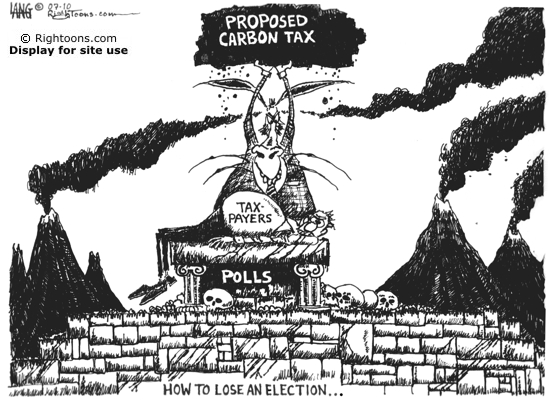
The legislation is a perilous road with high costs — costs Americans tell pollsters they don't want to pay. But Congress is poised to go its own way, skipping over simpler, more promising steps that cost less, such as unleashing America's reserves.


Instead, we go on with the absurd scene of the president of the United States going to Saudi Arabia with his hands out. America is an entrepreneurial nation with resources. We should not be acting like helpless victims. We should not be punishing energy users and embracing regulation over ingenuity and incentives.


Everyone should take a deep breath and listen to Bjorn Lomborg, author of "Cool It: The Skeptical Environmentalist's Guide to Global Warming," who says the legislation before Congress "looks set to be a massive subsidy-fest that would achieve very little for the environment, at great cost." He warns: "Wishful thinking is not sound public policy."


Lomborg says that instead of frenzied regulations and expenditures, "We need the technological solutions that will allow our societies to transition cost-effectively to low-carbon energy by mid-century. McCain could recognize that this is a century-long problem which needs century-long, smart solutions."


In other words — cool it. Drop the gimmicks. Stop getting freaked out by Al Gore. Let's be smart and think creatively rather than as a conventional pack of frenzied followers.

klopez@nationalreview.com

Saturday, April 19, 2008

Former Greenpeace Co-Founder Exposes 'Pop-Environmentalism' as the Root of Climate Change Hysteria, While Calmly Discussing Virtues of Nuclear Energy

http://www.newsweek.com/id/131753

A Renegade Against Greenpeace: Why he says they're wrong to view nuclear energy as 'evil'


Fareed Zakaria


NEWSWEEK


Apr 12, 2008


Patrick Moore is a critic of the environmental movement—an unlikely one at that. He was one of the cofounders of Greenpeace, and sailed into the Aleutian Islands on the organization's inaugural mission in 1971, to protest U.S. nuclear tests taking place there.


After leading the group for 15 years he left abruptly, and, in a controversial reversal, has become an outspoken advocate of some of the environmental movement's most detested causes, chief among them nuclear energy.


NEWSWEEK's Fareed Zakaria spoke to Moore about his sparring with the green movement, and why he thinks nuclear power is the energy of the future.


Excerpts:


ZAKARIA: At Greenpeace, you fought against nuclear energy. What changed?


MOORE: My belief, in retrospect, is that because we were so focused on the destructive aspect of nuclear technology and nuclear war, we made the mistake of lumping nuclear energy in with nuclear weapons, as if all things nuclear were evil. And indeed today, Greenpeace still uses the word "evil" to describe nuclear energy. I think that's as big a mistake as if you lumped nuclear medicine in with nuclear weapons. Nuclear medicine uses radioactive isotopes to successfully treat millions of people every year, and those isotopes are all produced in nuclear reactors.


That's why I left Greenpeace: I could see that my fellow directors, none of whom had any science education, were starting to deal with issues around chemicals and biology and genetics, which they had no formal training in, and they were taking the organization into what I call "pop environmentalism," which uses sensationalism, misinformation, fear tactics, etc., to deal with people on an emotional level rather than an intellectual level.


Why do you favor nuclear energy over other non-carbon-based sources of energy?


Other than hydroelectric energy—which I also strongly support—nuclear is the only technology besides fossil fuels available as a large-scale continuous power source, and I mean one you can rely on to be running 24 hours a day, seven days a week. Wind and solar energy are intermittent and thus unreliable.
How can you run hospitals and factories and schools and even a house on an electricity supply that disappears for three or four days at a time? Wind can play a minor role in reducing the amount of fossil fuels we use, because you can turn the fossil fuels off when the wind is blowing. And solar is completely ridiculous. The cost is so high—California's $3.2 billion in solar subsidies is all just going into Silicon Valley companies and consultants. It's ridiculous.


A number of analyses say that nuclear power isn't cost competitive, and that without government subsidies, there's no real market for it.


That's simply not true. Where the massive government subsidies are is in wind and solar. I know that France, which produces 80 percent of its electricity with nuclear, does not have high energy costs. Sweden, which produces 50 percent of its energy with nuclear and 50 percent with hydro, has very reasonable energy costs. I know that the cost of production of electricity among the 104 nuclear plants operating in the United States is 1.68 cents per kilowatt-hour. That's not including the capital costs, but the cost of production of electricity from nuclear is very low, and competitive with dirty coal. Gas costs three times as much as nuclear, at least. Wind costs five times as much, and solar costs 10 times as much.


What about the issue of nuclear waste?


As is now planned, I'd establish a recycling industry for nuclear fuel, which reduces the amount of waste to less than 10 percent of what it would be without recycling. How many Americans know that 50 percent of the nuclear energy being produced in the U.S. is now coming from dismantled Russian nuclear warheads?


The environmental movement is going on about how terrible it will be if someone does something destructive with these materials. Well, actually the opposite is occurring: all over the world, people are using former nuclear-weapons material for peaceful purposes—swords into plowshares. This constant propaganda about the cost of nuclear energy—that's just activists looking for the right buttons to push, and one of the key buttons to push is to make consumers afraid that their electricity prices will go up if nuclear energy is built. In fact, it's natural gas that is causing [energy] prices to go up.


Don't you worry about proliferation?


You do not need a nuclear reactor to make a nuclear weapon. With centrifuge technology, it is far easier, quicker and cheaper to make a nuclear weapon by enriching uranium directly. No nuclear reactor was involved in making the Hiroshima bomb. You'll never change the fact that there are evil people in the world. The most deaths in combat in the last 20 years have not been caused by nuclear weapons or car bombs or rifles or land mines or any of the usual suspects, but the machete. And yet the machete is the most important tool for farmers in the developing world. Hundreds of millions of people use it to clear their land, to cut their firewood and harvest their crops. Banning the machete is not an option.


Are you optimistic that there will be an aggressive move toward nuclear power in the industrial world, and in particular in the United States?


There are 32 nuclear plants on the drawing boards right now. Last year four applied for their licenses and this year we expect 10 or 11 more. That's just in the United States. There are hundreds of nuclear plants on the drawing boards around the world. This is a completely new thing: the term "'nuclear renaissance" didn't exist three years ago, and now it's a widely known term. Unfortunately, the environmental movement now is the primary obstacle here. If it weren't for their opposition to nuclear energy, there would be a lot fewer coal-fired power plants in the United States and other parts of the world today.

Tuesday, March 25, 2008

EU Energy Entrepreneurs Experience Economic Epiphany Exposing Elusive Emissions Endgame

http://www.enn.com/climate/article/31567


Power Users Warn EU Investment Stalls Over Climate

From: Reuters Published February 21, 2008 11:41 AM
By Huw Jones and William Schomberg


BRUSSELS (Reuters) - Energy-intensive industries in Europe warned on Thursday that big investment decisions are being put on hold until the European Union hammers out its plan for fighting climate change after 2012.


A month after the EU's executive announced proposals to curb greenhouse gas emissions in the 27-nation bloc, executives from some of Europe's biggest companies said they could not afford to wait long for details of how the system will work.


Juha Rantanen, chief executive of Finnish stainless steel company Outokumpu, said the EU's Emissions Trading Scheme, which will make companies pay increasingly for their pollution, was already hitting his company's plans to expand mining of ferrochrome, a stainless steel ingredient."With not knowing what the price of electricity will be beyond 2012, or what will be the price of emissions rights, we are not making that investment and instead we buy ferrochrome from South Africa and Kazakhstan, where it's being produced in an environmentally less efficient way," he told Reuters.

"This trading scheme puts a cost into operations in Europe which is higher than for competitors in other regions. That will ultimately lead to European industry investing less in Europe."


Jean-Pierre Clamadieu, CEO of French chemicals group Rhodia , noted that French cement maker Lafarge had recently suspended its investments in plants in the EU and said Rhodia might face a similar dilemma in the near future.

"It is important we get as quickly as possible visibility on (the EU plans)," Clamadieu said. "If we don't, then I think there will be lot of investment project delay or investment which will move to different regions of the world."

DECISION DEFERRED

EU governments aim to agree on a post-2012 reform of the Emissions Trading Scheme by the end of this year, but the Commission wants to defer the question of special treatment for energy-intensive industries until 2010.


The outcome will depend on whether there is an international agreement on curbing greenhouse gas emissions, blamed for global warming, it argues.


Addressing the same conference on climate change and business, European Commission President Jose Manuel Barroso pledged again that if there were no global solution,
the EU would look at interim measures such as free emissions permits for energy-intensive industries.


Other executives voiced concern that Europe's ambitious plans to cut greenhouse gas emissions would hurt the competitiveness of industry.


The United States, the world's biggest economy, rejects the idea of mandatory emissions caps and major developing economies, such as China and India, say it is unfair to ask them to make big emissions cuts after centuries of pollution by richer countries.


U.S. Ambassador to the EU Boyden Gray suggested Europe should delay its ambitious targets for cutting emissions from 2020 until 2030 to allow time for technology to develop.
European industries that are the biggest consumers of power want special treatment under the new rules.


Michel Wurth, who sits on the management board of the world's biggest steelmaker, ArcelorMittal, said companies like his wanted know how the EU would define energy-intensive industries, what proportion of emissions rights they would have to pay for and how much funding they would get to finance research into cleaner manufacturing and new products.


"Today the European steel industry is at the top in terms of energy efficiency so if you force European steel to reduce or get out of production, the consequence will be the global steel industry will emit more than it does today," he said.

ArcelorMittal recently agreed to keep open a blast furnace in Liege, Belgium, until 2012 but possibly not longer due to the uncertainties about the next phase of the EU energy rules after that date, Wurth said.
(Additional reporting by David Lawsky, editing by Anthony Barker)

Thursday, March 6, 2008

Hillary Clinton and Barack Obama Call For Large Unspecified National 'Sacrifices' and High Cost Enviro-Energy Use Regulatory 'Changes'

http://www.nytimes.com/2008/01/01/opinion/01tue1.html


New York Times


January 1, 2008


Editorial: In Office


The One Environmental Issue


The overriding environmental issue of these times is the warming of the planet. The Democratic hopefuls in the 2008 campaign are fully engaged, calling for large — if still unquantified — national sacrifices and for a transformation in the way the country produces and uses energy. The Republicans do not go much further than conceding that climate change could be a problem and, with the notable exception of John McCain, offer no comprehensive solutions.


In 2000, when Al Gore could have made warming a signature issue in his presidential campaign, his advisers persuaded him that it was too complicated and forbidding an issue to sell to ordinary voters. For similar reasons, John Kerry’s ambitious ideas for addressing climate change and reducing the country’s dependence on foreign oil never advanced much beyond his Web site.


Times have certainly changed. It is not yet clear to what extent Americans are willing to grapple with the implications of any serious strategy to reduce greenhouse gas emissions: more specifically, whether they are ready to pay higher prices for energy and change their lifestyles to reduce their consumption of fossil fuels.


Polls suggest, however, that voters are increasingly alarmed, and for that Mr. Gore is partly responsible. His film, “An Inconvenient Truth,” raised the issue’s profile. Then came four reports from the United Nations Intergovernmental Panel on Climate Change, which shared the Nobel Peace Prize with Mr. Gore, predicting catastrophic changes in weather patterns, sea levels and food production unless greenhouses gases can be quickly stabilized and then reduced by as much as 80 percent by midcentury.


There is also a growing appetite for decisive action — everywhere, it seems, except the White House. Governors in more than two dozen states are fashioning regional agreements to lower greenhouse gases, the federal courts have ordered the executive branch to begin regulating these gases, and the Senate has begun work on a bipartisan bill that would reduce emissions by nearly 65 percent by 2050.


[THIS IS PATENTLY FALSE - RATHER, THE U.S. SUPREME COURT ORDERED, IN MASSACHUSETTS V. EPA, WHICH WAS DECIDED APRIL 2, 2007, THAT
(http://www.supremecourtus.gov/opinions/06pdf/05-1120.pdf) "BECAUSE GREENHOUSE GASES FIT WELL WITHIN THE [CLEAN AIR] ACT'S CAPACIOUS DEFINITION OF 'AIR POLLUTANT', THE ENVIRONMENTAL PROTECTION AGENCY MUST EVALUTE WHETHER GREENHOUSE GASES, SUCH AS CARBON DIOXIDE, "CAUSE[] OR CONTRIBUTE[] TO AIR POLLUTION WHICH MAY REASONABLY BE ANTICIPATED TO 'ENDANGER' PUBLIC HEALTH OR WELFARE", WITHIN THE MEANING OF SECTION 7601(a)(1) OF THE FEDERAL CLEAN AIR ACT. THE SUPREME COURT DID NOT REQUIRE THE EPA TO REGULATE CARBON DIOXIDE AS MANY ENVIRONMENTAL ACTIVIST GROUPS HAVE FALSELY CLAIMED. "WHILE THE STATUTE [CLEAN AIR ACT] CONDITIONS EPA ACTION ON ITS FORMATION OF A 'JUDGMENT', THAT JUDGMENT MUST RELATED TO WHETHER AN AIR POLLUTANT 'CAUSES[S], OR CONTRIBUTE[S] TO, AIR POLLUTION WHICH MAY REASONABLY BE ANTICIPATED TO ENDANGER PUBLIC HEALTH OR WELFARE'." §7601(a)(1). UNDER THE ACT'S CLEAR TERMS, EPA CAN AVOID PROMULGATING REGULATIONS ONLY IF IT DETERMINES THAT GREENHOUSE GASES DO NOT CONTRIBUTE TO CLIMATE CHANGE OR IF IT PROVIDES SOME REASONABLE EXPLANATION AS TO WHY IT CANNOT OR WILL NOT EXERCISE ITS DISCRETION TO DETERMINE WHETHER THEY DO."]


Still, the country is a long way from a comprehensive response equal to the challenge. That is what the Democratic candidates are proposing. Senators Joseph Biden, Hillary Clinton and Barack Obama, former Senator John Edwards, Gov. Bill Richardson and Representative Dennis Kucinich have all offered aggressive plans that would go beyond the Senate bill and reduce emissions by 80 percent by midcentury (90 percent in Mr. Richardson’s case), much as called for in the United Nations reports.


These plans would rest primarily on a cap-and-trade scheme that imposes a gradually declining ceiling on emissions and allows power plants, refineries and other emitters to figure out the cheapest way to meet their quotas — either by reducing emissions on their own or by purchasing credits from more efficient producers. The idea is to give companies a clear financial incentive to invest in the new technologies and efficiencies required to create a more carbon-free economy.


[THE USE OF EMISSIONS CAP & TRADE REGIMES ARE QUITE EXPENSIVE TO THE PUBLIC (CONSUMERS) AND CANNOT ENSURE THAT ACTUAL EMISSIONS OF CARBON DIOXIDE INTO THE ENVIRONMENT ARE INDEED REDUCED, SINCE A CAP & TRADE REGIME SIMPLY INVOLVES ONLY 'PAPER ACCOUNTING ENTRIES' THAT REFLECT 'OFFSETS' OF FICTITIOUS CARBON CREDITS CALCULATED IN RELATIONSHIP TO A REGULATORY LIMIT, WITH ACTUAL CALCULATED EMISSIONS. THE CANDIDATES' CAP & TRADE PLANS DO NOT SPECIFY HOW SUCH CALCULATIONS CAN AND WILL BE VERIFIED. ONE NEED ONLY LOOK TO THE SELF-ADMITTED FAILURE OF THE EUROPEAN UNION'S CARBON DIOXIDE CAP & TRADE SYSTEM]


None of the Democrats trust the market to do the job by itself. All would make major investments in cleaner fuels and delivery systems, including coal-fired power plants capable of capturing carbon emissions and storing them underground. Every Democrat except Mr. Kucinich says that carbon-free nuclear power has to be part of the mix, although all are careful to say that safety issues and other concerns must first be resolved.


Internationally, the Democrats say they would seek a new global accord on reducing emissions to replace and improve upon the Kyoto Protocol, which expires in 2012. Winning agreement among more than 180 nations will be slow-going, so several candidates, including Mrs. Clinton, have suggested jump-starting the process by bringing together the big emitters like China very early in their administrations. China and the United States together produce about 40 percent of the world’s total emissions and neither has agreed to binding reductions.


The only Republican candidate who comes close to the Democrats with a plan for addressing climate change is John McCain, one of the authentic pioneers on the issue in the Senate. In 2003, along with Joseph Lieberman, Mr. McCain introduced the first Senate bill aimed at mandatory economy-wide reductions in emissions of 65 percent by midcentury. He also regularly addresses the subject on the campaign trail.


The other leading Republican candidates — Mitt Romney, Rudolph Giuliani, Fred Thompson, Mike Huckabee — talk about energy issues almost exclusively in the context of freeing America from its dependence on foreign oil. All promote nuclear power, embrace energy efficiency and promise greener technologies. Only Mr. Huckabee has dared raise the idea of government regulation, embracing, at least theoretically, the idea of a mandatory cap on emissions. The rest prefer President Bush’s cost-free and demonstrably inadequate voluntary approach, which essentially asks industry to do what it can to reduce emissions.


So far, the Democratic candidates seem more engaged with the issue than some of their interrogators in the news media. In a recent study, the League of Conservation Voters found that as of two weeks ago, the five main political talk-show hosts had collectively asked 2,275 questions of candidates in both parties. Only 24 of the questions even touched on climate change.


One result is that even the candidates who urge comprehensive change have not been pressed on important questions of cost: How do they intend to pay for all the new efficiencies and technologies that will be necessary? And what kind of sacrifices will they be asking of people who almost certainly will have to pay more for their electric bills and their greener cars?


[THESE ARE EXCELLENT QUESTIONS THAT DESERVE HONEST ANSWERS, WHICH HAVE NOT YET BEEN FORTHCOMING]


Addressing these questions will require more courage of the candidates than simply offering up broad new visions. The voters deserve an honest accounting and the candidates should be prepared to give it.

Sunday, January 27, 2008

UK Used Presidency of UN Security Council to Incorporate Sustainable Development Within Broader Council Mandate

http://www.securitycouncilreport.org/atf/cf/%7B65BFCF9B-6D27-4E9C-8CD3-CF6E4FF96FF9%7D/CC%20S2007%20186.pdf


UK Used Presidency of UN Security Council to Incorporate Sustainable Development Within Broader Council Mandate


During September 2005, the UN Security Council adopted Resolution S/RES/1625 (14 September 2005), declaring "the effectiveness of the Security Council's role in conflict prevention [and] reaffirming the need to adopt a broad strategy to conflict prevention, which addresses the root causes of armed conflict in a comprehensive manner, including by promoting sustainable development.


"Reaffirming the need to adopt a broad strategy of conflict prevention, which addresses the root causes of armed conflict and political and social crises in a comprehensive manner, including by promoting sustainable development, poverty eradication, national reconciliation, good governance, democracy, gender equality, the rule of law and respect for and protection of human rights..."


"...2. Affirms its determination to strengthen United Nations conflict
prevention capacities by:


...(g) helping to enhance durable institutions conducive to peace, stability and sustainable development..."

http://www.securitycouncilreport.org/atf/cf/%7B65BFCF9B-6D27-4E9C-8CD3-CF6E4FF96FF9%7D/CC%20SRES%201625.pdf


Building upon Security Council Resolution 1625, during April 2007, UK Foreign Secretary Margaret Beckett used Britain’s then presidency of the Security Council as a platform to promote sustainable development as a separate rationale to preserve international peace and security. This indirectly served the purpose of pushing reform of the Security Council’s traditional scope of jurisdiction and authority.[1] In particular, she insisted that the UN Security Council expand its jurisdictional mandate, traditionally limited to ‘prevention of conflicts’ and ‘maintenance of international peace and security’, so that it also covers ‘collective global environmental threats’ to sustainable development, such as climate change.[2]


In pursuing this multilateral campaign, Ms. Beckett not unexpectedly relied on the recently issued Stern and UN Intergovernmental Climate Change Committee Reports [3] to raise the specter of an impending global environmental and human disaster should the member states of the United Nations fail to reach a political ‘burden-sharing’ (a/k/a economic wealth redistribution and technology transfer) accord that proactively and adequately addresses the hazards posed by runaway climate change. Many left-leaning politicians, scientific academies and environmentalists in Europe and the United States have likewise used these controversial reports to squelch the scientific debate over the causes and effects of climate change.[4]


This proposal was contained in a more formal UK concept paper that resulted in the Security Council’s first debate on environmental issues. The Security Council Report documenting this meeting states the following:


“1. All members of the international community face a shared dilemma. To ensure well-being for a growing population with unfulfilled needs and rising expectations, we must grow our economies. Should we fail, we increase the risk of conflict and insecurity. To grow our economies we must continue to use more energy. Much of that energy will be in the form of fossil fuels. But if we use more fossil fuels without mitigating the resulting emissions, we will accelerate climate change, which itself presents risks to the very security we are trying to build.


2. The aim of the debate is to raise awareness of a set of significant future security risks facing the international community as a result of failing to resolve this shared dilemma, to promote a shared understanding of these risks, and to explore ways to address them.


3. The focus of the debate will be on the security implications of a changing climate, including through its impact on potential drivers of conflict (such as access to energy, water, food and other scarce resources, population movements and border disputes). No other international forum has yet addressed these issues from this perspective. A Security Council discussion will therefore make a useful initial contribution, while recognizing that it is for other United Nations bodies (in particular the United Nations Framework Convention on Climate Change) to pursue other aspects of climate change that are not within the mandate of the Security Council (including action to stabilize greenhouse gas concentrations in the atmosphere at a safe level, based on the principle of common but differentiated responsibilities and respective capabilities).


... 6. While the physical effects of climate change and what can be done about them are important issues, it is their potential impact on security that is the proposed focus of this Security Council debate.”


The UN Security Council Report then proceeded to outline the following key ‘security risks’ posed by climate change which would not only contribute mightily to political efforts aimed at raising public fears about the hypothetical impacts arising from climate change, but would also justify greater UN involvement in national sovereign affairs:


Border Disputes


A significant proportion of current threats to international peace and security are disputes over borders or land. Melting ice and rising sea levels caused by climate change are likely to result in major changes to the world’s physical landmass during this century. Will political and maritime borders change as well?... [T]he possible submergence of entire small island States, dramatically receding coastlines, and the development of new shipping routes...could all lead to disputes over maritime zones and other territorial rights.


Migration


[S]ubstantial parts of the world risk being left uninhabitable by rising sea levels, reduced freshwater availability or declining agricultural capacity. This will exacerbate existing migratory pressures from rural areas to cities, from unproductive land to more fertile land, and across international borders... Migration does not in itself lead directly to conflict. But it can alter the ethnic composition and/or population distribution within and between States, which can increase the potential for instability and conflict


Energy Supplies


There is already extensive discussion on the relationship between energy resources and the risk of conflict, in terms of competition over scarce energy resources, security of supply, and the role energy resources play once conflict has broken out. Climate change is expected to complicate this relationship still further, presenting us with a shared dilemma about how to balance our climate and energy objectives while preserving security...


Other Resource Changes


Climate change is likely to make essential resources (notably freshwater, cultivable land, crop yields and fish stocks) more scarce in many parts of the world, particularly in already vulnerable societies. Resource scarcity threatens people’s livelihoods, especially when changes occur relatively quickly. Much depends on the adequacy of adaptation strategies. But increased scarcity increases the risk of competition over resources within and between communities and States. This can create instability, increasing vulnerability to conflict...


Societal Stress


The 2006 Stern Review on the Economics of Climate Change noted that climate change was a major challenge to poverty reduction, affecting the poorest countries earliest and most. The tensions that climate change through its impact on development — and hence inequality — could produce within and between States might not in themselves necessarily lead to conflict. But in some weaker States — e.g., where severe inequalities occur among different groups in society, for example on ethnic grounds — political violence within and between States may become more likely.


Humanitarian Crises


Climate change is likely to increase the risk of extreme weather events that may become sudden humanitarian emergencies. There are already indications that such events, especially on a large scale, can exacerbate societal and cross-border stresses, with potential consequent political and security impacts. There is a proven correlation between drought and the likelihood of high intensity conflicts in some regions, and some Governments have struggled to cope with the social consequences of major natural disasters. 8. Conflicts often start when societies cannot cope with multiple stresses...”


http://www.securitycouncilreport.org/atf/cf/%7B65BFCF9B-6D27-4E9C-8CD3-CF6E4FF96FF9%7D/CC%20S2007%20186.pdf


It is interesting to note how the Security Council referred to the term ‘correlation’ rather than ‘causation’.


While standing their political ground, it was apparent that Madams Merkel and Beckett had side-stepped the important scientific debate that continues to rage throughout the world. This debate concerns the extent to which certain human activities can actually be shown to cause measurable global warming or to merely correlate with a barely observable rise in global temperatures that may or may not prove cyclical in nature. Ordinary scientists, engineers and business people, the world over, know quite well that there is a marked difference between causation and correlation, and that they can make rationally-based decisions in their daily lives guided only by the ‘knowables’ in life rather than the ‘unknowables’.


Did Ms. Beckett’s reference to the term ‘correlation’ rather than ‘causation’ suggest a nuanced effort to base intergovernmental regulatory policy on popularly fanned fears about largely hypothetical, unpredictable and/or unknowable future natural and man-made hazards that have not yet been shown to pose direct ascertainable risks to human health or the environment???


[1] See "Update Report No. 2 Energy, Security and Climate", UN Security Council (12 April 2007) at: http://www.securitycouncilreport.org/site/c.glKWLeMTIsG/b.2666033/k.BE96/Update_Report_No_2brEnergy_Security_and_Climatebr12_April_2007.htm [2] See “Opening Statement of Margaret Beckett at UN Security Council Climate Change Debate” British Embassy Buenos Aires (April 17, 2007) at:
http://www.britishembassy.gov.uk/servlet/Front?pagename=OpenMarket/Xcelerate/ShowPage&c=Page&cid=1138870133146 .
[3] See “Speech of Margaret Beckett and UN Security Council Climate Change Debate On Energy, Climate and Security” Foreign and Commonwealth Office News (April 17, 2007) at:
http://www.fco.gov.uk/servlet/Front?pagename=OpenMarket/Xcelerate/ShowPage&c=Page&cid=1007029391629&a=KArticle&aid=1176454354972 . [4] See, e.g., “Royal Society Letter to ExxonMobil Requesting ExxonMobil to Stop Funding of Lobby Groups that Seek to Misrepresent the Scientific Evidence Relating to Climate Change” (Sept. 4, 2006) at:
http://www.royalsoc.ac.uk/displaypagedoc.asp?id=23780 ; “Rockefeller and Snowe Demand that Exxon Mobil End Funding of Campaign that Denies Global Climate Change”, Press Release, Office of United States Senator for Maine, Olympia Snowe (Oct. 30, 3006) at:
http://snowe.senate.gov/public/index.cfm?FuseAction=PressRoom.PressReleases&ContentRecord_id=9ACBA744-802A-23AD-47BE-2683985C724E ; Michael Erman, “Greenpeace: Exxon Still Funding Climate Skeptics”, Reuters (May 17, 2007) at: http://in.today.reuters.com/news/newsArticle.aspx?type=worldNews&storyID=2007-05-18T102946Z_01_NOOTR_RTRJONC_0_India-298816-1.xml&archived=False .

Thursday, January 24, 2008

US Enviros Aim to Halt Coal Use and Risk US Economic & Energy Security: Launch Court Actions Pushing US to Adopt Flawed EU Policy on Carbon Emissions

Coal Power Goes on Trial Across U.S. Activists Sue to Slow Boom; Industry Says Americans Want the Electricity


updated 4:26 p.m. ET, Mon., Jan. 14, 2008


BILLINGS, Mont. - In federal and state courtrooms across the country, environmental groups are putting coal-fueled power plants on trial in a bid to slow the industry's biggest construction boom in decades.


At least four dozen coal plants are being contested in 29 states, according to a recent Associated Press tally. The targeted utilities include giants like Peabody Energy and American Electric Power down to small rural cooperatives.


From lawsuits and administrative appeals against the companies, to lobbying pressure on federal and state regulators, the coordinated offensive against coal is emerging as a pivotal front in the debate over global warming.


"Our goal is to oppose these projects at each and every stage, from zoning and air and water permits, to their mining permits and new coal railroads," said Bruce Nilles, a Sierra Club attorney who directs the group's national coal campaign. "They know they don't have an answer to global warming, so they're fighting for their life."


Industry representatives say the environmentalists' actions threaten to undermine the country's fragile power grid, setting the stage for a future of high-priced electricity and uncontrollable blackouts.


"These projects won't be denied, but they can be delayed by those who oppose any new energy projects," said Vic Svec, vice president of the mining and power company Peabody Energy.
While observers say forecasts of power grid doom are exaggerated, the importance of coal — one of the country's cheapest and most abundant fuels — is undeniable.


Coal plants provide just over 50 percent of the nation's electricity. They also are the largest domestic source of the greenhouse gas carbon dioxide, emitting 2 billion tons annually, about a third of the country's total.


The score so far Environmental groups cite 59 canceled, delayed or blocked plants as evidence they are turning back the "coal rush." That stacks up against 22 new plants now under construction in 14 states — the most in more than two decades.


Mining companies, utilities and coal-state politicians promote coal in the name of national security, as an alternative to foreign fuels. With hundreds of years of reserves still in the ground, they're also pushing coal-to-diesel plants as a way to sharply increase domestic production.


The outcome of the fight over coal could determine the nation's greenhouse gas emissions for years to come, said Gregory Nemet, assistant professor of public affairs at the University of Wisconsin.


"It's pretty much irreversible," Nemet said. "Once a coal plant is built, it will last 50 years or so."


But in opposing coal projects across the board, environmentalists risk hobbling more advanced coal plants that could rein in at least some of those emissions, Nemet said. He added that rising demand for electricity means more power "has to come from somewhere."


"There's too much pressure — in terms of energy independence and the inexpensiveness of that resource — to not use that coal," Nemet said.


One of the latest challenges to a utility came in the heart of coal country — Montana, which boasts the largest coal reserves in the nation.


On Friday, a state panel refused to rescind an air-quality permit it had granted for a plant proposed for the Great Falls area by Southern Montana Electric, despite concerns about the plant's carbon dioxide emissions. The 250-megawatt plant is projected to emit the equivalent of 2.8 million tons of carbon dioxide annually, as much as a half-million vehicles.


The Montana Environmental Information Center, which had asked the panel to review the permit, vowed to appeal the ruling.


Nilles said the Sierra Club spent about $1 million on such efforts in 2007 and hopes to ratchet that figure up to $10 million this year.


Meanwhile, coal interests are pouring even more into a promotional campaign launched by the industry group Americans for Balanced Energy Choices. It spent $15 million last year and expects to more than double that to $35 million in 2008, said the group's director, Joe Lucas.


Funding for the group comes from coal mining and utility companies such as Peabody and railroads that depend on coal shipments for a large share of their revenues.


Peabody's Svec acknowledged a rush to build new plants, but denied the goal was to beat any of at least seven bills pending before Congress to restrict carbon dioxide emissions — a charge leveled by some environmentalists.


Rather, he said, the construction boom is driven by projections that the country will fall into a power deficit within the next decade if new plants are not built. [A LARGELY TRUE STATEMENT]


Industry attorney Jeffrey Holmstead said that could lead to a future of rolling blackouts as the economy expands and electricity consumption increases. Holmstead was in charge of the U.S. Environmental Protection Agency's air program during the first five years of the current Bush administration.


The power deficit cited by industry officials is based on projections from the North American Electric Reliability Corporation. NERC vice president David Nevius said his group is "neutral" on what kind of plants should be built to meet rising demand.


"We're not saying the lights will go out. We're just saying additional resources are needed," Nevius said. "We don't say coal over gas over wind over solar."


600-plus plants nowUtilities currently burn more than 1 billion tons of coal annually in more than 600 plants. Over the next two decades, the Bush administration projects coal's share of electricity generation will increase to almost 60 percent.


That projection held steady in recent months even as courts and regulators turned back, delayed or asked for changes to plants in at least nine states.


Other projects in Utah, Texas, Wyoming, Florida and several other states have been abandoned or shelved.


Some were canceled over global warming concerns. Utilities backed off others after their price tags climbed over $1 billion due to rising costs for materials and skilled labor.


Environmental opposition to coal plants was galvanized by a U.S. Supreme Court decision in April that said carbon dioxide is a pollutant open to regulation.


The case, Massachusetts vs. U.S. Environmental Protection Agency, involved vehicle emissions. But environmentalists aim to use the decision as a fulcrum to leverage regulators to take a harder line on greenhouse gases in several emerging power plant disputes. The result could serve as an early barometer of the reach of the Supreme Court ruling.


More tests of the two sides' arguments are certain. Industry groups say at least 15 coal-fired power projects are nearing the end of the approval process and could soon start construction.