http://epw.senate.gov/public/index.cfm?FuseAction=Majority.PressReleases&ContentRecord_id=ae230690-802a-23ad-4b41-cfdc0d90bac6&Region_id=&Issue_id=
Boxer Introduces Bill to Reverse EPA Global Warming Waiver Decision
U.S. Senate Committee on Environment and Public Works
January 24, 2008
[THE REFERENCE ABOVE TO A REVERSE 'BOXER REBELLION' IS INTENTIONAL, AS IT IMPLIES HOW SENATOR BARBARA BOXER IS ENDEAVORING TO IMPORT EUROPEAN NON-SCIENCE & NON-ECONOMICS-BASED PRECAUTIONARY PRINCIPLE CLIMATE CHANGE REGULATIONS INTO THE UNITED STATES AS U.S. LAW. THE 'BOXER REBELLION' IS ACTUALLY AN HISTORICAL EVENT THAT TOOK PLACE AT THE BEGINNING OF THE 20TH CENTURY IN CHINA. UNLIKE SENATOR
BOXER'S INVITING FOREIGN INFLUENCES INTO THE U.S., THE CHINESE BOXER REBELLION REFLECTED CHINESE PEASANT'S REPULSION OF FOREIGN INFLUENCES. "The Boxer Rebellion, or Boxer Movement, was an uprising by members of the Chinese Society of Right and Harmonious Fists against foreign influence in areas such as trade, politics, religion and technology. It took place in China from November 1899 to 7 September 1901, during the final years of the Manchu rule (Qing Dynasty). The members of the Society of Right and Harmonious Fists were simply called 'Boxers' by the Westerners due to the martial arts and calisthenics they practiced. The uprising began as an anti-foreign, anti-imperialist peasant-based movement in northern China. They attacked foreigners who were building railroads and violating Feng shui, as well as Christians, who were held responsible for the foreign domination of China." See Wikipedia at: http://en.wikipedia.org/wiki/Boxer_Rebellion ].
UPDATED: This release has been revised to include quotes from Senators Olympia Snowe (R-ME) and Robert Menendez (D-NJ) as original cosponsors.
Washington, DC - U.S. Senator Barbara Boxer (D-CA), Chairman of the Senate Committee on Environment and Public Works, introduced legislation today that would direct the U.S. Environmental Protection Agency (EPA) to grant California a waiver under the Clean Air Act to cut global warming pollution from motor vehicles.
Cosponsors of the bill include Senators Dianne Feinstein (D-CA), Joseph Lieberman (ID, CT), Hillary Clinton (D-NY), Frank Lautenberg (D-NJ), Benjamin Cardin (D-MD), Bernie Sanders (I-VT), Sheldon Whitehouse (D-RI), Edward Kennedy (D-MA), Patrick Leahy (D-VT), Christopher Dodd (D-CT), John Kerry (D-MA), Barbara A. Mikulski (D-MD), Olympia Snowe (R-ME), Susan Collins (R-ME), Bill Nelson (D-FL.) Barack Obama (D, IL), and Roberts Menendez (D-NJ).
Senator Boxer said, "Administrator Johnson's decision to deny the waiver was not supported by the facts, by the law, by the science, or by precedent. I will use every available tool to ensure that California and the nation are able to reduce the pollution that causes global warming. One of those tools is legislation that essentially overturns Mr. Johnson's actions."
Senator Feinstein said, "It's become clear that Administrator Johnson's denial of California's waiver was based on politics, not science. Even the EPA's own experts have said that there was a compelling need for action. So, today, Senator Boxer and I have introduced legislation to take this decision out of the hands of the EPA - and allow California to move ahead with curbing tailpipe emissions. Bottom line: I'm committed to protecting California's landmark global warming efforts - and will do everything in my power to ensure that this Administration doesn't stand in the way."
Senator Lieberman said, "The vision and leadership of California, Connecticut, and the other states that have moved to curb global warming pollution from cars should be rewarded by the grant of authority to implement the states' programs. In the wake of the Bush administration's failure to follow federal law and deliver the needed authority, we in Congress must step in with legislation that gives the states the go-ahead to fight climate change."
Senator Clinton said, "It is outrageous that the Bush Administration chose to block the efforts of New York, California and many other states that want to reduce greenhouse gas emissions from vehicles. Chairman Boxer's continued oversight on this issue is critically important, and I am proud to join with her in introducing legislation to overturn EPA's wrongheaded decision and allow states to move forward on global warming."
Senator Lautenberg said: "It's bad enough the Bush Administration has been sitting on its hands and done virtually nothing to fight global warming, but now it's trying to block states from taking strong action on their own. Our legislation would work to overturn this misguided decision and allow states like New Jersey and California to continue their efforts to reduce greenhouse gases and combat global warming."
Senator Cardin said, "The EPA has clearly chosen to ignore the issue of global warming. It's time that States are allowed to take meaningful action to protect the health of their citizens by reducing greenhouse gas emissions."
Senator Sanders told the EPA administrator, "If you can't do the right thing, at least get out of the way of California, Vermont and other states. If we do not move aggressively, this planet is in danger."
Senator Whitehouse said, "Allowing Rhode Island and all these states to set tough vehicle emissions standards is one of the strongest and most common-sense steps we can take to begin to tackle the enormous challenge of global warming. But once again, this administration has put blind ideology before science; once again, this administration has let politics govern policy; and once again, this administration has taken an action that will directly undermine our efforts to protect our environment and safeguard public health. I applaud Chairman Boxer's commitment to addressing this issue and am proud to cosponsor this important bill."
Senator Kennedy said, "It's extremely unfortunate that the Administration has stood in the way of states' efforts to reduce greenhouse gas emissions from vehicles. I commend Senator Boxer for her leadership in filing this bill, which is so vital to states like Massachusetts and California which are ready to do the things necessary to curb global warming in spite of the obstacles EPA has set."
Senator Leahy said, "The Bush Administration has been AWOL or worse on air quality issues, and now they even want to undermine states like California and Vermont that are trying to pick up the slack. They won't lead and they won't follow, so the Boxer bill would force them at least to get out of the way and stop obstructing states like ours that are trying to lead on clean air policy."
Senator Dodd said, "The EPA's decision in December to deny the request by California, Connecticut, and 15 other states for the authority to regulate greenhouse gas emissions from motor vehicles was a politically-motivated roadblock erected to stop responsible solutions to the growing problem of global warming. Indeed, evidence suggests that EPA Administrator Stephen Johnson ignored the advice of his own climate experts, who recommended that this request be approved. This bill restores those efforts to address one of the most pressing issues of our day. I thank Senator Boxer for her leadership on this issue and am committed to seeing this important piece of legislation passed."
Senator Kerry said, "If the Bush Administration refuses to combat climate change, they at least need to get out of the way when the states do. California needs this waiver, and deserves a lot of credit for meeting an environmental challenge with the reform it demands."
Senator Mikulski said, "The world is facing a climate crisis and we must act now. Maryland and a number of other states have already joined California in setting a higher bar to reduce greenhouse gas emissions from vehicles than the federal government has. The country is looking to us for leadership. As we continue to assist our manufacturing industries in making this transition, we need to set the standard so states can do the right thing."
Senator Snowe said, "I am deeply disappointed that the Administration failed to follow the statute outlined in the Clean Air Act that allows California to adopt distinct environmental laws. This is a setback for Maine and as well as our national environmental stewardship. Although I am confident that the court system will ultimately overturn this decision, I am troubled that this Administration has unnecessarily delayed enactment of a strong curtailment of greenhouse gas emissions. This legislation will allow the states to move forward with enacting strong reductions in green house gas emissions filling the void of federal action."
Senator Collins said, "Climate change is one of the most daunting challenges we face and we must develop reasonable solutions to reduce our greenhouse gas emissions. If states, like my home state of Maine, establish reasonable standards to help address this serious problem, the federal government should not stand in the way."
Senator Nelson said, "The failure of the Bush administration to allow states to clean up auto emissions means that Congress is going to have to step in and pass this legislation."
Senator Obama said, "Effectively tackling global warming demands bold and innovative solutions, and given the failure of this Administration to act, California should be allowed to pioneer. I commend Chairman Boxer for her leadership on this bill and on working to eliminate the damaging consequences of climate change around the world."
Sen. Menendez said: "Our planet is in peril and this administration simply refuses to let anyone do very much about it. Under this administration, the EPA is acting like the ‘Environmental Pollution Agency'. Since they won't act, states that want to undertake serious efforts to clean our air should not have their hands tied. New Jersey is one of those states, and I will stand up for our right to help save our planet. I applaud Chairwoman Boxer for her leadership on this issue."
The bill introduced today directs the Administrator of the Environmental Protection Agency to grant California's request for the waiver, which will allow California to implement its greenhouse gas emissions standards for motor vehicles. The waiver will also permit other states to adopt California's emissions standards.
Fourteen other states have adopted California's standards, or are in the process of adopting them. Another four are moving toward adopting the California standards. All together, those 19 states represent more than 152,000,000 Americans - a majority of the U.S. population.
[THE EPA ADMINISTRATOR WAS DOING WHAT WAS CALLED FOR. THE EPA CANNOT GRANT A WAIVER FROM A FEDERAL STANDARD THAT DOES NOT YET EXIST. THAT IS PRECISELY WHAT THE EPA WAS TRYING TO DEVELOP - A FEDERAL STANDARD. THE PROBLEM HERE, IS THUS, THAT THE PROPONENTS OF THE BILL DO NOT WISH TO GRANT THE EPA THE OPPORTUNITY TO DEVELOP A FEDERAL STANDARD THAT CAN WITHSTAND LEGAL CHALLENGE FROM WHICH IT COULD THEN GRANT A WAIVER.]
-------------------------------------------------------------------------------------------------
http://www.greencarcongress.com/2007/12/epa-denies-cali.html
EPA Denies California Vehicle GHG Waiver; State Will Sue to Overturn Decision
Green Car Congress
December 19, 2007
The US Environmental Agency (EPA) today denied the state of California the waiver required to enable the state to regulate tailpipe greenhouse gas emissions from passenger cars and light trucks. Sixteen other states—Arizona, Colorado, Connecticut, Florida, Maine, Maryland, Massachusetts, New Jersey, New Mexico, New York, Oregon, Pennsylvania, Rhode Island, Utah, Vermont and Washington—have adopted or are in the process of adopting the California regulations.
In announcing the rejection of the waiver, EPA Administrator Stephen Johnson said, “The Bush Administration is moving forward with a clear national solution—not a confusing patchwork of state rules—to reduce America’s climate footprint from vehicles. President Bush and Congress have set the bar high, and, when fully implemented, our federal fuel economy standard will achieve significant benefits by applying to all 50 states.”
The EPA is relying upon the new CAFE standard of an average 35 mpg by 2020 to deliver reductions in greenhouse gas emissions from cars and trucks. President Bush signed the CAFE legislation—contained with the larger energy bill—into law today. The California standards call for 205 g CO2/mile for passenger cars (about 43 mpg for a gasoline vehicle) and 332 g/mile for light trucks (about 27 mpg for a gasoline vehicle) by 2016.
The EPA said that California’s current waiver request is distinct from all prior requests, which covered pollutants that predominantly impacted local and regional air quality. The agency asserted that greenhouse gases are fundamentally global in nature, unlike the other air pollutants covered by prior California waiver requests. Since these gases contribute to the challenge of global climate change affecting every state in the union, the EPA argued, according to the criteria in section 209 of the Clean Air Act, it did not find that separate California standards are needed to “meet compelling and extraordinary conditions.”
In reaction, California Governor Arnold Schwarzenegger vowed to appeal the decision and pursue every legal opportunity to obtain the waiver.
While the federal energy bill is a good step toward reducing dependence on foreign oil, the President's approval of it does not constitute grounds for denying our waiver. The energy bill does not reflect a vision, beyond 2020, to address climate change, while California's vehicle greenhouse gas standards are part of a carefully designed, comprehensive program to fight climate change through 2050.
It has been nearly two years since we requested the waiver and, now, sixteen other states are following our lead to reduce our dependence on foreign oil, increase fuel efficiency and help reduce harmful greenhouse gases. A ruling from the US Supreme Court earlier this year made it clear that the US EPA has the authority to limit greenhouse gas emissions from motor vehicles.
It is disappointing that the federal government is standing in our way and ignoring the will of tens of millions of people across the nation. We will continue to fight this battle. California sued to compel the agency to act on our waiver, and now we will sue to overturn today’s decision and allow Californians to protect our environment.
—Gov. Schwarzenegger
[GOVERNOR SCHWARZENEGGER HAS FAILED TO CONSIDER THE VIEWS OF TENS OF MILLIONS OF PEOPLE ACROSS THE NATION THAT DO NOT BELIEVE IN THE GLOBAL WARMING CRISES, LET ALONE, THE RECOMMENDED EUROPEAN REGULATORY CAP & TRADE LEGISLATION SITTING IN CONGRESS OR IN CALIFORNIA. THE CALIFORNIA CAFE STANDARD IS BUT THE TIP OF THE REGULATORY ICEBERG. WHILE HIGHER MPG REQUIREMENTS ARE NECESSARY TO HELP SECURE U.S. ENERGY INDEPENDENCE BASED ON REDUCED ENERGY USE /EFFICIENCY, IT DOES LITTLE TO ADDRESS CO2 EMISSIONS. EUROPEAN-STYLE CLIMATE CHANGE CAP & TRADE REGULATIONS ARE REALLY WHAT THESE DEMOGAGUES ARE AFTER, SINCE THEY WOULD COVER ALL U.S. ECONOMIC SECTORS...]
Under the Federal Clean Air Act, California has the right to set its own tougher-than-federal vehicle emission standards, as long as it obtains a waiver from US EPA. Over the past 30 years the US EPA has granted California more than 40 such waivers, denying none.
The original request for a waiver of federal preemption of California's Motor Vehicle Greenhouse Gas Emissions Standards was made by the California Air Resources Board (ARB) on December 21, 2005. The waiver, allowing California to enact and enforce emissions standards to reduce greenhouse gas emissions from automobiles, was requested after the Air Resources Board developed regulations based on a 2002 California law, AB 1493 by Assemblymember Fran Pavley.
That law required California to establish new standards for motor vehicle greenhouse gas emissions beginning in model year 2009. The ARB-adopted regulations will phase in and ramp up over eight years to cut global warming emissions from new vehicles by nearly 30% by model year 2016.
In letters sent on April 10, 2006 and October 24, 2006 to President Bush, the Governor reiterated the urgency of approving California's request to address global warming. On April 25, 2007, 16 months after the original waiver request, Governor Schwarzenegger sent a letter to Administrator Johnson informing him of California’s intent to sue after 180 days under the Clean Air Act and Administrative Procedure Act, which provides mechanisms for compelling delayed agency action.
California’s request has been supported by recent judicial decisions.
Showing posts with label democrats' political sham. Show all posts
Showing posts with label democrats' political sham. Show all posts
Sunday, June 8, 2008


Political CO2 Emissions Threat in US Capitol Extinguished At Least For Now, as Disingenuous Climate Change Bill is Withdrawn From Senate Debate
http://www.foxnews.com/story/0,2933,363642,00.html
Climate Change Bill Heads for Vote, But GOP Opposition Could Prevail
June 06, 2008
Associated Press
Senate Republicans on Friday blocked a global warming bill that would have required major reductions in greenhouse gases, pushing debate over the world's biggest environmental concern to next year for a new Congress and president.
Democratic leaders fell a dozen votes short of getting the 60 needed to end a Republican filibuster on the measure and bring the bill up for a vote, prompting Majority Leader Harry Reid to pull the legislation from consideration.
The Senate debate focused on bitter disagreement over the expected economic costs of putting a price on carbon dioxide, the leading greenhouse gas that comes from burning fossil fuels.
Opponents said it would lead to higher energy costs.

The 48-36 vote fell short of a majority, but Democrats produced letters from six senators — including both presidential candidates Barack Obama and John McCain — saying they would have voted for the measure had they been there.
"It's just the beginning for us," proclaimed Sen. Barbara Boxer, D-Calif., a chief sponsor of the bill, noting that 54 senators had expressed support of the legislation, although that's still short of what would be needed to overcome concerted GOP opposition.
"It's clear a majority of Congress wants to act," Boxer said at a news conference.
She and other Democrats said this now lays the groundwork for action on climate change next year with a new Congress and a new president that will be more hospitable to mandatory greenhouse gas reductions.
Both Obama and McCain have called for capping carbon dioxide and other emissions linked to climate change. President Bush has opposed such measures and said he would have vetoed the Senate bill if he had received it.
The bill would have capped carbon dioxide coming from power plants, refineries and factories, with a target of cutting greenhouse gas emissions by 71 percent by mid-century.
"It's a huge tax increase," argued Republican Senate leader Mitch McConnell of Kentucky, a prominent coal-producing state. He maintained that the proposed system of allowing widespread trading of carbon emissions allowances would produce "the largest restructuring of the American economy since the New Deal."
Supporters of the bill accused Republicans of muddying the water with misinformation.
"There is no tax increase," Sen. Barbara Boxer, D-Calif., one of the bill's chief sponsors said. She said the emissions trading system would provide tax relief to help people pay energy prices. And supporters disputed that it would substantially increase gasoline prices.
[THIS IS A BOLD-FACED LIE BY A U.S. SENATOR WHO IS SWORN TO UPHOLD AND PROTECT THE U.S. CONSTITUTION.]
Four Democrats joined most Republicans in essentially killing the bill.
Obama and McCain, as well as Sen. Hillary Rodham Clinton, D-N.Y., and Sen. Edward Kennedy, D-Mass., who is recovering from cancer surgery, were absent, although they each sent a letter supporting the bill.
-----------------------------------------------------------------------------------------------
http://www.nytimes.com/2008/06/07/washington/07climate.html?ref=environment
After Verbal Fire, Senate Effectively Kills Climate Change Bill
By David M. HERSZENHORN
New York Times
June 7, 2008
WASHINGTON — Before the anticlimactic demise on Friday of legislation to combat global warming, the Senate majority leader, Harry Reid, Democrat of Nevada, called climate change “the most important issue facing the world today.” Senator George V. Voinovich, Republican of Ohio, a critic of the bill, nonetheless called it “the most significant piece of legislation to ever come out of the Environment and Public Works Committee.”
Senator Barbara Boxer, Democrat of California, said the effort to limit heat-trapping gases was “one of the greatest challenges of our generation.” Senator Barack Obama of Illinois, the presumptive Democratic presidential nominee, said in a statement, “The future of our planet is at stake.”
[DISCERNING READERS WILL NOTE THAT THIS IS 'AL GORE LANGUAGE'. AFTER ALL, AL GORE IS ADVISING BARACK OBAMA'S PRESIDENTIAL CAMPAIGN...].
And even Senator James M. Inhofe, Republican of Oklahoma, the leading opponent of the legislation, called it “probably the largest bill ever considered by the Senate in its impact on the economy and our way of life.”
And so it was, with a chorus of Senate voices having proclaimed the urgency and importance of the issue that the Great Climate Change Debate of 2008 ended on Friday morning, after three and a half days, with a procedural vote that effectively shelved the bill until next year. A motion by Democrats to end debate and move to a final vote, requiring 60 votes to succeed, fell far short, with 48 senators in favor and 36 against.
The bill would cap the production of heat-trapping gases and force polluters to buy permits to emit carbon dioxide. Critics, including many Republican senators, said it would raise energy prices, including the cost of oil, at a time when Americans are struggling with record gasoline prices.
But there were also critics at the other end of the political spectrum who said the bill’s limits on carbon emissions were not strict enough. They said the legislation would allow some industries to prosper while forcing average Americans to pay higher energy prices.
The result left lawmakers pointing fingers at one another. Democrats said Republicans had obstructed their efforts to address a most crucial issue, while Republicans said the Democrats were never serious about passing the bill, as evidenced by their unwillingness to allow a serious and lengthy debate over amendments.
Environmental groups, meanwhile, were left struggling to read the tea leaves of yet another procedural step by the Senate, which has been called the world’s greatest deliberative body but can also be its most mercurial and maddening.
In a speech on the Senate floor on Thursday, the Republican leader, Mitch McConnell of Kentucky, mocked the Democrats as trumpeting the magnitude of the climate change but then seeking to cut off debate and move swiftly to a final vote.
“What are they afraid of?” Mr. McConnell asked. “Why don’t they want to consider amendments to a bill addressing what they call ‘the most important issue facing the world today?’ If it is the most important issue facing the world today, it certainly deserves a lot longer debate than a few days.”
[THIS IS AN EXCELLENT QUESTION. WHAT ARE THEY AFRAID OF?? TELLING THE TRUTH??? WHY DO THEY SEEK TO DENY AMERICANS THEIR CONSTITUTIONAL DUE PROCESS RIGHT TO KNOW??]
Dana Perino, the White House press secretary, echoed Mr. McConnell’s remarks at her daily briefing.
The Democrats insisted that comments by Mr. McConnell and other Republicans were disingenuous because Republicans never intended to allow an open and honest debate, never intended to allow the bill to come to a final vote, never intended to support it regardless of what amendments were made, and had no intention of pressuring President Bush, who had made clear that he would not sign the bill.
“They do not want to address the most important issue of the day, so they stalled,” Mr. Reid said, noting that Republicans insisted on having the entire nearly 500-page bill read aloud on Wednesday. “They are doing everything they can to maintain the status quo.”
Some lawmakers and experts on the national debate on climate said there was merit in bringing the bill to the Senate floor for what amounted to a trial run, drawing out supporters and opponents and their particular concerns.
“We have a road map as to where our colleagues are,” said Mrs. Boxer, who was a main sponsor of the bill with Senator John W. Warner, Republican of Virginia, and Senator Joseph I. Lieberman, independent of Connecticut. “We will give the road map to the next president so he knows where our colleagues are and where are the consensus areas and where are the difficult areas.”
But even after the vote, it was hard to discern where many lawmakers stood, with 10 Democrats among the 48 senators who voted to close debate saying they would have opposed the bill had it come to a final vote.
-------------------------------------------------------------------------------------------------
http://www.dallasnews.com/sharedcontent/dws/dn/opinion/editorials/stories/DN-carbon_08edi.ART.State.Edition1.460958e.html
Climate bill meets disappointing end
Editorial
Dallas Morning News
June 8, 2008
For a moment, the climate appeared to be changing in the U.S. Senate.
Last week's decision to bring landmark global warming legislation to the Senate floor signified the start of a long overdue discussion about the most important environmental and energy issues facing this country. And while the bill faced long odds from the get-go – and a likely presidential veto – this was an opening to begin tackling tough questions and to establish a baseline for future dialogue.
Unfortunately, opponents weren't satisfied with simply voting the bill down. They viewed this as an opportunity to avenge past political defeats and impede debate.
Minority Leader Mitch McConnell of Kentucky forced Democrats to have all 492 pages of the legislation read aloud – a nearly nine-hour ordeal that he said was prompted by residual anger over judicial nominations. On Friday, filibuster was the Republicans' weapon of choice, as they effectively killed the bill before a scheduled vote.
These obstructionist tactics were unnecessary political ploys that only served to further delay urgently needed action on climate change. Much to our disappointment, Texas Sen. Kay Bailey Hutchison joined Republican colleagues in thwarting the vote.
For both parties, this was a missed opportunity.
Reducing greenhouse gas emissions and putting a price on carbon will be a difficult and complex process. Whether Congress chooses to begin what inevitably will be a long negotiation now or next year, it's not going to get any easier.
Scientific evidence, though, makes clear that lawmakers can't afford to dally with nine-hour dramatic readings while the planet warms. Opponents of the bill passed up the chance for a serious debate that should include a full airing of their concerns about the proposal's economic impact.
[SCIENTIFIC EVIDENCE TO DATE ONLY DEMONSTRATES A CORRELATIVE, NOT A CAUSAL RELATIONSHIP BETWEEN GLOBAL WARMING AND ECONOMIC ACTIVITY - POLITICIANS ARE EXPLOITING PUBLIC IGNORANCE OF THIS KEY DISTINCTION.]
Sadly, just advancing the bill to the Senate floor was progress. But moral victories will not move the country closer to shedding its distinction as a global warming laggard.
[IT IS SOMETIMES BETTER TO DO NOTHING THAN TO DO HARM. IN THIS CASE, THE PROPOSED BOXER-SUPPORTED CLIMATE CHANGE CAP & TRADE LEGISLATION WOULD HAVE SEVERELY HARMED THE U.S. ECONOMY AND ADVERSELY AFFECTED AMERICANS' STANDARD OF LIVING. THE DEFEAT OF THIS BILL IS NOT ONLY A MORAL VICTORY, IT IS ALSO A VICTORY OF: 1) COMMON SENSE OVER 'FEAR-MONGERING & POLITICAL OPPORTUNISM; and 2) INDIVIDUALISM OVER COMMUNALISM.]
Climate Change Bill Heads for Vote, But GOP Opposition Could Prevail
June 06, 2008
Associated Press
Senate Republicans on Friday blocked a global warming bill that would have required major reductions in greenhouse gases, pushing debate over the world's biggest environmental concern to next year for a new Congress and president.
Democratic leaders fell a dozen votes short of getting the 60 needed to end a Republican filibuster on the measure and bring the bill up for a vote, prompting Majority Leader Harry Reid to pull the legislation from consideration.
The Senate debate focused on bitter disagreement over the expected economic costs of putting a price on carbon dioxide, the leading greenhouse gas that comes from burning fossil fuels.
Opponents said it would lead to higher energy costs.

The 48-36 vote fell short of a majority, but Democrats produced letters from six senators — including both presidential candidates Barack Obama and John McCain — saying they would have voted for the measure had they been there.
"It's just the beginning for us," proclaimed Sen. Barbara Boxer, D-Calif., a chief sponsor of the bill, noting that 54 senators had expressed support of the legislation, although that's still short of what would be needed to overcome concerted GOP opposition.
"It's clear a majority of Congress wants to act," Boxer said at a news conference.
She and other Democrats said this now lays the groundwork for action on climate change next year with a new Congress and a new president that will be more hospitable to mandatory greenhouse gas reductions.
Both Obama and McCain have called for capping carbon dioxide and other emissions linked to climate change. President Bush has opposed such measures and said he would have vetoed the Senate bill if he had received it.
The bill would have capped carbon dioxide coming from power plants, refineries and factories, with a target of cutting greenhouse gas emissions by 71 percent by mid-century.
"It's a huge tax increase," argued Republican Senate leader Mitch McConnell of Kentucky, a prominent coal-producing state. He maintained that the proposed system of allowing widespread trading of carbon emissions allowances would produce "the largest restructuring of the American economy since the New Deal."
Supporters of the bill accused Republicans of muddying the water with misinformation.
"There is no tax increase," Sen. Barbara Boxer, D-Calif., one of the bill's chief sponsors said. She said the emissions trading system would provide tax relief to help people pay energy prices. And supporters disputed that it would substantially increase gasoline prices.
[THIS IS A BOLD-FACED LIE BY A U.S. SENATOR WHO IS SWORN TO UPHOLD AND PROTECT THE U.S. CONSTITUTION.]
Four Democrats joined most Republicans in essentially killing the bill.
Obama and McCain, as well as Sen. Hillary Rodham Clinton, D-N.Y., and Sen. Edward Kennedy, D-Mass., who is recovering from cancer surgery, were absent, although they each sent a letter supporting the bill.
-----------------------------------------------------------------------------------------------
http://www.nytimes.com/2008/06/07/washington/07climate.html?ref=environment
After Verbal Fire, Senate Effectively Kills Climate Change Bill
By David M. HERSZENHORN
New York Times
June 7, 2008
WASHINGTON — Before the anticlimactic demise on Friday of legislation to combat global warming, the Senate majority leader, Harry Reid, Democrat of Nevada, called climate change “the most important issue facing the world today.” Senator George V. Voinovich, Republican of Ohio, a critic of the bill, nonetheless called it “the most significant piece of legislation to ever come out of the Environment and Public Works Committee.”
Senator Barbara Boxer, Democrat of California, said the effort to limit heat-trapping gases was “one of the greatest challenges of our generation.” Senator Barack Obama of Illinois, the presumptive Democratic presidential nominee, said in a statement, “The future of our planet is at stake.”
[DISCERNING READERS WILL NOTE THAT THIS IS 'AL GORE LANGUAGE'. AFTER ALL, AL GORE IS ADVISING BARACK OBAMA'S PRESIDENTIAL CAMPAIGN...].
And even Senator James M. Inhofe, Republican of Oklahoma, the leading opponent of the legislation, called it “probably the largest bill ever considered by the Senate in its impact on the economy and our way of life.”
And so it was, with a chorus of Senate voices having proclaimed the urgency and importance of the issue that the Great Climate Change Debate of 2008 ended on Friday morning, after three and a half days, with a procedural vote that effectively shelved the bill until next year. A motion by Democrats to end debate and move to a final vote, requiring 60 votes to succeed, fell far short, with 48 senators in favor and 36 against.
The bill would cap the production of heat-trapping gases and force polluters to buy permits to emit carbon dioxide. Critics, including many Republican senators, said it would raise energy prices, including the cost of oil, at a time when Americans are struggling with record gasoline prices.
But there were also critics at the other end of the political spectrum who said the bill’s limits on carbon emissions were not strict enough. They said the legislation would allow some industries to prosper while forcing average Americans to pay higher energy prices.
The result left lawmakers pointing fingers at one another. Democrats said Republicans had obstructed their efforts to address a most crucial issue, while Republicans said the Democrats were never serious about passing the bill, as evidenced by their unwillingness to allow a serious and lengthy debate over amendments.
Environmental groups, meanwhile, were left struggling to read the tea leaves of yet another procedural step by the Senate, which has been called the world’s greatest deliberative body but can also be its most mercurial and maddening.
In a speech on the Senate floor on Thursday, the Republican leader, Mitch McConnell of Kentucky, mocked the Democrats as trumpeting the magnitude of the climate change but then seeking to cut off debate and move swiftly to a final vote.
“What are they afraid of?” Mr. McConnell asked. “Why don’t they want to consider amendments to a bill addressing what they call ‘the most important issue facing the world today?’ If it is the most important issue facing the world today, it certainly deserves a lot longer debate than a few days.”
[THIS IS AN EXCELLENT QUESTION. WHAT ARE THEY AFRAID OF?? TELLING THE TRUTH??? WHY DO THEY SEEK TO DENY AMERICANS THEIR CONSTITUTIONAL DUE PROCESS RIGHT TO KNOW??]
Dana Perino, the White House press secretary, echoed Mr. McConnell’s remarks at her daily briefing.
The Democrats insisted that comments by Mr. McConnell and other Republicans were disingenuous because Republicans never intended to allow an open and honest debate, never intended to allow the bill to come to a final vote, never intended to support it regardless of what amendments were made, and had no intention of pressuring President Bush, who had made clear that he would not sign the bill.
“They do not want to address the most important issue of the day, so they stalled,” Mr. Reid said, noting that Republicans insisted on having the entire nearly 500-page bill read aloud on Wednesday. “They are doing everything they can to maintain the status quo.”
Some lawmakers and experts on the national debate on climate said there was merit in bringing the bill to the Senate floor for what amounted to a trial run, drawing out supporters and opponents and their particular concerns.
“We have a road map as to where our colleagues are,” said Mrs. Boxer, who was a main sponsor of the bill with Senator John W. Warner, Republican of Virginia, and Senator Joseph I. Lieberman, independent of Connecticut. “We will give the road map to the next president so he knows where our colleagues are and where are the consensus areas and where are the difficult areas.”
But even after the vote, it was hard to discern where many lawmakers stood, with 10 Democrats among the 48 senators who voted to close debate saying they would have opposed the bill had it come to a final vote.
-------------------------------------------------------------------------------------------------
http://www.dallasnews.com/sharedcontent/dws/dn/opinion/editorials/stories/DN-carbon_08edi.ART.State.Edition1.460958e.html
Climate bill meets disappointing end
Editorial
Dallas Morning News
June 8, 2008
For a moment, the climate appeared to be changing in the U.S. Senate.
Last week's decision to bring landmark global warming legislation to the Senate floor signified the start of a long overdue discussion about the most important environmental and energy issues facing this country. And while the bill faced long odds from the get-go – and a likely presidential veto – this was an opening to begin tackling tough questions and to establish a baseline for future dialogue.
Unfortunately, opponents weren't satisfied with simply voting the bill down. They viewed this as an opportunity to avenge past political defeats and impede debate.
Minority Leader Mitch McConnell of Kentucky forced Democrats to have all 492 pages of the legislation read aloud – a nearly nine-hour ordeal that he said was prompted by residual anger over judicial nominations. On Friday, filibuster was the Republicans' weapon of choice, as they effectively killed the bill before a scheduled vote.
These obstructionist tactics were unnecessary political ploys that only served to further delay urgently needed action on climate change. Much to our disappointment, Texas Sen. Kay Bailey Hutchison joined Republican colleagues in thwarting the vote.
For both parties, this was a missed opportunity.
Reducing greenhouse gas emissions and putting a price on carbon will be a difficult and complex process. Whether Congress chooses to begin what inevitably will be a long negotiation now or next year, it's not going to get any easier.
Scientific evidence, though, makes clear that lawmakers can't afford to dally with nine-hour dramatic readings while the planet warms. Opponents of the bill passed up the chance for a serious debate that should include a full airing of their concerns about the proposal's economic impact.
[SCIENTIFIC EVIDENCE TO DATE ONLY DEMONSTRATES A CORRELATIVE, NOT A CAUSAL RELATIONSHIP BETWEEN GLOBAL WARMING AND ECONOMIC ACTIVITY - POLITICIANS ARE EXPLOITING PUBLIC IGNORANCE OF THIS KEY DISTINCTION.]
Sadly, just advancing the bill to the Senate floor was progress. But moral victories will not move the country closer to shedding its distinction as a global warming laggard.
[IT IS SOMETIMES BETTER TO DO NOTHING THAN TO DO HARM. IN THIS CASE, THE PROPOSED BOXER-SUPPORTED CLIMATE CHANGE CAP & TRADE LEGISLATION WOULD HAVE SEVERELY HARMED THE U.S. ECONOMY AND ADVERSELY AFFECTED AMERICANS' STANDARD OF LIVING. THE DEFEAT OF THIS BILL IS NOT ONLY A MORAL VICTORY, IT IS ALSO A VICTORY OF: 1) COMMON SENSE OVER 'FEAR-MONGERING & POLITICAL OPPORTUNISM; and 2) INDIVIDUALISM OVER COMMUNALISM.]
Tuesday, June 3, 2008
Environmentalist Ideology Behind Congressional Climate Change Chicanery
 To solve the oil crisis, we need to use resources, not gimmicks
By Kathryn Lopez (National Review Online)
Austin-American Statesman
June 1, 2008
COMMENTARY
The temperature's getting hot, and so is the energy-policy debate. Gas prices are reaching new heights as anyone with a car knows. What are we going to do about it? Apparently, nothing serious.
Republican presidential candidate John McCain has taken out ads pushing his silly gas-tax holiday. A gas-tax holiday may be a fun, cheap marketing gimmick, but it's not a solution. In fact, McCain, like the Democrat he will run against, opposes a real solution: Drilling here. Drilling alone won't do it, but it's a practical start.
Thus far, the debate about accessing those resources closest to home has focused on Alaska's Arctic National Wildlife Reserve (ANWR). Congress ridiculously refuses to green-light the project. I say "ridiculous" because concerns about preserving the vast swaths of nature and the caribou there are not serious: Congress would be giving a go-ahead to oil exploration on 2,000 — or 0.01 percent — of ANWR's 19 million acres, which can supply 5 percent of America's oil per year for 12 years, according to the U.S. Energy Department.
"Drill here" is a mantra on conservative talk radio. As former House Speaker Newt Gingrich puts it: "Drill Here. Drill Now. Pay Less." He is collecting signatures on a petition that reads, "We, therefore, the undersigned citizens of the United States, petition the U.S. Congress to act immediately to lower gasoline prices by authorizing the exploration of proven energy reserves to reduce our dependence on foreign energy sources from unstable countries."
Meanwhile, we keep hearing sad high-gas-price stories such as that of Nevada's Clark County School District: With a 62 percent budget expenditure increase due largely to the price of gas, the district has cut its bus route and stops to reduce costs. According to the Department of Transportation, Americans are (predictably) driving less.
It's no wonder that Gallup reports that a majority of Americans support "drilling in U.S. coastal and wilderness areas now off limits." Unlike Congress, Americans don't blame oil companies for the high prices. According to Gallup, "The number of Americans who blame oil companies for the high price of gasoline has decreased from 34 percent to 20 percent."
But don't expect Congress to pull out its power tools any time soon. Right now, the momentum is with America's Climate Security Act of 2007, a bill sponsored by Sens. Joe Lieberman, I-Conn., and John Warner, R-Va. According to the Heritage Foundation, the bill "would likely be — by far — the most expensive environmental undertaking in history." As Heritage describes it, the Warner-Lieberman Bill "extracts trillions of dollars from the millions of American energy consumers and delivers this wealth to permanently identified classes of recipients, such as tribal groups and preferred technology sectors, while largely circumventing the normal congressional appropriations process."
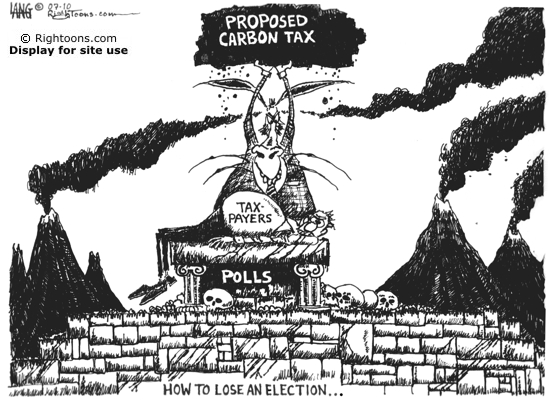
The legislation is a perilous road with high costs — costs Americans tell pollsters they don't want to pay. But Congress is poised to go its own way, skipping over simpler, more promising steps that cost less, such as unleashing America's reserves.
Instead, we go on with the absurd scene of the president of the United States going to Saudi Arabia with his hands out. America is an entrepreneurial nation with resources. We should not be acting like helpless victims. We should not be punishing energy users and embracing regulation over ingenuity and incentives.
Everyone should take a deep breath and listen to Bjorn Lomborg, author of "Cool It: The Skeptical Environmentalist's Guide to Global Warming," who says the legislation before Congress "looks set to be a massive subsidy-fest that would achieve very little for the environment, at great cost." He warns: "Wishful thinking is not sound public policy."
Lomborg says that instead of frenzied regulations and expenditures, "We need the technological solutions that will allow our societies to transition cost-effectively to low-carbon energy by mid-century. McCain could recognize that this is a century-long problem which needs century-long, smart solutions."
In other words — cool it. Drop the gimmicks. Stop getting freaked out by Al Gore. Let's be smart and think creatively rather than as a conventional pack of frenzied followers.
klopez@nationalreview.com
Politicians' Calls for Climate Change Chastity A Socialist Sham Leading to Loss of Individual Constitutional Rights
http://www.washingtonpost.com/wp-dyn/content/article/2008/05/29/AR2008052903266.html

 Carbon Chastity: The FirstCommandment of the Church of the Environment
By Charles Krauthammer
Friday, May 30, 2008; Page A13
http://www.dallasnews.com/sharedcontent/dws/dn/opinion/viewpoints/stories/DNkrauthammer_02edi.ART.State.Edition1.461f31e.html
A Global-Warming Agnostic's Take on the Problem
By Charles Krauthammer:
The Dallas Morning News Op-Ed
June 2, 2008
I'm not a global warming believer. I'm not a global warming denier. I'm a global warming agnostic who believes instinctively that it can't be very good to pump lots of CO2 into the atmosphere but is equally convinced that those who presume to know exactly where that leads are talking through their hats.
[Webster's Dictionary defines the idiomatic expression 'to talk through one's hat' as follows: "talk through one's hat : to voice irrational, illogical, or erroneous ideas". Wiktionary defines 'talk through one's hat' as "To speak lacking expertise, authority, or knowledge; to invent or fabricate facts - The politician is talking through his hat." Wordweb online defines the expression 'to talk through one's hat' as a "Verb: Speak insincerely or without regard for facts or truths- bull, fake Type of: affect, dissemble, feign, pretend, sham".]
Predictions of catastrophe depend on models. Models depend on assumptions about complex planetary systems – from ocean currents to cloud formation – that no one fully understands. Which is why the models are inherently flawed and forever changing.
The doomsday scenarios posit a cascade of events, each with a certain probability. The multiple improbability of their simultaneous occurrence renders all such predictions entirely speculative.
Yet on the basis of this speculation, environmental activists, attended by compliant scientists and opportunistic politicians, are advocating radical economic and social regulation. "The largest threat to freedom, democracy, the market economy and prosperity," warns Czech President Vaclav Klaus, "is no longer socialism. It is, instead, the ambitious, arrogant, unscrupulous ideology of environmentalism."
If you doubt the arrogance, you haven't seen that Newsweek cover story that declared the global warming debate over. Consider: If Newton's laws of motion could, after 200 years of unfailing experimental and experiential confirmation, be overthrown, it requires religious fervor to believe that global warming – infinitely more untested, complex and speculative – is a closed issue.
[See: Sharon Begley, The Truth About Denial, Newsweek (Aug. 15, 2007) at: http://www.newsweek.com/id/32482/output/print ].
But declaring it closed has its rewards. It not only dismisses skeptics as the running dogs of reaction, i.e., of Exxon, Cheney and now Mr. Klaus. By fiat, it also hugely re-empowers the intellectual left, who want to regulate your life in the name of Earth itself.
Environmentalists are Gaia's priests, instructing us in her proper service and casting out those who refuse to genuflect. (See Newsweek above.) And having proclaimed the ultimate commandment – carbon chastity – they are preparing the supporting canonical legislation that will tell you how much you can travel, what kind of light you will read by and at what temperature you may set your bedroom thermostat.
 Just last Monday, a British parliamentary committee proposed that every citizen be required to carry a carbon card that must be presented, under penalty of law, when buying gasoline, taking an airplane or using electricity.
  The card contains your yearly carbon ration to be drawn down with every purchase, every trip, every swipe.
There's no greater social power than the power to ration. And, other than rationing food, there is no greater instrument of social control than rationing energy, the currency of just about everything one does and uses in an advanced society.
So what does the global warming agnostic propose as an alternative? First, more research – untainted and reliable – to determine (a) whether the carbon footprint of man is or is not lost among the massive natural forces (from sunspot activity to ocean currents) that affect climate, and (b) if the human effect is indeed significant, whether the planetary climate system has the homeostatic mechanisms (like the feedback loops in the human body, for example) with which to compensate.

 Every adult in Britain should be forced to carry 'carbon ration cards', say MPs
By David Derbyshire
Mail Online
Under the scheme, everyone would be given an annual carbon allowance to use when buying oil, gas, electricity and flights.
Anyone who exceeds their entitlement would have to buy top-up credits from individuals who haven't used up their allowance. The amount paid would be driven by market forces and the deal done through a specialist company.
MPs, led by Tory Tim Yeo, say the scheme could be more effective at cutting greenhouse gas emissions than green taxes.
But critics say the idea is costly, bureaucratic, intrusive and unworkable.
The Government says it supports the scheme in principle, but warns it is 'ahead of its time'.
For the scheme to work, the Government would need to give out 45million carbon cards - each one linked to a personal carbon account. Every year, the account would be credited with a notional amount of CO2 in kilograms.
Every time someone makes a purchase of petrol, energy or airline tickets, they would use up credits. A return flight from London to Rome would, for instance, use up 900kg of CO2 credits, while 10 litres of petrol would use up 23kg.
'What we are asking the Government to do is to seize the reins on this, leading the debate and coordinating research.'
The Government is committed to cutting CO2 emissions to 20 per cent below 1990 levels by 2010.
The Climate Change Bill going through Parliament aims to cut emissions by 60 per cent by 2050. The Government has said it backs the idea in principle, but it is currently too expensive and bureaucratic.
Environment Minister Hilary Benn said: 'It's got potential but, in essence, it's ahead of its time. There are a lot of practical problems to overcome.'
But critics say the idea is deeply flawed. The scheme would penalise those living in the countryside who were dependent on their cars, as well as the elderly or housebound who need to heat their homes in the day.
Large families would suffer, as would those working at nights when little public transport is available.
It would need to take into account the size of families, and their ages. There is huge potential for fraud.
Matthew Elliott of the Taxpayers' Alliance said the cards would be hugely unpopular. 'The Government has shown itself incapable of managing any huge, complex IT system.' he said.
HOW THE SCHEME WOULD WORK
Every adult in the UK would be given an annual carbon dioxide allowance in kgs and a special carbon card.
Every time someone paid for road fuel, flights or energy, their carbon account would be docked. A litre of petrol would use up 2.3kg in carbon, while every 1.3 miles of airline flight would use another 1kg.
Trading would be done through specialist companies.
[A RENT-SEEKING SOCIALIST REGULATORY REGIME FAVORING OPPORTUNISTIC INDUSTRY LOBBYISTS]

 Carbon Chastity: The FirstCommandment of the Church of the Environment
By Charles Krauthammer
Friday, May 30, 2008; Page A13
http://www.dallasnews.com/sharedcontent/dws/dn/opinion/viewpoints/stories/DNkrauthammer_02edi.ART.State.Edition1.461f31e.html
A Global-Warming Agnostic's Take on the Problem
By Charles Krauthammer:
The Dallas Morning News Op-Ed
June 2, 2008
I'm not a global warming believer. I'm not a global warming denier. I'm a global warming agnostic who believes instinctively that it can't be very good to pump lots of CO2 into the atmosphere but is equally convinced that those who presume to know exactly where that leads are talking through their hats.
[Webster's Dictionary defines the idiomatic expression 'to talk through one's hat' as follows: "talk through one's hat : to voice irrational, illogical, or erroneous ideas". Wiktionary defines 'talk through one's hat' as "To speak lacking expertise, authority, or knowledge; to invent or fabricate facts - The politician is talking through his hat." Wordweb online defines the expression 'to talk through one's hat' as a "Verb: Speak insincerely or without regard for facts or truths- bull, fake Type of: affect, dissemble, feign, pretend, sham".]
Predictions of catastrophe depend on models. Models depend on assumptions about complex planetary systems – from ocean currents to cloud formation – that no one fully understands. Which is why the models are inherently flawed and forever changing.
The doomsday scenarios posit a cascade of events, each with a certain probability. The multiple improbability of their simultaneous occurrence renders all such predictions entirely speculative.
Yet on the basis of this speculation, environmental activists, attended by compliant scientists and opportunistic politicians, are advocating radical economic and social regulation. "The largest threat to freedom, democracy, the market economy and prosperity," warns Czech President Vaclav Klaus, "is no longer socialism. It is, instead, the ambitious, arrogant, unscrupulous ideology of environmentalism."
If you doubt the arrogance, you haven't seen that Newsweek cover story that declared the global warming debate over. Consider: If Newton's laws of motion could, after 200 years of unfailing experimental and experiential confirmation, be overthrown, it requires religious fervor to believe that global warming – infinitely more untested, complex and speculative – is a closed issue.
[See: Sharon Begley, The Truth About Denial, Newsweek (Aug. 15, 2007) at: http://www.newsweek.com/id/32482/output/print ].
But declaring it closed has its rewards. It not only dismisses skeptics as the running dogs of reaction, i.e., of Exxon, Cheney and now Mr. Klaus. By fiat, it also hugely re-empowers the intellectual left, who want to regulate your life in the name of Earth itself.
Environmentalists are Gaia's priests, instructing us in her proper service and casting out those who refuse to genuflect. (See Newsweek above.) And having proclaimed the ultimate commandment – carbon chastity – they are preparing the supporting canonical legislation that will tell you how much you can travel, what kind of light you will read by and at what temperature you may set your bedroom thermostat.
 Just last Monday, a British parliamentary committee proposed that every citizen be required to carry a carbon card that must be presented, under penalty of law, when buying gasoline, taking an airplane or using electricity.
  The card contains your yearly carbon ration to be drawn down with every purchase, every trip, every swipe.
There's no greater social power than the power to ration. And, other than rationing food, there is no greater instrument of social control than rationing energy, the currency of just about everything one does and uses in an advanced society.
So what does the global warming agnostic propose as an alternative? First, more research – untainted and reliable – to determine (a) whether the carbon footprint of man is or is not lost among the massive natural forces (from sunspot activity to ocean currents) that affect climate, and (b) if the human effect is indeed significant, whether the planetary climate system has the homeostatic mechanisms (like the feedback loops in the human body, for example) with which to compensate.
Second, reduce our carbon footprint in the interim by doing the doable, rather than the economically ruinous and socially destructive. The most obvious step is a major move to nuclear power, which to the atmosphere is the cleanest of the clean.
But your would-be masters also have a strict nuclear taboo. Rather convenient, is it not? Take this major coal-substituting fix off the table and we will be rationing all the more. Guess who does the rationing?
Charles Krauthammer is a Washington Post columnist. He may be reached through letters@charleskrauthammer.com.
------------------------------------------------------------------------------------------------

 Every adult in Britain should be forced to carry 'carbon ration cards', say MPs
By David Derbyshire
Mail Online
May 27, 2008
Every adult should be forced to use a 'carbon ration card' when they pay for petrol, airline tickets or household energy, MPs say.
The influential Environmental Audit Committee says a personal carbon trading scheme is the best and fairest way of cutting Britain's CO2 emissions without penalising the poor.
Under the scheme, everyone would be given an annual carbon allowance to use when buying oil, gas, electricity and flights.
Anyone who exceeds their entitlement would have to buy top-up credits from individuals who haven't used up their allowance. The amount paid would be driven by market forces and the deal done through a specialist company.
MPs, led by Tory Tim Yeo, say the scheme could be more effective at cutting greenhouse gas emissions than green taxes.
But critics say the idea is costly, bureaucratic, intrusive and unworkable.
The Government says it supports the scheme in principle, but warns it is 'ahead of its time'.
The idea of personal carbon trading is increasingly being promoted by environmentalists. In theory it could be used to cover all purchases - from petrol to food.
For the scheme to work, the Government would need to give out 45million carbon cards - each one linked to a personal carbon account. Every year, the account would be credited with a notional amount of CO2 in kilograms.
Every time someone makes a purchase of petrol, energy or airline tickets, they would use up credits. A return flight from London to Rome would, for instance, use up 900kg of CO2 credits, while 10 litres of petrol would use up 23kg.
MP Tim Yeo MP, says the scheme could be more effective at cutting Britain's greenhouse gas emissions
Mr Yeo, chairman of the committee said personal carbon trading rewarded those with a low carbon footprint with cash.
'We found that personal carbon trading has real potential to engage the population in the fight against climate change and to achieve significant emissions reductions in a progressive way,' he said.
'The idea is a radical one. As such it inevitably faces some significant challenges in its development. It is important to meet these challenges.
[ANOTHER 'RADICAL' IDEA FROM THE UTOPIAN PHILOSOPHER KINGS. THIS REMINDS US OF U.S. PRESIDENTIAL CANDIDATE BARACK OBAMA'S CALL FOR RADICAL CHANGE!! SEE: ITSSD JOURNAL ON POLITICAL SURREALISM, at: http://itssdjournalpoliticalsurrealism.blogspot.com ].
'What we are asking the Government to do is to seize the reins on this, leading the debate and coordinating research.'
The Government is committed to cutting CO2 emissions to 20 per cent below 1990 levels by 2010.
The Climate Change Bill going through Parliament aims to cut emissions by 60 per cent by 2050. The Government has said it backs the idea in principle, but it is currently too expensive and bureaucratic.
Environment Minister Hilary Benn said: 'It's got potential but, in essence, it's ahead of its time. There are a lot of practical problems to overcome.'
A Department for Environment, Food and Rural Affairs report into the scheme found it would cost between £700million and £2billion to set up and up to another £2billion a year to run.
Tory environment spokesman Peter Ainsworth added: 'Although it does have potential we should proceed with care. We don't want to alienate people and we want everyone to be on board.'
[THE FACT THAT THE TORIES WOULD EVEN CONSIDER THIS SCHEME REFLECTS HOW DESPERATELY OUT OF TOUCH THEY MUST BE WITH THEIR CORE PRINCIPLES!!]
But critics say the idea is deeply flawed. The scheme would penalise those living in the countryside who were dependent on their cars, as well as the elderly or housebound who need to heat their homes in the day.
Large families would suffer, as would those working at nights when little public transport is available.
It would need to take into account the size of families, and their ages. There is huge potential for fraud.
Matthew Elliott of the Taxpayers' Alliance said the cards would be hugely unpopular. 'The Government has shown itself incapable of managing any huge, complex IT system.' he said.
HOW THE SCHEME WOULD WORK
Every adult in the UK would be given an annual carbon dioxide allowance in kgs and a special carbon card.
The scheme would cover road fuel, flights and energy bills.
Every time someone paid for road fuel, flights or energy, their carbon account would be docked. A litre of petrol would use up 2.3kg in carbon, while every 1.3 miles of airline flight would use another 1kg.
When paying for petrol, the card would need to swiped at the till. It would be a legal offence to buy petrol without using a card.
 When paying online, or by direct debit, the carbon account would be debited directly. Anyone who doesn't use up their credits in a year can sell them to someone who wants more credits.
 When paying online, or by direct debit, the carbon account would be debited directly. Anyone who doesn't use up their credits in a year can sell them to someone who wants more credits.
Trading would be done through specialist companies.
[A RENT-SEEKING SOCIALIST REGULATORY REGIME FAVORING OPPORTUNISTIC INDUSTRY LOBBYISTS]
Sunday, June 1, 2008
Lieberman-Warner Global Warming Bill Adopts Very Costly, Unproven European Socialist Regulatory Model at Expense of U.S. Consumers, New Report Finds
http://www.heritage.org/Research/EnergyandEnvironment/wm1940.cfm 
Five Myths About the Lieberman-Warner Global Warming Legislation (S. 2191)
by Ben Lieberman
Heritage Foundation WebMemo #1940 (May 30, 2008)
Myth #1: LW would not be expensive.
"
 ...By restricting carbon dioxide emissions from coal, oil, and natural gas--with a freeze at 2005 levels beginning in 2012, to a 70 percent reduction in 2050--the bill forces down supply and thus boosts the price of energy...Cumulative gross domestic product (GDP) losses could reach $4.8 trillion by 2030...
Myth #2: The costs fall on industry, not consumers.
...Particularly hard hit is the manufacturing sector where over one million jobs will be lost by 2022 and two million by 2027. The losses in household incomes could reach $1,026 per year by 2015. Annual household energy-price increases could hit $1,000 by 2030, including a 29 percent increase in the price of gasoline from 2008 levels.
Myth #3: Global warming is a crisis that must be addressed at all costs.

 Global warming is a concern, not a crisis. Both the seriousness and the imminence of the threat are overstated... Overall, current and expected future temperatures are far from unprecedented, and are highly unlikely to lead to catastrophes.
Myth #4: LW effectively addresses the threat of climate change.
 China has overtaken America as the world's largest emitter, and its emissions growth is several times greater than that of the U.S. India and other fast-developing nations are on a similar trajectory. Thus, the unilateral impact of the bill on global emissions would be inconsequential.
Myth #5: LW's cap-and-trade approach is a proven success.


Most E.U. nations are not on track to meet their targets, and many are seeing their emissions rise faster than those in the U.S. The program is furthermore plagued by accusations of fraud and unfairness. LW essentially adopts the European approach wholesale."
-------------------------------------------------------------------------------------------------
http://www.europa-eu-un.org/documents/en/070531_eu_action_against_climate_change.pdf
EU action against climate change: Leading global action to 2020 and beyond
© European Communities, 2007
"The February 2007 science report from the Intergovernmental Panel on Climate Change (IPCC)1 shows that the world has warmed by an average of 0.76º Celsius since pre-industrial times and the temperature rise is accelerating. Sea levels rose almost twice as fast between 1993 and 2003 as during the previous three decades. Man-made emissions of greenhouse gases are causing these changes.
 The IPPC projects that, without action to limit emissions, the global average temperature is likely to increase further by 1.8º to 4ºC this century. We cannot allow this to happen. The European Union considers it vital to prevent global warming of more than 2ºC above the pre-industrial level.
There is considerable scientific evidence that, beyond this threshold, irreversible and potentially catastrophic changes could occur. In March 2007 EU Heads of State and Government endorsed an integrated climate change and energy strategy put forward by the European Commission which outlines the EU’s proposals for a global and comprehensive agreement to combat climate change after 2012, when the Kyoto Protocol targets will expire.
[READERS SHOULD NOTE THAT IT DOESN'T SAY 'CONCLUSIVE SCIENTIFIC EVIDENCE!].
The Commission’s analysis shows that for the world to have a fair chance of keeping the average temperature rise to no more than 2ºC, global emissions of greenhouse gases will have to be stabilised by around 2020 and then reduced by up to 50% of 1990 levels by 2050.
...The European Commission’s analysis shows that the investment needed to achieve a low-carbon economy would cost only around 0.5% of world GDP between 2013 and 2030. According to its projections, taking action against climate change would reduce global GDP growth by just 0.14% per year up to 2020. Global GDP growth over the period 2005-2020 would be 53%, barely lower than the 55% growth projected if no action were undertaken. And this figure does not take account of the benefits of cutting emissions, such as reduced damage from avoided climate change, greater energy security, and healthcare savings from less air pollution.
-------------------------------------------------------------------------------------------------
http://www.heritage.org/Research/EnergyandEnvironment/cda08-02.cfm
The Economic Costs of the Lieberman-Warner Climate Change Legislation
by William W. Beach, David Kreutzer, Ph.D., Ben Lieberman and Nick Loris
"...S. 2191 imposes strict upper limits on the emission of six greenhouse gases (GHGs) with the primary emphasis on carbon dioxide (CO2). The mechanism for capping these emissions requires emitters to acquire federally created permits (allowances) for each ton emitted. The cost of the allowances will be significant and will lead to large increases in the cost of energy. Because the allowances have an economic effect much like the effect of an energy tax, the increase in energy costs creates correspondingly large transfers of income from private energy consumers to special interests.

...We use these two cases to bracket our cost projections of S. 2191:
- Cumulative gross domestic product (GDP) losses are at least $1.7 trillion and could reach $4.8 trillion by 2030 (in inflation-adjusted 2006 dollars).
- Single-year GDP losses hit at least $155 billion and realistically could exceed $500 billion (in inflation-adjusted 2006 dollars).
- Annual job losses exceed 500,000 before 2030 and could approach 1,000,000.
- The annual cost of emission permits to energy users will be at least $100 billion by 2020 and could exceed $300 billion by 2030 (in inflation-adjusted 2006 dollars).
- The average household will pay $467 more each year for its natural gas and electricity (in inflation-adjusted 2006 dollars). That means that the average household will spend an additional $8,870 to purchase household energy over the period 2012 through 2030.
Our analysis does not extend beyond 2030, at which point S. 2191 mandates GHG reductions to 33 percent below the 2005 level. However, it should be noted that the mandated GHG reductions continue to become more severe and must be 70 percent below the 2005 level by 2050.

...Since income (as measured by GDP) drops as a result of S. 2191, it is clear that more capital is destroyed than is created. The cumulative GDP losses for the period 2010 to 2030 fall between $1.7 trillion and $4.8 trillion, with single-year losses reaching into the hundreds of billions.
...With S. 2191, there is an initial small employment increase as firms build and purchase the newer more CO2-friendly plants and equipment. However, any "green-collar" jobs created are more than offset by other job losses. The initial uptick is small compared to the hundreds of thousands of lost jobs in later years. Table 1 shows the high and low projections of the employment and income effects of S. 2191.

...Distribution of Auction Proceeds
S. 2191 specifies how the distribution of the auction proceeds will be spent, with constant percentages from 2012 to 2036. The auction process depends on the creation of a new nonprofit corporation called the Climate Change Credit Corporation to initiate and complete the auctioning of allowances.
Eleven percent will be allocated to an advanced-technology vehicles-manufacturing incentive. While 44 percent is to be spent on low-carbon energy technology, advanced coal and sequestration programs, and cellulosic biomass ethanol technology programs, 45 percent is to be spent on assisting individuals, families, firms, and organizations in the transition to a low-carbon regime. This includes 20 percent allocated to an Energy Assistance Fund, 20 percent allocated to an Adaptation Fund, and 5 percent allocated to a Climate Change Worker Training Fund.
...Proponents of cap and trade describe it as a flexible and market-based approach that allows the private sector to find the most cost-effective means of reducing greenhouse gas emissions. They expect the program to motivate fossil energy producers and users to reduce their carbon dioxide emissions through improvements in energy efficiency, expanded use of energy sources with fewer or no carbon emissions, or new carbon capture and sequestration (CCS) technologies that allow such emissions to be stored underground rather than released into the atmosphere.
...In contrast, critics fear that many of the necessary advances are decades away from being technologically and economically viable and that, in the interim, the caps in S. 2191 can be met only with severe reductions in energy use, which would drive up energy costs significantly--and would be, in effect, a massive energy tax.
...Critics also point to the substantial difficulties that the European Union has faced since implementing its greenhouse gas cap-and-trade program in 2005 in order to comply with the Kyoto Protocol, the multilateral treaty on emissions that the United States declined to ratify.
...In addition to the provisions of the bill, the many baseline assumptions about the future also affect the projected costs of S. 2191. They include assumptions about the pace of technological advances, especially those regarding the CCS breakthroughs that will be necessary for the continued use of coal, the energy source with the highest CO2 emissions per unit of energy. Continued use of coal is critical because it provides half of the nation's electricity. Assumptions about America's economic growth and concomitant energy needs are also of great importance, as are assumptions about the effect of previously enacted energy legislation, particularly the Energy Independence and Security Act of 2007.
...The Simulations
This CDA report discusses three different views of this country's economic future, each shaped by different policies designed to reduce atmospheric carbon dioxide and, presumably, to reduce the warming trend in global climate change. Policymakers and others who follow the climate change debate closely should find each of these three views helpful in understanding the policy alternatives currently before us. These three views are:
- The current-law baseline. Presented here is a highly detailed, 30-year economic forecast that incorporates the principal elements of energy and climate change policies signed into law last year.
- Simulation of S. 2191, America's Climate Security Act of 2007, sponsored by Senators Joseph Lieberman (I-CT) and John Warner (R-VA). The simulation builds on the detailed baseline and assumes that critical technologies are fully developed.
- An alternative, more realistic scenario in which critical technology does not materialize over the 20-year forecast horizon...
Baseline --
...Natural Gas. In the baseline scenario, gas prices settle just below $7 per million British thermal units (Btus). This is less than the current price but well above the 1990s levels. Alaskan pipeline deliveries will not start until 2025, at which point they will help to offset supply reductions in the Lower 48 as well as imports from Canada. Nearly 100 gigawatts of old natural-gas-steam capacity is retired, and 50 gigawatts of the more efficient "natural gas combined cycle" (NGCC) plants are built. Total natural gas consumption grows by 0.4 percent per year through 2030.
Coal. In the baseline case, coal use is restrained by slower growth of energy demand and increasing generation of nuclear and renewable power. Demand will grow by an average of 0.2 percent each year through 2030. One hundred gigawatts of old inefficient energy is retired. Sixty-five gigawatts of new and replacement coal-fired power-generation plants will be added using the "integrated gas combined cycle" (IGCC) or advanced pulverized-coal technologies. These more efficient technologies use less coal and emit less CO2 per unit of electricity generated and are ready to be fitted for carbon capture and sequestration. Because of the additional cost, there is no use of CCS technology in the baseline case.
...Nuclear Energy. Though there are no significant CO2 emissions from nuclear power generation, it is not considered "renewable" for the purpose of meeting existing state-imposed targets. Nevertheless, federal incentives are already in place for an additional nuclear power capacity. There will be 12 gigawatts of new capacity built and 3 gigawatts of uprated additional capacity added at existing plants. Resolving the problems with waste disposal is a major hurdle in expanding nuclear power generation.
...Renewable Energy Sources. Federal and state initiatives already in place seek to increase the use of renewable energy sources. The definition of "renewable" varies from state to state but generally includes biomass, wind, and solar power. Higher fuel prices along with state and federal mandates cause renewable fuel use to grow at 5.5 percent per year through 2030.
...Lieberman-Warner --
S. 2191 sets ever more stringent caps on emissions of these gases. Using previous emission levels as yardsticks, the 2012 cap is set at the 2005 emission level. The cap drops to 15 percent below the 2005 emission level by 2020 and 33 percent below by 2030. By 2050, the goal is to have man-made GHG emissions at 70 percent below those of 2005.
...Barriers to Trade: Title VI, Global Effort to Reduce Greenhouse Gas Emissions
Title VI of S. 2191 is part of a global effort to reduce greenhouse gas emissions and ensures that emitting GHG in other countries does not undermine U.S. efforts to reduce GHG. The bill's supporters hope to encourage international action on GHG reduction.
To this end, the bill includes the suggestion that the President establish an interagency group to determine whether or not other countries have taken similar action to limit their release of GHG. The interagency group will be responsible for creating a reserve of international allowances, and any U.S. importer of covered goods must submit international allowances as a condition for the trade to occur.
Thus, importers of covered goods must submit emissions allowances that are equal in value to those required for those goods in our system. For instance, if the production of a product generates two tons of CO2 , importers of this product need two tons of allowances for each product they import.
An importer must also submit a written declaration to the administrator of U.S. Customs and Border Protection for each import. Failure to make a CO2 emissions declaration bars the importation of a good into the United States.
...Coal Technology... The costs of meeting the CO2 reductions mandated by S. 2191 are very sensitive to changes in the rate at which CCS technology is developed. Our generous scenario operates on the assumption that any coal-fired plant built after 2018 uses CCS. A second scenario assumes that the significant technological and political hurdles prevent CCS adoption before 2030.
...Natural Gas. Because of its higher cost, natural gas is not competitive with coal in the baseline case of zero CO2 restrictions. Though natural gas generates less CO2 per Btu than does today's coal, it is not competitive when coal generators use CCS...For carbon-allowance prices in the $30 to $40 range, replacing old steam plants with combined-cycle natural gas plants makes sense. When allowance prices exceed $50, coal plants with CCS are more competitive.
...Nuclear Energy. The projection is for no additional nuclear power beyond the base case.
...Renewable Energy Sources. Current state and federal legislation calls for more than tripling the amount of renewable energy in power generation and increasing transport biofuels by more than 1,000 percent. This includes 16 billion gallons per year of corn-based ethanol and biodiesel and 20 billion gallons per year of cellulosic ethanol and biodiesel...While S. 2191 has no additional mandates for biofuels, the costs of allowances for fossil fuels lead to greater use of biofuels. At this time, there is no commercially feasible cellulosic ethanol production. If this technology fails to deliver as projected, energy prices will have to rise enough to reduce the quantity of energy demanded by the amount of missing cellulosic ethanol.
...Economic Costs of the Lieberman-Warner Bill
Economic Output Declines.
...Th[e] investment-driven burst of GDP subsides after 2018. Higher energy prices decrease the use of carbon-based energy in production of goods, incomes fall, and demand for goods subsides. GDP declines in 2020 by $94 billion, in 2025 by $129 billion, and in 2030 by $111 billion (all, again, after inflation). When CCS is not implemented, the higher carbon fees produce more adverse economic effects. GDP is $330 billion below its baseline levels by 2025 and $436 billion below its baseline levels by 2030.
...[M]anufacturing benefits from the initial investment in new energy production and fuel sources, but the sector's declines are sharp thereafter. Indeed, by 2020, manufacturing output in this energy-sensitive sector is 2.4 percent to 5.8 percent below what it would be if S. 2191 never becomes law. By 2030, the manufacturing sector has lost $319 billion to $767 billion in output when compared to our baseline; that is, when compared to the economic world without Lieberman-Warner.
...Number of Jobs Declines.
...In 2025, nearly a half-million jobs per year fail to materialize. The job losses expand to more than 600,000 in 2026. Indeed, in no year after the boomlet does the economy under Lieberman-Warner outperform the baseline economy where S. 2191 never becomes law...Our baseline contains a 9 percent decline between 2008 and 2030. Lieberman-Warner accelerates this decrease substantially: Under our generous-assumptions simulation, employment in manufacturing declines by 23 percent over that same time period, or more than twice the rate without Lieberman-Warner...Other, less energy-intensive sectors, however, do not suffer such decreases.
...Energy Prices Rise.
...Higher energy prices, of course, are the root cause of the slower economy...[C]onsumer prices for electricity, natural gas, and home heating oil increase significantly between 2015 and 2030. Indeed, by the last year of our simulation, the total energy bill for the average American consumer has gone up $8,870 from 2012.
Incomes and Consumption Decline.
Declining demand for energy-intensive products reduces employment and incomes in the businesses producing these products. Workers and investors earn less, and household incomes decline. Reductions in income in these sectors spread and cause declines in demand for other sectors of the economy.
Our simulation captures this effect of higher energy prices. Under the generous-assumptions simulation, the income that individuals have after taxes declines by $47 billion (after inflation) in 2015 and by $50.7 billion in 2030. Our reasonable-assumptions simulation contains worse news: Disposable personal income falls $120 billion below baseline in 2015 and averages $68 billion below baseline over the entire period of 2008 to 2030.
Consumption outlays by individuals and households follow the pattern of lower income. In 2020, consumption expenditures are $52 billion lower than they would be in an economic world in which S. 2191 is not the law. Personal consumption outlays (after inflation) are $67 billion lower by 2030 and average $54 billion below baseline over the entire 22-year forecast period. Under a more reasonable assessment of the likelihood of standard use of CCS, consumption expenditures by individuals average $113 billion lower over the 22-year forecast period.
These declines in consumption are particularly dramatic in those parts of the economy that are sensitive to economic shocks: consumer durables, financial services, and discretionary medical services, among others."

Five Myths About the Lieberman-Warner Global Warming Legislation (S. 2191)
by Ben Lieberman
Heritage Foundation WebMemo #1940 (May 30, 2008)
Myth #1: LW would not be expensive.
"

 ...By restricting carbon dioxide emissions from coal, oil, and natural gas--with a freeze at 2005 levels beginning in 2012, to a 70 percent reduction in 2050--the bill forces down supply and thus boosts the price of energy...Cumulative gross domestic product (GDP) losses could reach $4.8 trillion by 2030...
Myth #2: The costs fall on industry, not consumers.
...Particularly hard hit is the manufacturing sector where over one million jobs will be lost by 2022 and two million by 2027. The losses in household incomes could reach $1,026 per year by 2015. Annual household energy-price increases could hit $1,000 by 2030, including a 29 percent increase in the price of gasoline from 2008 levels.
Myth #3: Global warming is a crisis that must be addressed at all costs.

 Global warming is a concern, not a crisis. Both the seriousness and the imminence of the threat are overstated... Overall, current and expected future temperatures are far from unprecedented, and are highly unlikely to lead to catastrophes.
Myth #4: LW effectively addresses the threat of climate change.
 China has overtaken America as the world's largest emitter, and its emissions growth is several times greater than that of the U.S. India and other fast-developing nations are on a similar trajectory. Thus, the unilateral impact of the bill on global emissions would be inconsequential.
Myth #5: LW's cap-and-trade approach is a proven success.


Most E.U. nations are not on track to meet their targets, and many are seeing their emissions rise faster than those in the U.S. The program is furthermore plagued by accusations of fraud and unfairness. LW essentially adopts the European approach wholesale."
-------------------------------------------------------------------------------------------------
http://www.europa-eu-un.org/documents/en/070531_eu_action_against_climate_change.pdf
EU action against climate change: Leading global action to 2020 and beyond
© European Communities, 2007
"The February 2007 science report from the Intergovernmental Panel on Climate Change (IPCC)1 shows that the world has warmed by an average of 0.76º Celsius since pre-industrial times and the temperature rise is accelerating. Sea levels rose almost twice as fast between 1993 and 2003 as during the previous three decades. Man-made emissions of greenhouse gases are causing these changes.
 The IPPC projects that, without action to limit emissions, the global average temperature is likely to increase further by 1.8º to 4ºC this century. We cannot allow this to happen. The European Union considers it vital to prevent global warming of more than 2ºC above the pre-industrial level.
There is considerable scientific evidence that, beyond this threshold, irreversible and potentially catastrophic changes could occur. In March 2007 EU Heads of State and Government endorsed an integrated climate change and energy strategy put forward by the European Commission which outlines the EU’s proposals for a global and comprehensive agreement to combat climate change after 2012, when the Kyoto Protocol targets will expire.
[READERS SHOULD NOTE THAT IT DOESN'T SAY 'CONCLUSIVE SCIENTIFIC EVIDENCE!].
The Commission’s analysis shows that for the world to have a fair chance of keeping the average temperature rise to no more than 2ºC, global emissions of greenhouse gases will have to be stabilised by around 2020 and then reduced by up to 50% of 1990 levels by 2050.
...The European Commission’s analysis shows that the investment needed to achieve a low-carbon economy would cost only around 0.5% of world GDP between 2013 and 2030. According to its projections, taking action against climate change would reduce global GDP growth by just 0.14% per year up to 2020. Global GDP growth over the period 2005-2020 would be 53%, barely lower than the 55% growth projected if no action were undertaken. And this figure does not take account of the benefits of cutting emissions, such as reduced damage from avoided climate change, greater energy security, and healthcare savings from less air pollution.
-------------------------------------------------------------------------------------------------
http://www.heritage.org/Research/EnergyandEnvironment/cda08-02.cfm
The Economic Costs of the Lieberman-Warner Climate Change Legislation
by William W. Beach, David Kreutzer, Ph.D., Ben Lieberman and Nick Loris
Center for Data Analysis Report #08-02
May 12, 2008
"...S. 2191 imposes strict upper limits on the emission of six greenhouse gases (GHGs) with the primary emphasis on carbon dioxide (CO2). The mechanism for capping these emissions requires emitters to acquire federally created permits (allowances) for each ton emitted. The cost of the allowances will be significant and will lead to large increases in the cost of energy. Because the allowances have an economic effect much like the effect of an energy tax, the increase in energy costs creates correspondingly large transfers of income from private energy consumers to special interests.

...We use these two cases to bracket our cost projections of S. 2191:
- Cumulative gross domestic product (GDP) losses are at least $1.7 trillion and could reach $4.8 trillion by 2030 (in inflation-adjusted 2006 dollars).
- Single-year GDP losses hit at least $155 billion and realistically could exceed $500 billion (in inflation-adjusted 2006 dollars).
- Annual job losses exceed 500,000 before 2030 and could approach 1,000,000.
- The annual cost of emission permits to energy users will be at least $100 billion by 2020 and could exceed $300 billion by 2030 (in inflation-adjusted 2006 dollars).
- The average household will pay $467 more each year for its natural gas and electricity (in inflation-adjusted 2006 dollars). That means that the average household will spend an additional $8,870 to purchase household energy over the period 2012 through 2030.
Our analysis does not extend beyond 2030, at which point S. 2191 mandates GHG reductions to 33 percent below the 2005 level. However, it should be noted that the mandated GHG reductions continue to become more severe and must be 70 percent below the 2005 level by 2050.

...Since income (as measured by GDP) drops as a result of S. 2191, it is clear that more capital is destroyed than is created. The cumulative GDP losses for the period 2010 to 2030 fall between $1.7 trillion and $4.8 trillion, with single-year losses reaching into the hundreds of billions.
...With S. 2191, there is an initial small employment increase as firms build and purchase the newer more CO2-friendly plants and equipment. However, any "green-collar" jobs created are more than offset by other job losses. The initial uptick is small compared to the hundreds of thousands of lost jobs in later years. Table 1 shows the high and low projections of the employment and income effects of S. 2191.

...Distribution of Auction Proceeds
S. 2191 specifies how the distribution of the auction proceeds will be spent, with constant percentages from 2012 to 2036. The auction process depends on the creation of a new nonprofit corporation called the Climate Change Credit Corporation to initiate and complete the auctioning of allowances.
Eleven percent will be allocated to an advanced-technology vehicles-manufacturing incentive. While 44 percent is to be spent on low-carbon energy technology, advanced coal and sequestration programs, and cellulosic biomass ethanol technology programs, 45 percent is to be spent on assisting individuals, families, firms, and organizations in the transition to a low-carbon regime. This includes 20 percent allocated to an Energy Assistance Fund, 20 percent allocated to an Adaptation Fund, and 5 percent allocated to a Climate Change Worker Training Fund.
...Proponents of cap and trade describe it as a flexible and market-based approach that allows the private sector to find the most cost-effective means of reducing greenhouse gas emissions. They expect the program to motivate fossil energy producers and users to reduce their carbon dioxide emissions through improvements in energy efficiency, expanded use of energy sources with fewer or no carbon emissions, or new carbon capture and sequestration (CCS) technologies that allow such emissions to be stored underground rather than released into the atmosphere.
...In contrast, critics fear that many of the necessary advances are decades away from being technologically and economically viable and that, in the interim, the caps in S. 2191 can be met only with severe reductions in energy use, which would drive up energy costs significantly--and would be, in effect, a massive energy tax.
...Critics also point to the substantial difficulties that the European Union has faced since implementing its greenhouse gas cap-and-trade program in 2005 in order to comply with the Kyoto Protocol, the multilateral treaty on emissions that the United States declined to ratify.
...In addition to the provisions of the bill, the many baseline assumptions about the future also affect the projected costs of S. 2191. They include assumptions about the pace of technological advances, especially those regarding the CCS breakthroughs that will be necessary for the continued use of coal, the energy source with the highest CO2 emissions per unit of energy. Continued use of coal is critical because it provides half of the nation's electricity. Assumptions about America's economic growth and concomitant energy needs are also of great importance, as are assumptions about the effect of previously enacted energy legislation, particularly the Energy Independence and Security Act of 2007.
...The Simulations
This CDA report discusses three different views of this country's economic future, each shaped by different policies designed to reduce atmospheric carbon dioxide and, presumably, to reduce the warming trend in global climate change. Policymakers and others who follow the climate change debate closely should find each of these three views helpful in understanding the policy alternatives currently before us. These three views are:
- The current-law baseline. Presented here is a highly detailed, 30-year economic forecast that incorporates the principal elements of energy and climate change policies signed into law last year.
- Simulation of S. 2191, America's Climate Security Act of 2007, sponsored by Senators Joseph Lieberman (I-CT) and John Warner (R-VA). The simulation builds on the detailed baseline and assumes that critical technologies are fully developed.
- An alternative, more realistic scenario in which critical technology does not materialize over the 20-year forecast horizon...
Baseline --
...Natural Gas. In the baseline scenario, gas prices settle just below $7 per million British thermal units (Btus). This is less than the current price but well above the 1990s levels. Alaskan pipeline deliveries will not start until 2025, at which point they will help to offset supply reductions in the Lower 48 as well as imports from Canada. Nearly 100 gigawatts of old natural-gas-steam capacity is retired, and 50 gigawatts of the more efficient "natural gas combined cycle" (NGCC) plants are built. Total natural gas consumption grows by 0.4 percent per year through 2030.
Coal. In the baseline case, coal use is restrained by slower growth of energy demand and increasing generation of nuclear and renewable power. Demand will grow by an average of 0.2 percent each year through 2030. One hundred gigawatts of old inefficient energy is retired. Sixty-five gigawatts of new and replacement coal-fired power-generation plants will be added using the "integrated gas combined cycle" (IGCC) or advanced pulverized-coal technologies. These more efficient technologies use less coal and emit less CO2 per unit of electricity generated and are ready to be fitted for carbon capture and sequestration. Because of the additional cost, there is no use of CCS technology in the baseline case.
...Nuclear Energy. Though there are no significant CO2 emissions from nuclear power generation, it is not considered "renewable" for the purpose of meeting existing state-imposed targets. Nevertheless, federal incentives are already in place for an additional nuclear power capacity. There will be 12 gigawatts of new capacity built and 3 gigawatts of uprated additional capacity added at existing plants. Resolving the problems with waste disposal is a major hurdle in expanding nuclear power generation.
...Renewable Energy Sources. Federal and state initiatives already in place seek to increase the use of renewable energy sources. The definition of "renewable" varies from state to state but generally includes biomass, wind, and solar power. Higher fuel prices along with state and federal mandates cause renewable fuel use to grow at 5.5 percent per year through 2030.
...Lieberman-Warner --
S. 2191 sets ever more stringent caps on emissions of these gases. Using previous emission levels as yardsticks, the 2012 cap is set at the 2005 emission level. The cap drops to 15 percent below the 2005 emission level by 2020 and 33 percent below by 2030. By 2050, the goal is to have man-made GHG emissions at 70 percent below those of 2005.
...Barriers to Trade: Title VI, Global Effort to Reduce Greenhouse Gas Emissions
Title VI of S. 2191 is part of a global effort to reduce greenhouse gas emissions and ensures that emitting GHG in other countries does not undermine U.S. efforts to reduce GHG. The bill's supporters hope to encourage international action on GHG reduction.
To this end, the bill includes the suggestion that the President establish an interagency group to determine whether or not other countries have taken similar action to limit their release of GHG. The interagency group will be responsible for creating a reserve of international allowances, and any U.S. importer of covered goods must submit international allowances as a condition for the trade to occur.
Thus, importers of covered goods must submit emissions allowances that are equal in value to those required for those goods in our system. For instance, if the production of a product generates two tons of CO2 , importers of this product need two tons of allowances for each product they import.
An importer must also submit a written declaration to the administrator of U.S. Customs and Border Protection for each import. Failure to make a CO2 emissions declaration bars the importation of a good into the United States.
...Coal Technology... The costs of meeting the CO2 reductions mandated by S. 2191 are very sensitive to changes in the rate at which CCS technology is developed. Our generous scenario operates on the assumption that any coal-fired plant built after 2018 uses CCS. A second scenario assumes that the significant technological and political hurdles prevent CCS adoption before 2030.
...Natural Gas. Because of its higher cost, natural gas is not competitive with coal in the baseline case of zero CO2 restrictions. Though natural gas generates less CO2 per Btu than does today's coal, it is not competitive when coal generators use CCS...For carbon-allowance prices in the $30 to $40 range, replacing old steam plants with combined-cycle natural gas plants makes sense. When allowance prices exceed $50, coal plants with CCS are more competitive.
...Nuclear Energy. The projection is for no additional nuclear power beyond the base case.
...Renewable Energy Sources. Current state and federal legislation calls for more than tripling the amount of renewable energy in power generation and increasing transport biofuels by more than 1,000 percent. This includes 16 billion gallons per year of corn-based ethanol and biodiesel and 20 billion gallons per year of cellulosic ethanol and biodiesel...While S. 2191 has no additional mandates for biofuels, the costs of allowances for fossil fuels lead to greater use of biofuels. At this time, there is no commercially feasible cellulosic ethanol production. If this technology fails to deliver as projected, energy prices will have to rise enough to reduce the quantity of energy demanded by the amount of missing cellulosic ethanol.
...Economic Costs of the Lieberman-Warner Bill
Economic Output Declines.
...Th[e] investment-driven burst of GDP subsides after 2018. Higher energy prices decrease the use of carbon-based energy in production of goods, incomes fall, and demand for goods subsides. GDP declines in 2020 by $94 billion, in 2025 by $129 billion, and in 2030 by $111 billion (all, again, after inflation). When CCS is not implemented, the higher carbon fees produce more adverse economic effects. GDP is $330 billion below its baseline levels by 2025 and $436 billion below its baseline levels by 2030.
...[M]anufacturing benefits from the initial investment in new energy production and fuel sources, but the sector's declines are sharp thereafter. Indeed, by 2020, manufacturing output in this energy-sensitive sector is 2.4 percent to 5.8 percent below what it would be if S. 2191 never becomes law. By 2030, the manufacturing sector has lost $319 billion to $767 billion in output when compared to our baseline; that is, when compared to the economic world without Lieberman-Warner.
...Number of Jobs Declines.
...In 2025, nearly a half-million jobs per year fail to materialize. The job losses expand to more than 600,000 in 2026. Indeed, in no year after the boomlet does the economy under Lieberman-Warner outperform the baseline economy where S. 2191 never becomes law...Our baseline contains a 9 percent decline between 2008 and 2030. Lieberman-Warner accelerates this decrease substantially: Under our generous-assumptions simulation, employment in manufacturing declines by 23 percent over that same time period, or more than twice the rate without Lieberman-Warner...Other, less energy-intensive sectors, however, do not suffer such decreases.
...Energy Prices Rise.
...Higher energy prices, of course, are the root cause of the slower economy...[C]onsumer prices for electricity, natural gas, and home heating oil increase significantly between 2015 and 2030. Indeed, by the last year of our simulation, the total energy bill for the average American consumer has gone up $8,870 from 2012.
Incomes and Consumption Decline.
Declining demand for energy-intensive products reduces employment and incomes in the businesses producing these products. Workers and investors earn less, and household incomes decline. Reductions in income in these sectors spread and cause declines in demand for other sectors of the economy.
Our simulation captures this effect of higher energy prices. Under the generous-assumptions simulation, the income that individuals have after taxes declines by $47 billion (after inflation) in 2015 and by $50.7 billion in 2030. Our reasonable-assumptions simulation contains worse news: Disposable personal income falls $120 billion below baseline in 2015 and averages $68 billion below baseline over the entire period of 2008 to 2030.
Consumption outlays by individuals and households follow the pattern of lower income. In 2020, consumption expenditures are $52 billion lower than they would be in an economic world in which S. 2191 is not the law. Personal consumption outlays (after inflation) are $67 billion lower by 2030 and average $54 billion below baseline over the entire 22-year forecast period. Under a more reasonable assessment of the likelihood of standard use of CCS, consumption expenditures by individuals average $113 billion lower over the 22-year forecast period.
These declines in consumption are particularly dramatic in those parts of the economy that are sensitive to economic shocks: consumer durables, financial services, and discretionary medical services, among others."
Subscribe to:
Posts (Atom)


